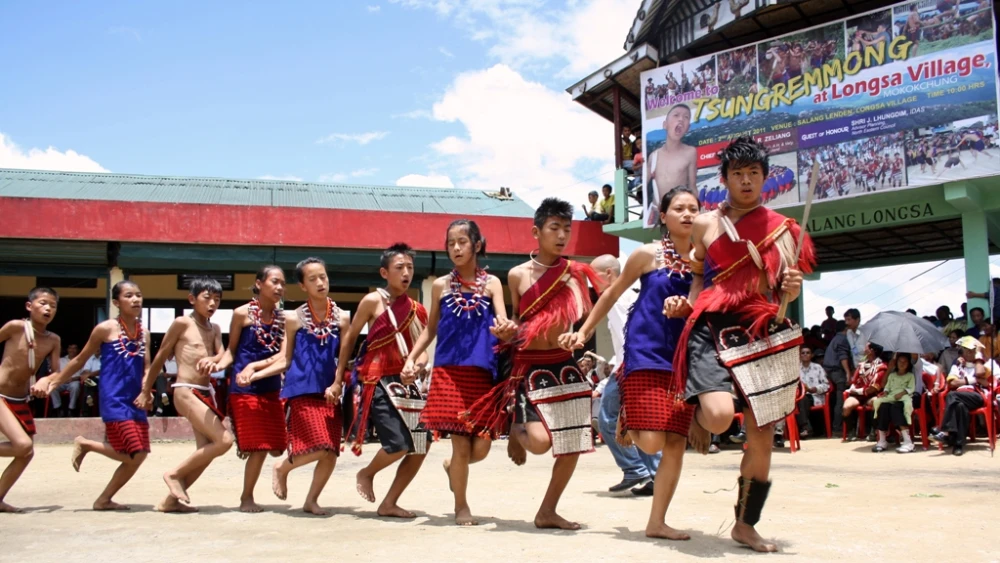
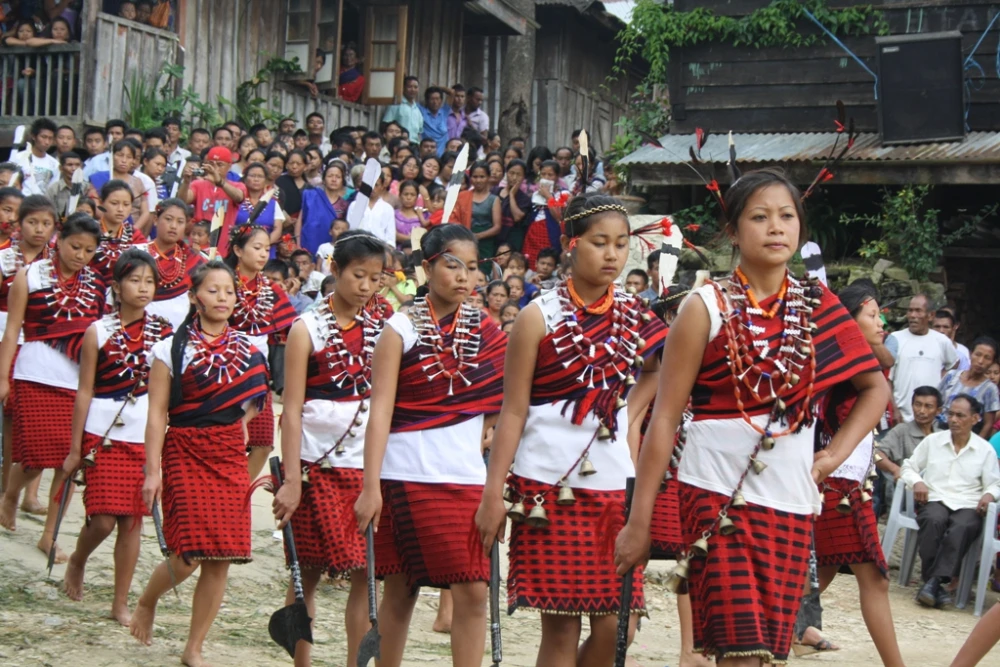
A group of young boys in traditional attire at Longsa village. (Photo Courtesy: Sashimeren Jamir)
Mokokchung, July 29 (MExN): Longsa village under Mokokchung District has begun preparations to host the Tsüngremmung Festival 2025 from August 1 to 3. After a long pause due to the COVID-19 pandemic, this year’s Tsüngremmung is set to be a grand celebration, showcasing the cultural richness, traditional practices, and communal spirit of the Ao Naga people.
Organised by the Longsa Village Council under the patronage of the Tourism Department, Government of Nagaland, the festival aims to highlight the essence of Ao Naga identity through traditional customs, cultural performances, and collective community participation, stated a press note received here.
Tsüngremmung, one of the most significant traditional festivals of the Ao Nagas, is celebrated ahead of the harvest season, symbolizing thanksgiving, unity, and renewal. Tsüngremmung is a traditional Ao Naga festival celebrated ahead of the harvest season, symbolizing thanksgiving, unity, and renewal. It symbolizes spiritual cleansing and strengthens community bonds through songs, dances, and feasts. Reflecting rich cultural heritage, it preserves ancestral values, stories, and identity, making it more than just a celebration, it’s a living expression of Ao Naga heritage.
This year’s celebration at Longsa village will be graced by G Kaito Aye, Minister, PWD (R&B), Nagaland, as the chief guest; Imkong L Imchen, Advisor, Information & Public Relations, Soil and Water Conservation, as the guest of honour and Imkongmar, MLA, Advisor, Minority Affairs & Sericulture, as the honoured guest.
The three-day celebration will begin with Süngben Mung (Preparation Day) on August 1, featuring traditional activities such as collection of firewood and vines, cleaning of homes, and pounding of rice, culminating in a cultural competition in the evening. The main celebration, Yatimung, on August 2 will include the ceremonial pulling of vines, tug-of-war between men and women, cultural dances, community feasting, and all-night singing of Kimak. The final day, Aien Lenpi, on August 3, will focus on traditional practices by unmarried men such as bonfires, village cleaning, and final community feasts.
Significance of süngremmung:
The essence of Tsüngremmung is sanctification of the self and society for obtaining blessings from God. It has a strong bearing on community building as the entire village comes together to work, earn, save, and eventually share in the feasts that accompany the festival. Preparations for the festival actually start during the cultivation season, when the Zünga (age groups) work the fields to collect for the Zünga Yongya (age group feasts), held during Tsüngremmung. Tsüngremmung thus evolved as a festival where, along with feasting, oral traditions and knowledge were passed from one generation to another through songs and dance, and community life was enhanced through sharing.
The origin:
In the days of old, when men abided close to God—there lived a man named Merangshang. He was hard-working and devoted much of his time to working his field. Tsüngremshang cultivated the field adjacent to his. While Merangshang toiled endlessly, he observed that Tsüngremshang worked only occasionally, and yet, at harvest time, his field yielded abundant grains. Observing this amazing phenomenon, Merangshang befriended Tsüngremshang and asked him his secret. Tsüngremshang revealed that he could communicate with God and that during the cultivation period he would purify himself, and just before harvest time, he performed a ritual to propitiate God, asking for His blessings. Merangshang also decided to follow in his neighbor’s footsteps, and in the following years, they observed the same worship, and both received abundant harvests.
Merangshang passed on this knowledge of propitiating ‘Longditsüngba’ (translated as ‘god the provider) for an abundant harvest to the rest of his village. Slowly, it gained a growing number of practitioners, and soon the entire village started coming together to offer thanksgiving in the form of a festival that came to be known as Tsüngremmung (named after the man who started the ritual). Eventually the entire Ao tribe began observing this festival.
As the years passed, the flowering of the white blossoms of ‘Songsaben’ below Chungliyimti was taken to herald the festival. Since the blossoms were first sighted from Longsa village, Tsüngremmung was therefore celebrated first at Longsa and only then observed in the other Ao villages. So the festival is also referred to as Longsamung.
About Longsa village:
Longsa, a picturesque Ao Naga village southeast of Mokokchung, borders Zunheboto and Tuensang districts. Nestled among rolling hills under vast blue skies, it offers stunning views of lush green landscapes. As one of the most prominent villages in Ao Naga territory, Longsa has produced many distinguished leaders and luminaries.
Longsa village is home to several cultural attractions and heritage sites that reflect its deep historical roots and unique traditions. Key sites include: Longkakak, a historic cave formed by natural boulders; Koralong, the legendary ‘stone that used to crow’; Longsa Long, believed to be the symbolic gateway to the afterlife; Ko Kongki, a traditional stringed instrument made from trophy-head hair; Awatzü Pond, tied to oral histories from the Sangpuyimti era. Visitors can also take in breathtaking views from Yimpenzükong, blending cultural heritage with stunning landscapes steeped in folklore and ancestral meaning.Recognizing its cultural and scenic appeal, the Nagaland government declared it a Tourist Village in 2006. Since then, Longsa has grown into a must-visit tourist destination, attracting travelers from around the world.
Longsa village prepares for grand Tsüngremmung Festival 2025 | MorungExpress | morungexpress.com