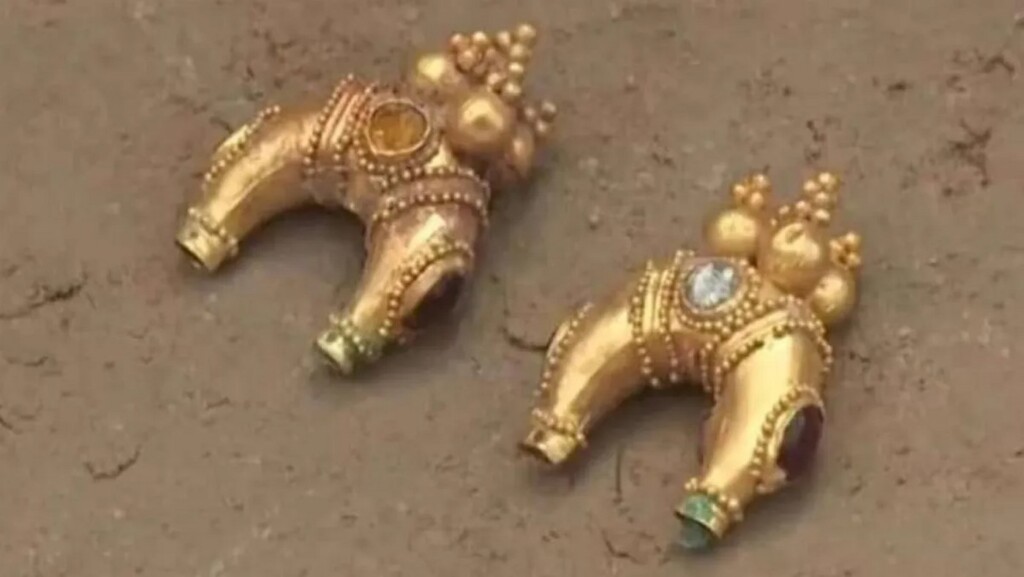
2,000-year-old Gold Jewelry from Mysterious Central Asian Culture Discovered in Kazakhstan

– credit Turkistan regional administration of Republic of Kazakhstan

Of the many famous empires and states along the Silk Road’s Central Asian passages, few are more mysterious than the Kangju.

But in a stroke of fortune, the section of an ancient burial ground reserved for the nobility of this kingdom escaped the attention of looters for over two millennia, and a recent excavation from a university in Kazakhstan has uncovered evidence of wealth and prestige.

The Kangju state ruled an area in southern Kazakhstan for almost 1,000 years between the 5th century BCE and the 4th century CE. Of the three tombs found in the rural Karaaspan district of Kazakhstan’s region of Turkistan, two had been looted in ancient times, but a third whose contents were still intact yielded these golden earrings, along with a bronze mirror, arrowheads, beads, and other items.

The earrings are a clear sign of the kingdom’s wealth, while the mirror reflects more on their social connections.

“Previously, similar mirrors were found in the city of Tillya Tepe in Afghanistan, the center of the Kushan Empire, and in the burial places of the Sarmatian kings in the Southern Urals,” a statement from the Kazakh government read after being translated.

Circular with a hole through the center, the mirror was made in the Han Dynasty, the first modern Chinese imperial empire, and the one which established the first Silk Road. Connecting the Han capital of Xi’an with Rome, Kangju would have been an important stop on the most famous trail in history.

The earrings are crescent-shaped and are assumed to represent the Moon in polychromatic gold with turquoise and rubies. At the bottom are bunches of grapes which along with being a lovely decoration also reflected the sunlight in different directions.

The two pieces almost certainly indicate the tomb belonged to a noble lady, the statement says.

Expedition leader Aleksandr Podushkin, an archaeologist at Ozbekali Zhanibekov University which conducted the excavations, says Kangju—itself a Chinese name—was made up of a variety of Central Asian steppe peoples who are all better known than the kingdom they lived in.

The bronze mirror from the Han Dynasty – credit Turkistan regional administration of Republic of Kazakhstan

The Sarmatians mentioned earlier from the regions of the Urals, Caucasus, and the Black Sea, the Xiongnu from northern China and the Tian Shan mountains, and the Saka people, who probably originated in Iran but eventually spread all throughout Central Asia and Siberia, would have each contributed to making Kangju a cosmopolitan center of Central Asian nomadic peoples.

A 2nd-century BCE historical text from the Han Chinese states that Kangju remained small for long periods, neither growing nor shrinking in wealth and influence. If this is the case, it was probably because several larger empires surrounded it, including the Xiongnu, the Parthians, and the Kushan Empire.2,000-year-old Gold Jewelry from Mysterious Central Asian Culture Discovered in Kazakhstan
Read More........

What does your musical taste say about your personality and lifestyle?

Adrian NorthCurtin University, I’m quite used to receiving abuse concerning the content of this column, but in contrast my previous post (about why fans of heavy metal shouldn’t have been banned from a pub) seems to have caused some interest in what one can infer from somebody’s musical taste about their personality and lifestyle.

The simple answer is an awful lot! In 2010 I surveyed 36,518 people about their liking for 104 musical styles and their personality. Self-esteem was highest among fans of blues, funk, jazz, classical music, opera, and rap, but lowest among fans of heavy metal, indie, and punk.

The most creative fans were those who liked jazz, classical music, opera, and indie, whereas lower creativity was linked to liking for easy listening and chart pop. The hardest-working fans were those who liked country and pop, whereas those who regarded themselves as relatively lazy tended to like funk and indie.

The most sociable and outgoing fans were those who liked funk, country, rap, and dance music, whereas more reserved people tended to like classical music and heavy metal. The gentlest people in my sample liked opera, easy listening, and heavy metal, whereas the most headstrong tended to prefer dance music, indie, and punk. The most nervous fans were those who liked chart pop, whereas those who were most at ease with themselves preferred blues, funk, jazz, classical music, and heavy metal.

Links between musical taste and people’s more general lifestyles are also manifold and wide-ranging. Factors concerning money, education, employment and health tended to show that those who like high art music are wealthier, better educated, and in higher status jobs. Fans of jazz, opera and classical music in particular seem to lead blessed lives with the highest income, and greater access to financial resources (e.g. several bank accounts, credits cards, and owning shares in companies).

This greater wealth means they also spend more on food than others, and prefer to drink wine. As an academic, I might also add that this wealth is probably because they were more likely to have a Masters degree or PhD; and it is interesting that they are also more likely to give something back to the community by doing voluntary work.

But income and education can’t explain all the differences between the lifestyles of fans of different styles. Fans of opera and jazz were more likely than most to vote for right-wing political parties, but this conservatism was shared with country music fans. Similarly, despite their typically right-wing voting habits, fans of classical music and opera were among the most likely to favour development of green energy sources, whereas fans of hip hop and R&B, despite their radical counter-culture stereotype, were happiest with the fossil fuel status quo.

What is also interesting about these findings is the extent of overlap between those who like musical styles that are, on the surface, very different. Country and classical music fans overlap considerably in everything but their income, in reflection of a shared conservative worldview; and opera and heavy metal fans also united on more than just their love of dramatic music, as they share similarly creative and gentle personalities.

So someone’s musical taste does tell you a lot about them, but as these examples show, many of the stereotypes of the fans are nothing more than that. Moreover, the gross differences between fans that do exist in terms of, for example, income and conservatism, express themselves in some very specific ways in everyday attitudes and behaviour.The Conversation

Adrian North, Head of School of Psychology and Speech Pathology, Curtin University

This article is republished from The Conversation under a Creative Commons license. Read the original article.

Read More........