Play Holi Naturally! Make Natural Organic Colors at Home

Play Holi Naturally! Make Natural Organic Colors at Home
Playing Holi in Indian style means a blast of colors all over you. But when these chemically loaded colors come in contact with the skin, they tend to react and cause allergies and other skin related problems. The colors available in market are extremely harmful and stink due to the presence of harsh chemicals in them. Chemicals like Copper Sulphate (Green) causes eye allergy, temporary blindness; Aluminium Bromide (Silver) may prove to be Carcinogenic; Lead Oxide (Black) can cause renal failure & learning disability; Chromium Iodide (Purple) can lead to bronchial asthma & allergies; Mercury Sulphite (Red) can lead to Skin cancer!!! After learning this, don’t you think that using natural colors is the safest option as they would go off easily, won’t harm your skin and won’t even cost you much. Holi can be fun by using environment friendly colours. Let’s explore the fascinating world of natural harmless colours that not only are gentle on our skin but are also helping to save our environment and conserve our biodiversity. Natural
Make Natural Organic Colors at Home
Prepare Natural colours at Home
colors can be easily made at home. Here are a few ideas on how to create your own natural colours and stay away from harmful chemicals. So, get set to be drenched in colours, without any worries.
  • Dry the rind of the Bael fruit and grind to obtain a yellow colored gulal.
  • Mix turmeric powder with double the quantity of gram flour (besan) to be used as yellow gulal. Besan can be substituted by wheat, rice or talcum powder. Turmeric can also be boiled in water to get deep yellow color. 
  • Soak marigold flowers in water and boil it to get yellow color solution. 
  • Dry the petals of flowers like yellow chrysanthemum, Amaltas or marigold and grind them to obtain different shades of yellow. Use this powder with gram flour or use it separately.
Vibrant and Energetic Red is one of the most favorable colors used in Holi. Use the simple tips to make the red colour at home: 
  • Dry red rose petals by spreading them on newspaper. Grind these rose petals and use this red powder as `gulal`. 
  • Dry red hibiscus flowers in the shade and grind them to a lovely red color. 
  • The red sandalwood powder can also be used as Red Gulal. It is beneficial for skin. For wet colour, boil 2 tsp of red sandalwood powder in 5 liters of water. Dilute it with twenty liters of water to get red color solution. 
  • Mix a pinch of lime powder in half a cup of water and add 2 tsp of turmeric powder in it. Use only after diluting with 10 litres of water for red colour.
  • Peels of red pomegranate can be boiled in water to obtain red colour.
  • Madder Tree Wood can also be boiled in water to get a lovely red color. 
  • Sinduria (Annato) fruit contains lovely brick color red seeds which can be used to obtain both dry and wet colors.
Saffron and orange colors are easy to prepare at home. Try these methods-
  • Add little turmeric and sandalwood powder to rose water to make a saffron color solution. 
  • Mix a pinch of sandalwood powder in 1 litre of water for an instant, beautiful and fragrant saffron color.
  • Collect and dry the stalks of Harashringar flowers during the early winter season. Soak them in water to get a pleasant orange color.
  • The flowers, Tesu, Palash or Dhak can be soaked overnight in water and can also be boiled to obtain a fragrant yellowish orange colored water.
  • Soak a few stalks of Saffron in 2 tbsp of water. Leave for few hours and grind to make a fine paste. Dilute with water for desired color strength.
Green Colour has a calming and healing effect, in its natural and herbal form. To prepare the same at home, go for these suggested methods-
  • Use Henna (mehendi) powder mixed with equal quantity of any flour to attain a lovely green shade. Dry mehendi will not leave color on your face as it can be easily brushed off. Only mehendi mixed in water might leave a slight color on face. To prepare wet colour, mix 2 tsp of mehendi in a litre of water and stir well.
  • Gulmohar, spinach, coriander or mint leaves can be dried and ground to get a rich green gulal. Dry and finely powder the Gulmohur tree leaves for a natural Green gulal.
  • Crush the tender leaves of the Wheat plant to obtain a natural safe green Holi color.
Blue and Magenta are the colors of new beginnings and creative expression. Learn about the simple ways to make these at home-
  • Crush berries of the Indigo tree and add to water for desired color strength. The leaves of Indigo plant can also yield rich blue color, when boiled in water. 
  • Jacaranda flowers that bloom in summers can be dried in the shade and ground to obtain a lovely blue gulal.
  • Grate a beetroot and soak in water overnight for a wonderful magenta colour solution. Boil or leave overnight in water for a deeper shade.
  • Celebrating an eco-friendly Holi can make a difference to this colorful festival. So, work out these fabulous options and have a happy and safe holi.
Note: While natural colours are usually considered safe, do look out for any reactions or rashes. Each person is different and people with sensitive skin may react to everyday herbs or ingredients. Source: HerbHealtH,
Read More........

When Your Muscles Work Out, They Help Neurons Grow and Heal 4x Faster, MIT Study Shows

Natalia Blauth / Unsplash+

There’s no doubt that exercise does a body good—strengthening muscles and bolstering our bones, blood vessels, and immune system—but now, MIT engineers have found that it also has benefits at the level of individual neurons.

They observed that when muscles contract during exercise, they release a soup of biochemical signals called myokines. In the presence of these muscle-generated signals, neurons grew four times farther compared to neurons that were not exposed to myokines.

These cellular-level experiments suggest that exercise can have a significant biochemical effect on nerve growth. Surprisingly, the researchers also found that neurons respond not only to the biochemical signals of exercise but also to its physical impacts.

While previous studies have indicated a potential biochemical link between muscle activity and nerve growth, this is the first to show that physical effects can be just as important—and the results shed light on the connection between muscles and nerves during exercise, and could inform exercise-related therapies for repairing nerves.

“Now that we know this muscle-nerve crosstalk exists, it can be useful for treating things like nerve injury, where communication between nerve and muscle is cut off,” says Ritu Raman, Assistant Professor of Mechanical Engineering at MIT and senior author of the study. “Maybe if we stimulate the muscle, we could encourage the nerve to heal, and restore mobility to those who have lost it due to traumatic injury or neurodegenerative diseases.”
“Exercise as medicine”

In 2023, Raman and her colleagues reported that they could restore mobility in mice that had experienced a traumatic muscle injury, by first implanting muscle tissue at the site of injury, then exercising the new tissue by stimulating it repeatedly with light. Over time, they found that the exercised graft helped mice to regain their motor function, reaching activity levels comparable to those of healthy mice.

When the researchers analyzed the graft itself, it appeared that regular exercise stimulated the grafted muscle to produce certain biochemical signals that are known to promote nerve and blood vessel growth.

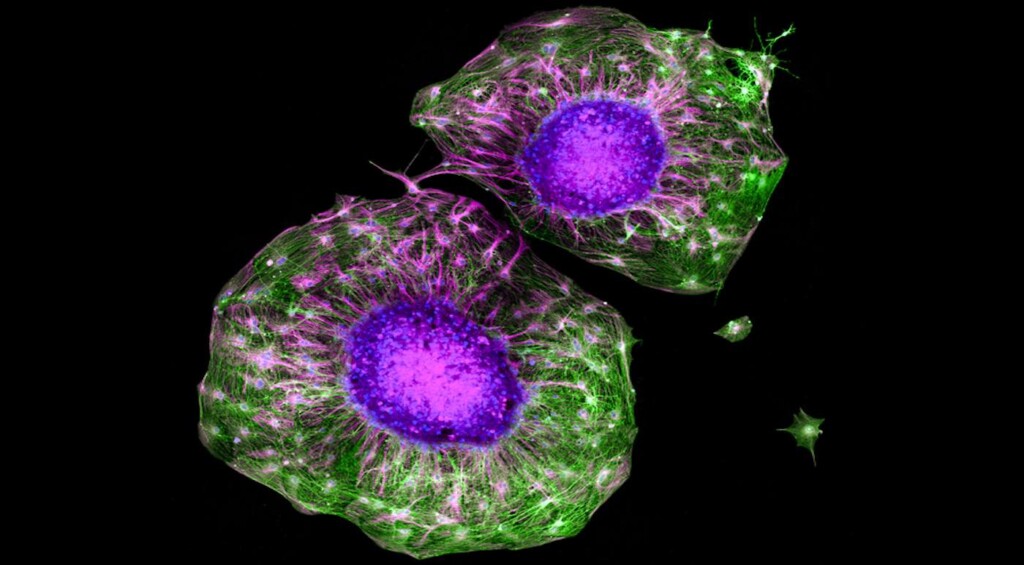
After exercise, motor neurons (purple) exhibit new growth (green) faster than without exercise – Credit: Angel Bu / MIT

“We always think that nerves control muscle, but we don’t think of muscles talking back to nerves,” Raman says. “So, we started to think stimulating muscle was encouraging nerve growth. And people replied that maybe that’s the case, but there’s hundreds of other cell types in an animal, and it’s really hard to prove that the nerve is growing more because of the muscle, rather than the immune system or something else playing a role.”

In their new study published in the journal Advanced Healthcare Materials, the team set out to determine whether exercising muscles has direct effect on how nerves grow, by focusing solely on muscle and nerve tissue.

The team genetically modified the muscle to contract in response to light. With this modification, the team could flash a light repeatedly, causing the muscle to squeeze in response, in a way that mimicked the act of exercise. Raman previously developed a novel gel mat on which to grow and exercise muscle tissue. The gel’s properties are such that it can support muscle tissue and prevent it from peeling away as the researchers stimulated the muscle to exercise.

The team then collected samples of the surrounding solution in which the muscle tissue was exercised, thinking that the solution should hold myokines, including growth factors, RNA, and a mix of other proteins.

“Muscles are pretty much always secreting myokines, but when you exercise them, they make more,” Raman says.

The researchers grew the neurons from stem cells derived from mice. As with the muscle tissue, the neurons were grown on a similar gel mat. After the neurons were exposed to the myokine mixture, the team observed that they quickly began to grow—four times faster than neurons that did not receive the biochemical solution.

“They grow much farther and faster, and the effect is pretty immediate,” Raman notes.

For a closer look at how neurons changed in response to the exercise-induced myokines, the team ran a genetic analysis, extracting RNA from the neurons to see whether the myokines induced any change in the expression of certain neuronal genes.

“We saw that many of the genes that up-regulated in the exercise-stimulated neurons were not only related to neuron growth, but also neuron maturation, how well they talk to muscles and other nerves, and how mature the axons are,” Raman says. “Exercise seems to impact not just neuron growth but also how mature and well-functioning they are.”

The results suggest that biochemical effects of exercise can promote neuron growth. Then the group wondered: Could exercise’s purely physical impacts have a similar benefit?

“Neurons are physically attached to muscles, so they are also stretching and moving with the muscle,” Raman says. “We also wanted to see, even in the absence of biochemical cues from muscle, could we stretch the neurons back and forth, mimicking the mechanical forces (of exercise), and could that have an impact on growth as well?”

It turned out that both biochemical and physical effects of exercise are “equally important”.

Now that the group has shown that exercising muscle can promote nerve growth at the cellular level, they plan to study how targeted muscle stimulation can be used to grow and heal damaged nerves, and restore mobility for people who are living with a neurodegenerative disease such as ALS.“This is just our first step toward understanding and controlling exercise as medicine,” Raman says. When Your Muscles Work Out, They Help Neurons Grow and Heal 4x Faster, MIT Study Shows
Read More........