
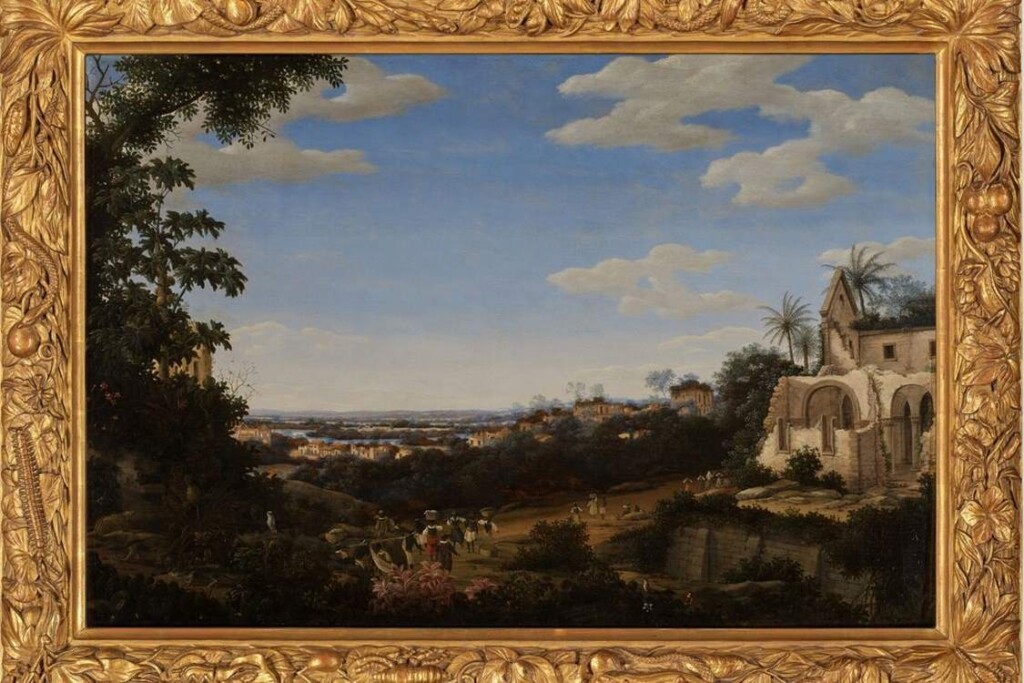
View of Olinda, Brazil, with Ruins of the Jesuit Church, Frans Post, 1666 – credit, Sotheby’s
A painting by a lesser-known Dutch master has sold for $7 million at Sotheby’s more than 25 years after being found in the dusty attic of an old barn in Connecticut.
Proving themselves to be worthy of their status as the world’s top auctioneers, Sotheby’s managed to convince collectors to buy it for $2.2 million even though it was so covered in black grime it was hardly visible.
Owned by a series of Parisians, including Napoleon’s paternal uncle, it eventually ended up in the hands of a private collection in the US. Caked with grime, the collectors brought it to a leading New York art conservator, who managed to peel back the layers of time and filth to reveal a blue skies, black figures carrying baskets, and a variety of New World animals.
“Of all the paintings we put up at Sotheby’s… probably 40% are dirty,” said George Wachter, the chairman of Sotheby’s North and South America in a video released by the auctioneer. “Is it worth pursuing? That’s the question I need to ask, and with the Post there was no question we were looking at something beyond.”
It was Watcher who convinced Tom and Jordan Saunders III to buy View of Olinda back in 1998, despite barely being able to see it, and it was they who eventually benefitted when it set the record for a Post sale price just 2 minutes into the auction—$7 million.
The value in the work derives from something rather simple: exclusivity. Spending a sojourn of around 8 years in the former Dutch colony in northeast Brazil, Post would have been one of a tiny handful of European artists who could accurately depict the flora, fauna, and faces of South America in their art.
The surviving canvases from his long stay are fewer than its years, despite Post becoming an in-demand artist upon returning to Europe. Merchants and slave-traders wanted accurate images of the landscapes they knew, while well-to-do members of society wanted more evocative imagery crowded with fantastic animals, and less focus on realism.As a result, View of Olinda is something of the two together, with an armadillo, anteater, and alligator all clustered in the bottom left of the painting—an almost garish ornament to a normal country scene. 17th-Century Dutch Painting Rescued from a Dusty Attic in Connecticut Sells for $7 Million

 The world's largest art car parade rolled through the fourth-largest U.S. city of Houston on Saturday, attracting an estimated more than 300,000 spectators. The parade, now in its 25th year, gave art car-lovers a rare chance to view more than 300 cars of every shape and design imaginable, from a giant Radio Flyer
