Pigments and palettes from the past – science of Indigenous art

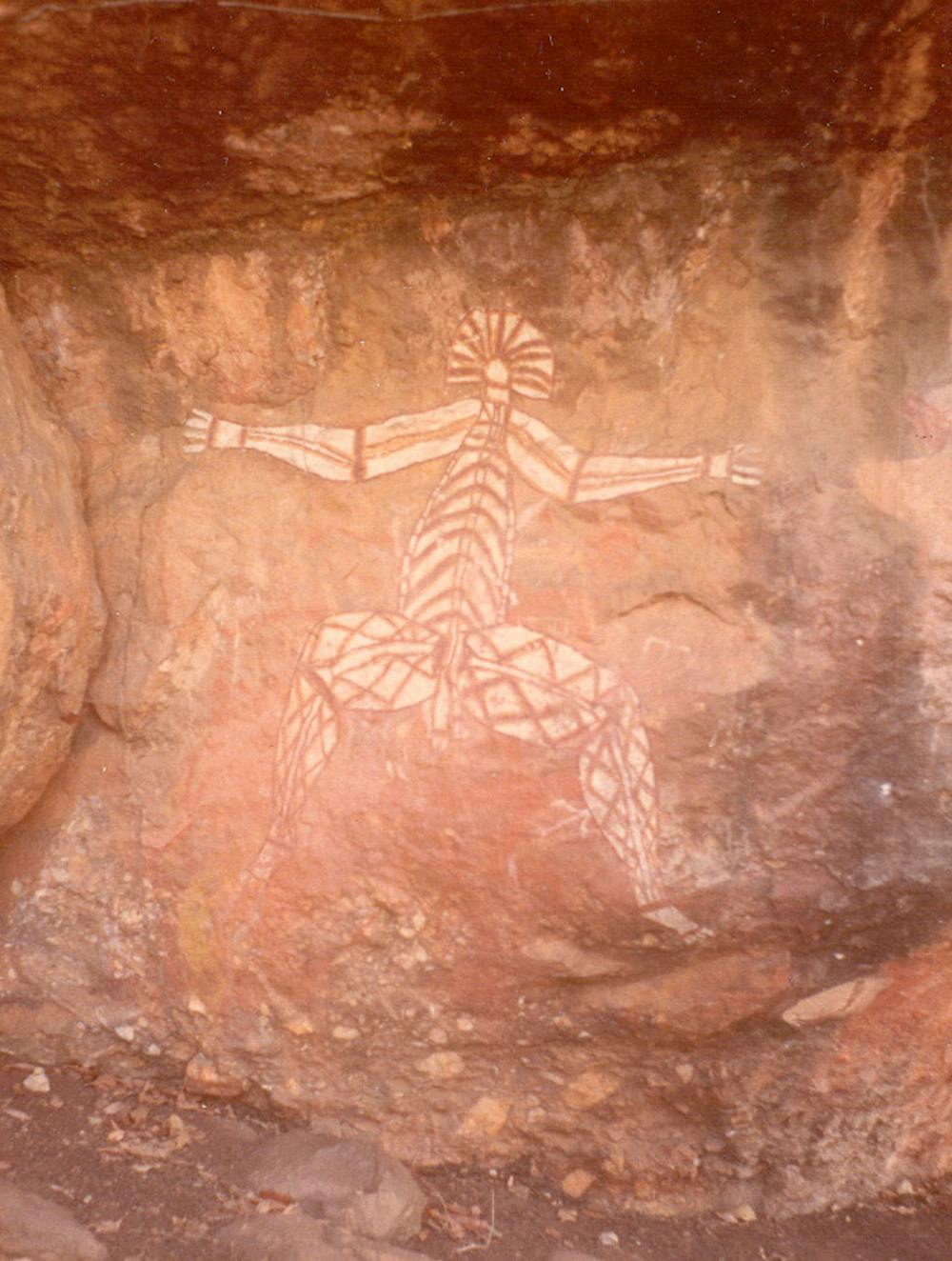
Some Indigenous paintings have lasted thousands of years … so what is it about the pigments that make them so long-lasting? Carolien Coenen/Flickr, CC BY-NC-ND Andrew Thorn, International Centre for the Study of the Preservation and Restoration of Cultural Property

Indigenous Australian practices, honed over thousands of years, weave science with storytelling. In this Indigenous science series, we look at different aspects of First Australians’ traditional life and uncover the knowledge behind them. Here we examine the chemistry and techniques behind perhaps the most iconic element of Indigenous life: rock art.


Visitors to Uluru might also find themselves at Mutitjulu Waterhole in the company of a travel guide filled with wisdom about the meaning of the paintings. Uluru has almost 100 painted sites, of which I have studied most, and tourists will encounter a dozen or less.

Anangu people will explain that the paintings have many meanings depending on the audience. An undulose band may be a snake in one story, a creek in another. A tourist may or may not be told that the paintings at Uluru are in themselves not necessarily highly charged with spiritual values but rather an auxiliary expression in response to the power of the rock itself. The main stories, the big stories, are told in the rock.

So why did people paint? What did it mean? How was it done? Why did they use certain pigments? Why has it lasted so long? The answers inevitably vary depending on where you are standing and with whom.

Painting techniques

Paint has been applied to rocks, almost all types, by a variety of application techniques. Marks were made using what appears to be a dry crayon or pastel application, where a piece of pigment-rich soft rock has been drawn across the surface.

A wide variety of implements were used as brushes to apply water-dispersed pigment, and there is ethnographic evidence of chewed bark and other suitable implements being used – as they still are today for bark paintings.

Fingers may have been used and in one rare and precious place across the flood plain from Ubirr in Kakadu, senior elder of Kakadu, Bill Neidjie, once pointed to a place in the ceiling where his footprints still remained from his youth where he was dipped in paint and pressed against the ceiling.

Stencils at Carnarvon Gorge. Pierre Pouliquin/Flickr, CC BY-NC

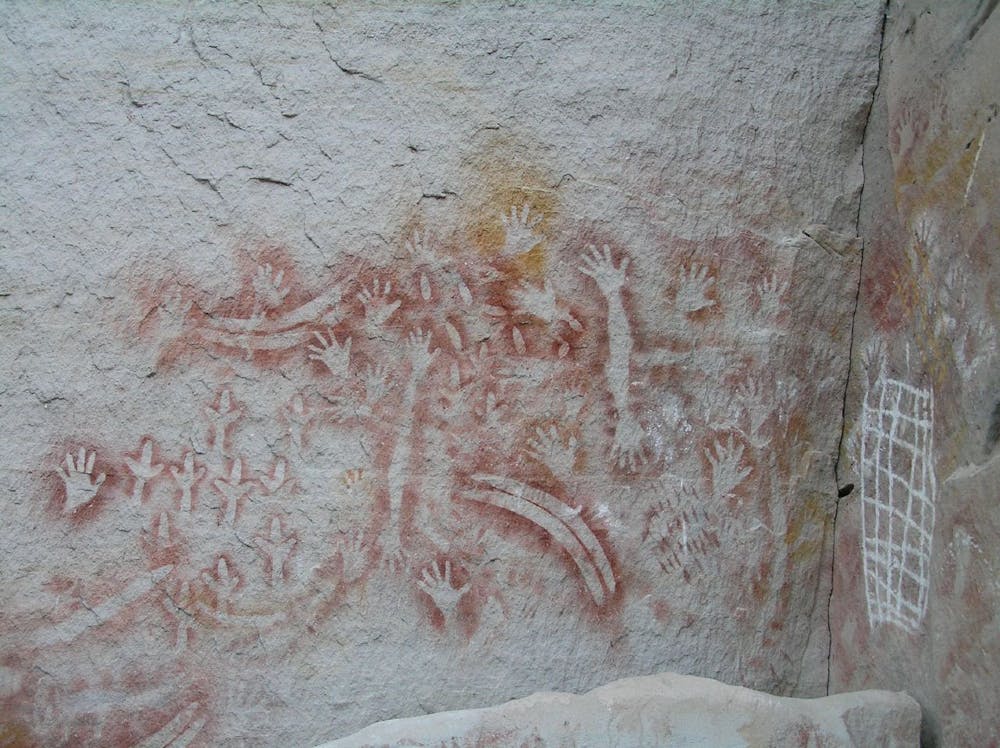
Stencil techniques have been used to portray everything from full bodies (the finest examples in Carnarvon Gorge in Queensland), to hands, weapons, and introduced objects of fascination such as clay pipes and wool shears. There are some very fine and complex hand prints east of King’s Canyon in the Northern Territory, pressing three coaxial U shapes to the rock by painting the two inner, the two outer fingers, and the palm.

Paintings can be highly detailed within an individual figure but rarely narrative panels extend across a whole site or rock panel. More typically pre-existing paintings are painted over with no regard for their meaning or author.

There are examples of important images that have been faithfully reproduced because of their fundamental meaning for a given site. It is important to underline this fact, that repainting, when considered over several hundred years is not commonly faithful reproduction but an accumulation of new expression.

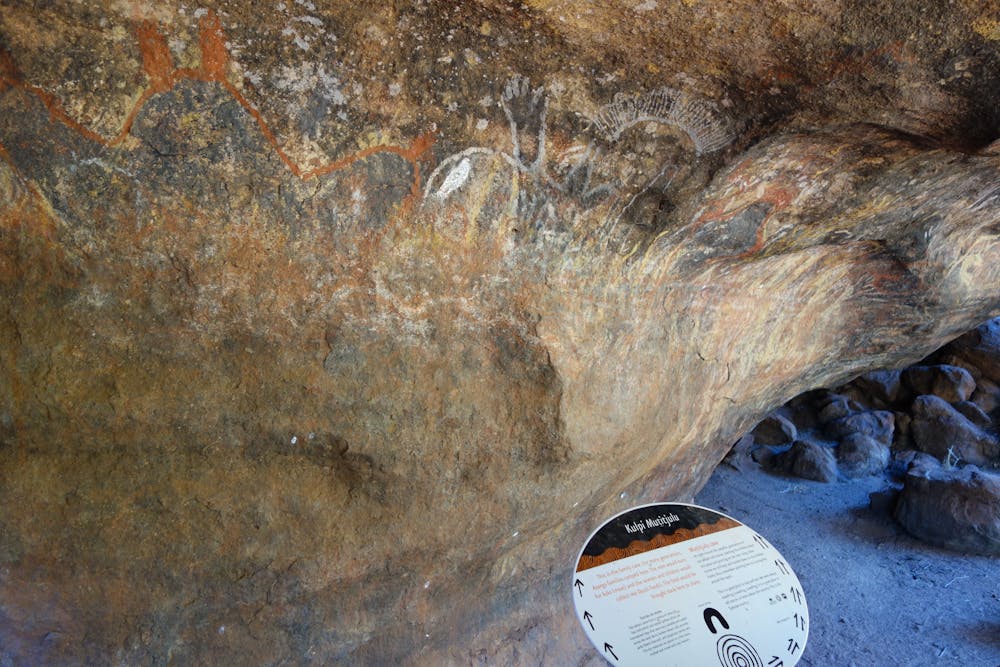
Photographs of Mutitjulu waterhole at Uluru, taken by Australian anthropologist Charles Mountford in the late 1930s, are almost unrecognisable due to the accumulated new painting since that time.

Artwork at Mutitjulu. aa140/Flickr, CC BY-NC-ND

Regular painting at Uluru ceased in the 1960s with only a few isolated cases of painting through to the 1980s.

Pigments

In Australia, pigments were chosen from naturally occurring minerals with little evidence of manufacture. Charcoal is one exception to this, but it could be argued that it was a routine by-product rather than a deliberately manufactured pigment.

There is some unsubstantiated speculation that yellow ochre was heated to turn it red and cases where European pigments were adopted. This availability of new colours did not result in the adoption of more colourful paintings, with the exception of some use of washing blue (a coarse synthetic ultramarine) in parts of Arnhem Land.

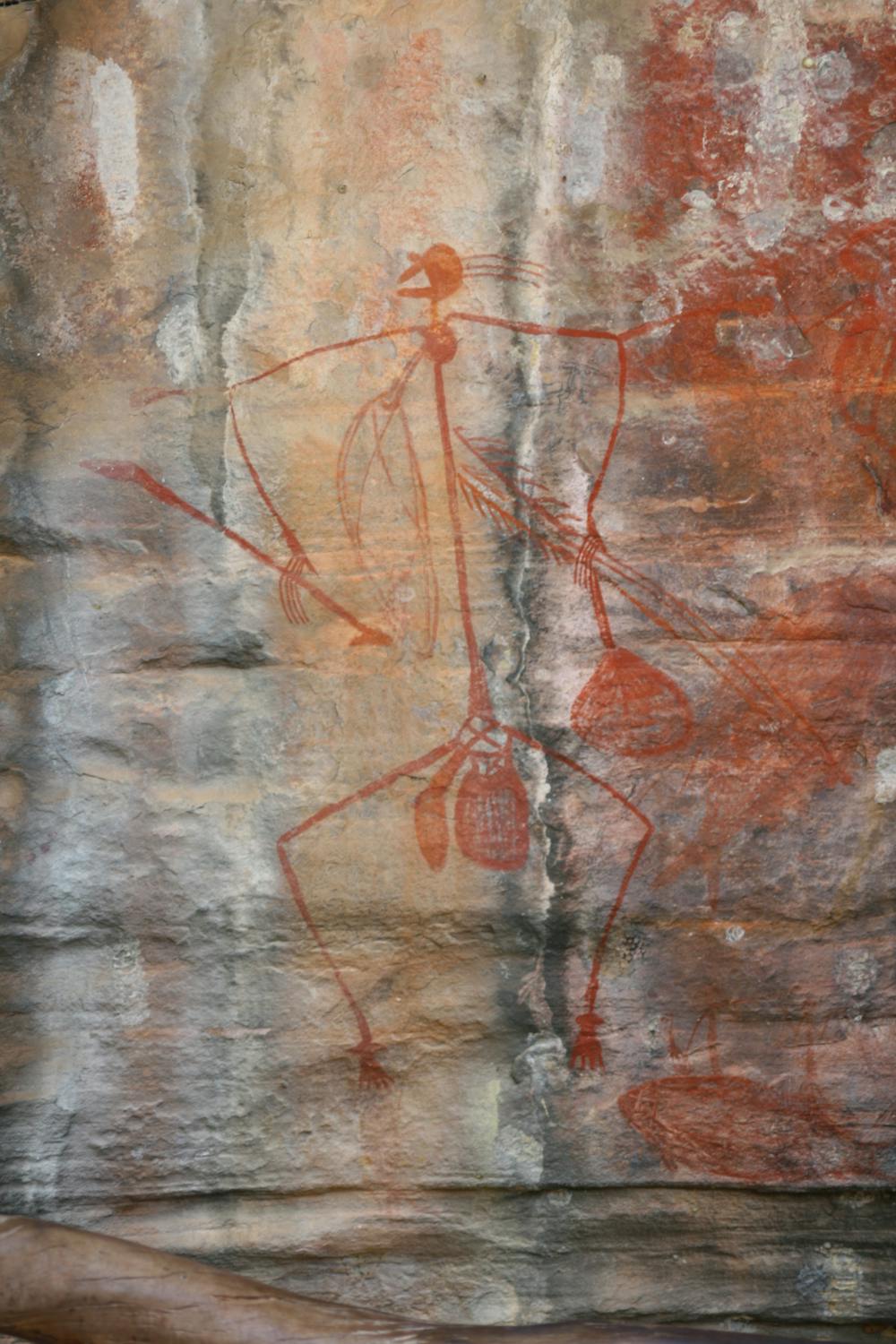
The traditional palette, that is to say the most commonly encountered colours, are red, white, yellow and black, with variations on the composition of these but with little evidence of mixing to create intermediate tones.

By studying the trace elemental composition of pigments it is possible to connect them to geological events, and hence their source. Such studies proves that pigments were traded, in some cases over long distances. It is difficult to postulate however that distance of manuportation equals significance or spiritual value, but further research may enlighten this fact.

Pigments were sourced from known locations such as Walgi Mia in central Western Australia and from large coloured earth deposits in the Flinders Ranges. But if we look at one colour – white – the distribution of the minerals used suggests local source rather than trade.

White, yellow and red painting at Burrunggui, Kakadu. Rae Allen/Flickr, CC BY-NC-SA

Kaolin – a soft white clay – is abundant in most parts of Australia but where calcite is found, as it is in the river beds of Arnhem Land, it becomes the more common white pigment. The Kimberly is more abundant in the carbonate mineral huntite and yet it is rare to find huntite used outside this region, despite it being a brighter white than kaolin.

Examples of trade exist and some of these provide interesting insights into the selection of paints.

Just south of Uluru, near the South Australian border, lie a group of sites containing a metallic red pigment characteristic of the Walgi Mia quarry 1,000km to the west. It is said these caves and their paintings were created by the emu creation beings who had a dreaming path extending out to the western coastline and which would have passed very nearby the pigment source. It is not surprising therefore to find a pigment that has come from such a distance.

What is fascinating is that near to Walgi Mia is a very large painting site, Walghanna, that features a very large emu footprint. Emus are not known to have existed in the vicinity of Walghanna, according to the archaeological record and oral history. There appears to have been a two-way trade in materials and stories.

Durability and age

The 1930s photograph by Mountford, showing paintings that no longer exist due to subsequent overpainting indicates, among other things, that all of what one sees at Mutitjulu today is “modern art” painted in the period 1936-1962.

I had great fun at a conference using Powerpoint to fade between an image of the Mutitjulu panel and Convergence, a Jackson Pollock painting with an almost identical scramble of lines, shapes and colours, aimed to make the point that not all rock art is ancient. Some other more significant statements can be added. Most very old paintings survive as very thin remnants.

Art at Ubirr, Kakadu. andrea castelli/Flickr (rotated), CC BY

There are cases in Kakadu of whole colours falling off an image, resulting in, for example, birds without legs. Some very old paintings have survived for thousands of years with every detail seemingly intact, such as those of the dynamic style and others of that period.

These paintings tend to be monochromatic red, applied with haematite that is both very fine and non-responsive to humidity or chemical alteration.

Studies have shown degradation pathways for rock art pigments and it is no surprise that charcoal will jump off the rock very quickly, followed by kaolinite, huntite, then yellow and red ochres.

Dark red haematite is usually the last surviving pigment, unless a painting is subject to floodwaters or other physical agents. There are examples of red paintings surviving under water at Jowalbinna near Laura and east of Mt Isa, both in northern Queensland.

Pigments survive depending on their stability to climatic variations and then ultimately due to their ability to intimately bond with the rock.

It has to be stated that the greatest threat to indigenous rock paintings is the tourist, who out of curiosity rather than malice, desires a sensory connection to inanimate culture.

Having on many occasions adopted the disguise of the tourist I have observed a bus load of fascinated fellow travellers comparing their own hand with that sprayed on the ceiling of Mulga’s Cave just north of Wave Rock.

This is an act of connection with someone from the past but its very execution ensures that connection will soon be lost.


See also:
Stories from the sky: astronomy in Indigenous knowledge
Indigenous medicine – a fusion of ritual and remedy
The Conversation

Andrew Thorn, Heritage Consultant and Materials Conservator; Sessional Lecturer in Stone Conservation, International Centre for the Study of the Preservation and Restoration of Cultural Property

This article is republished from The Conversation under a Creative Commons license. Read the original article.

Read More........

Pigments and palettes from the past – science of Indigenous art

Some Indigenous paintings have lasted thousands of years … so what is it about the pigments that make them so long-lasting? Carolien Coenen/Flickr, CC BY-NC-ND Andrew Thorn, International Centre for the Study of the Preservation and Restoration of Cultural Property
Indigenous Australian practices, honed over thousands of years, weave science with storytelling. In this Indigenous science series, we look at different aspects of First Australians’ traditional life and uncover the knowledge behind them. Here we examine the chemistry and techniques behind perhaps the most iconic element of Indigenous life: rock art.


Visitors to Uluru might also find themselves at Mutitjulu Waterhole in the company of a travel guide filled with wisdom about the meaning of the paintings. Uluru has almost 100 painted sites, of which I have studied most, and tourists will encounter a dozen or less.

Anangu people will explain that the paintings have many meanings depending on the audience. An undulose band may be a snake in one story, a creek in another. A tourist may or may not be told that the paintings at Uluru are in themselves not necessarily highly charged with spiritual values but rather an auxiliary expression in response to the power of the rock itself. The main stories, the big stories, are told in the rock.

So why did people paint? What did it mean? How was it done? Why did they use certain pigments? Why has it lasted so long? The answers inevitably vary depending on where you are standing and with whom.

Painting techniques

Paint has been applied to rocks, almost all types, by a variety of application techniques. Marks were made using what appears to be a dry crayon or pastel application, where a piece of pigment-rich soft rock has been drawn across the surface.

A wide variety of implements were used as brushes to apply water-dispersed pigment, and there is ethnographic evidence of chewed bark and other suitable implements being used – as they still are today for bark paintings.

Fingers may have been used and in one rare and precious place across the flood plain from Ubirr in Kakadu, senior elder of Kakadu, Bill Neidjie, once pointed to a place in the ceiling where his footprints still remained from his youth where he was dipped in paint and pressed against the ceiling.

Stencils at Carnarvon Gorge. Pierre Pouliquin/Flickr, CC BY-NC

Stencil techniques have been used to portray everything from full bodies (the finest examples in Carnarvon Gorge in Queensland), to hands, weapons, and introduced objects of fascination such as clay pipes and wool shears. There are some very fine and complex hand prints east of King’s Canyon in the Northern Territory, pressing three coaxial U shapes to the rock by painting the two inner, the two outer fingers, and the palm.

Paintings can be highly detailed within an individual figure but rarely narrative panels extend across a whole site or rock panel. More typically pre-existing paintings are painted over with no regard for their meaning or author.

There are examples of important images that have been faithfully reproduced because of their fundamental meaning for a given site. It is important to underline this fact, that repainting, when considered over several hundred years is not commonly faithful reproduction but an accumulation of new expression.

Photographs of Mutitjulu waterhole at Uluru, taken by Australian anthropologist Charles Mountford in the late 1930s, are almost unrecognisable due to the accumulated new painting since that time.

Artwork at Mutitjulu. aa140/Flickr, CC BY-NC-ND

Regular painting at Uluru ceased in the 1960s with only a few isolated cases of painting through to the 1980s.

Pigments

In Australia, pigments were chosen from naturally occurring minerals with little evidence of manufacture. Charcoal is one exception to this, but it could be argued that it was a routine by-product rather than a deliberately manufactured pigment.

There is some unsubstantiated speculation that yellow ochre was heated to turn it red and cases where European pigments were adopted. This availability of new colours did not result in the adoption of more colourful paintings, with the exception of some use of washing blue (a coarse synthetic ultramarine) in parts of Arnhem Land.

The traditional palette, that is to say the most commonly encountered colours, are red, white, yellow and black, with variations on the composition of these but with little evidence of mixing to create intermediate tones.

By studying the trace elemental composition of pigments it is possible to connect them to geological events, and hence their source. Such studies proves that pigments were traded, in some cases over long distances. It is difficult to postulate however that distance of manuportation equals significance or spiritual value, but further research may enlighten this fact.

Pigments were sourced from known locations such as Walgi Mia in central Western Australia and from large coloured earth deposits in the Flinders Ranges. But if we look at one colour – white – the distribution of the minerals used suggests local source rather than trade.

White, yellow and red painting at Burrunggui, Kakadu. Rae Allen/Flickr, CC BY-NC-SA

Kaolin – a soft white clay – is abundant in most parts of Australia but where calcite is found, as it is in the river beds of Arnhem Land, it becomes the more common white pigment. The Kimberly is more abundant in the carbonate mineral huntite and yet it is rare to find huntite used outside this region, despite it being a brighter white than kaolin.

Examples of trade exist and some of these provide interesting insights into the selection of paints.

Just south of Uluru, near the South Australian border, lie a group of sites containing a metallic red pigment characteristic of the Walgi Mia quarry 1,000km to the west. It is said these caves and their paintings were created by the emu creation beings who had a dreaming path extending out to the western coastline and which would have passed very nearby the pigment source. It is not surprising therefore to find a pigment that has come from such a distance.

What is fascinating is that near to Walgi Mia is a very large painting site, Walghanna, that features a very large emu footprint. Emus are not known to have existed in the vicinity of Walghanna, according to the archaeological record and oral history. There appears to have been a two-way trade in materials and stories.

Durability and age

The 1930s photograph by Mountford, showing paintings that no longer exist due to subsequent overpainting indicates, among other things, that all of what one sees at Mutitjulu today is “modern art” painted in the period 1936-1962.

I had great fun at a conference using Powerpoint to fade between an image of the Mutitjulu panel and Convergence, a Jackson Pollock painting with an almost identical scramble of lines, shapes and colours, aimed to make the point that not all rock art is ancient. Some other more significant statements can be added. Most very old paintings survive as very thin remnants.

Art at Ubirr, Kakadu. andrea castelli/Flickr (rotated), CC BY

There are cases in Kakadu of whole colours falling off an image, resulting in, for example, birds without legs. Some very old paintings have survived for thousands of years with every detail seemingly intact, such as those of the dynamic style and others of that period.

These paintings tend to be monochromatic red, applied with haematite that is both very fine and non-responsive to humidity or chemical alteration.

Studies have shown degradation pathways for rock art pigments and it is no surprise that charcoal will jump off the rock very quickly, followed by kaolinite, huntite, then yellow and red ochres.

Dark red haematite is usually the last surviving pigment, unless a painting is subject to floodwaters or other physical agents. There are examples of red paintings surviving under water at Jowalbinna near Laura and east of Mt Isa, both in northern Queensland.

Pigments survive depending on their stability to climatic variations and then ultimately due to their ability to intimately bond with the rock.

It has to be stated that the greatest threat to indigenous rock paintings is the tourist, who out of curiosity rather than malice, desires a sensory connection to inanimate culture.

Having on many occasions adopted the disguise of the tourist I have observed a bus load of fascinated fellow travellers comparing their own hand with that sprayed on the ceiling of Mulga’s Cave just north of Wave Rock.

This is an act of connection with someone from the past but its very execution ensures that connection will soon be lost.


See also:
Stories from the sky: astronomy in Indigenous knowledge
Indigenous medicine – a fusion of ritual and remedy
The Conversation

Andrew Thorn, Heritage Consultant and Materials Conservator; Sessional Lecturer in Stone Conservation, International Centre for the Study of the Preservation and Restoration of Cultural Property

This article is republished from The Conversation under a Creative Commons license. Read the original article.

Read More........

John Oliver Sells His Bob Ross Painting Raises Record $1.5 Million for Public Television

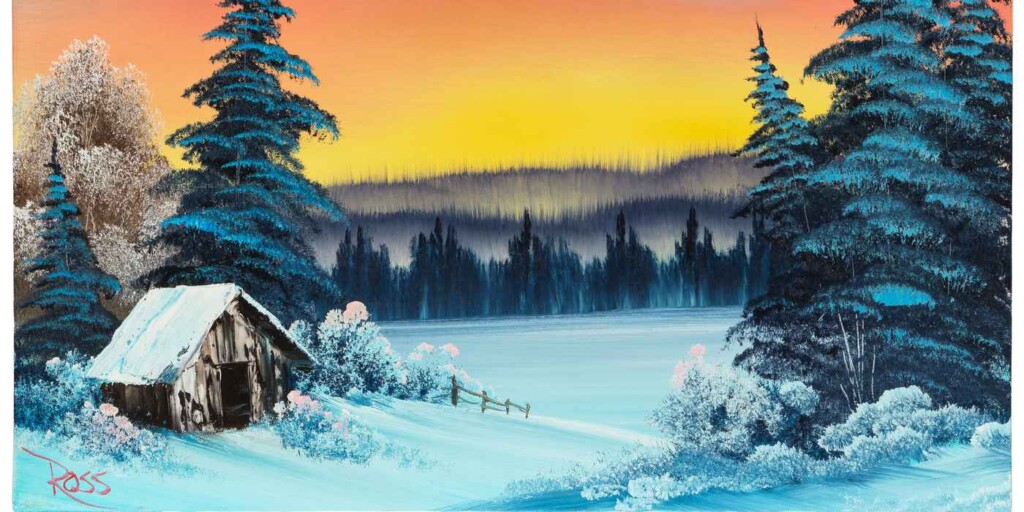
Bob Ross painting Cabin at Sunset – credit, screenshot via John Oliver’s Junk

GNN reported recently that a Los Angeles auction house recently handled the sale of three paintings by the famous TV artist Bob Ross, with the proceeds of over $600,000 going to fund public television and radio.

Inspired by the effort, HBO’s comedy news host John Oliver announced that he too had an original Ross that he would auction for the Corporation for Public Broadcasting.

On the last episode of the most recent season of Last Week Tonight with John Oliver, the British-born TV host revealed an auction catalogue called “John Oliver’s Junk” headlined by Cabin at Sunset, which Ross painted in season 10 of his show The Joy of Painting.

It managed to set a new auction record for a Bob Ross painting of $1,035,000 after 35 bids.

“We’ve actually accumulated a bunch of weird artifacts on this show over the years that we could definitely auction off to raise some much needed money,” Oliver said on last week’s show. “I am proud to announce last week tonight’s first ever auction in aid of public media.”

The proceeds from the sales of Cabin at Sunset and 34 other items totaled $1.5 million which has been transferred to the Public Media Bridge Fund which helps support stations and programs in need of funding.

Most of the items included show memorabilia, including a pair of golden sneakers Oliver promised to wear almost decade ago if former FIFA President Sep Blatter resigned, a cabbage that Oliver married in a segment on AI-generated art, and a jockstrap worn by Russel Crowe.

A pair of VIP tickets to a live show taping caught over $110,000.

While the Corporation for Public Broadcasting, a GSE that funds public radio and television in America, was receiving over $1 billion of its budget from the government, anyone who watches PBS or listens to NPR notes the frequency with which they run pledge drives. This along with other for-profit productions generates substantial revenue that helps keep the CBP operational.

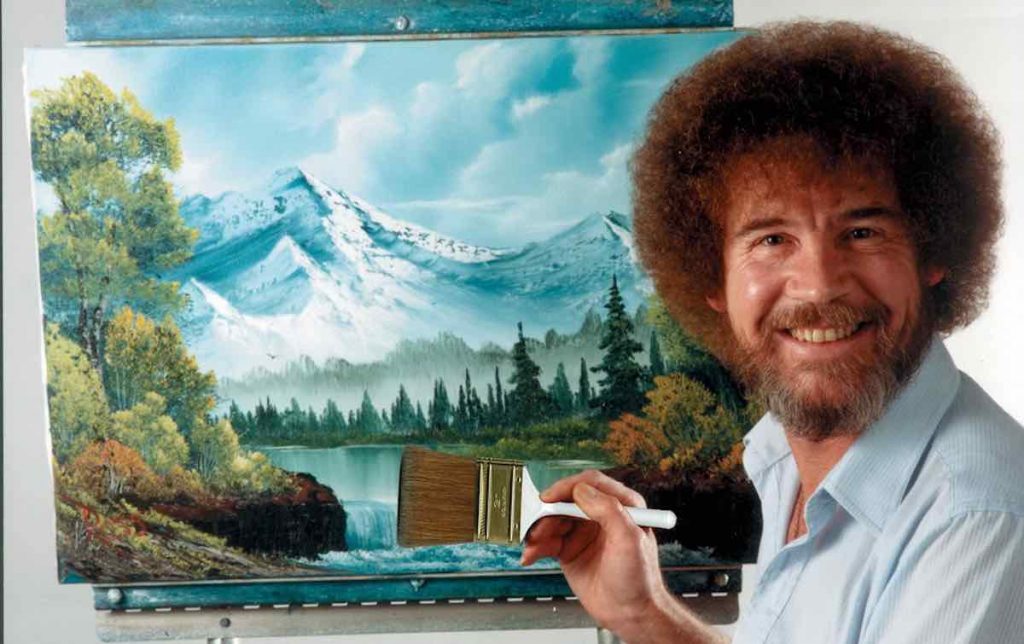
It was the idea of Bob Ross Inc., the company that manages the painter’s likeness and property, to hold the auction in support of public television, something which he loved so much.

“I think this actually would have been Bob’s idea,” said Joan Kowalski, president of Bob Ross Inc. “And when I think about that, it makes me very proud.”

Home in the Valley, (1993) Cliffside, (1990) and Winter’s Peace (1993) were priced to start at Bonham’s auctioneers at between $25,000 – $30,000, but all three quickly exploded in action.The first brought $229,100, the second $114,800, and Winter’s Peace went for a staggering $318,000. John Oliver Sells His Bob Ross Painting Raises Record $1.5 Million for Public Television
Read More........

Three Bob Ross Paintings Sold for $600,000 at Auction in Fundraiser for Public Television

Winter’s Peace by Bob Ross – credit Bonham’s Auctioneers, released

Three works from Bob Ross’ classic public television show The Joy of Painting raised over half a million dollars for public television.

Having relied for decades on endowment contributions and pledge drives of every tact and description, it was brilliant idea that puts a brilliant man and his brilliant perspective on the arts back into the spotlight 30 years after his death.

“I think this actually would have been Bob’s idea,” said Joan Kowalski, president of Bob Ross Inc., the firm that manages his likeness, content, and collection of thousands of works that he painted on television, in advance of the auction. “And when I think about that, it makes me very proud.”

The auction came months after cuts to PBS and other stations were passed in the most recent budget, but also as a pair of Bob Ross paintings touched, and then surmounted, 6-figure valuations—something very rarely seen before.

Straight Arrow News, which spoke with Kowalski, also reached out to Bonham’s, which had seen a pair of Ross’ sold for $115,000 and $95,000.

In many ways, the gentle television painter was a singular figure; irreplicable, not only as a figure in time but also in style and method. Ross paintings have always been conspicuously absent from the fine art auction circuits, and rarely come anywhere close to these sorts of valuations.

But in light of the appreciation, Bob Ross Inc. will be auctioning Home in the Valley, (1993) Cliffside, (1990) and Winter’s Peace (1993). They were priced to start at between $25,000 – $30,000, but quickly went to the Moon.

The first brought $229,100, the second $114,800, and Winter’s Peace went for a staggering $318,000.

– credit, Bob Ross Inc. fair use

“I think that there’s a certain amount of snobbery in the art business, but Bob is a cultural touchstone,” Aaron Bastian, senior director of California and Western paintings at Bonhams, told Straight Arrow News.

“He crosses a lot of different generations. Kids these days have seen him on YouTube. I watched him with my parents, right? And so, it’s something that is readily accessible to everyone.”

Modern artistic stars and works commonly seek to portray the world’s challenges, contradictions, and crises, while Bob Ross, a former Air Force drill sergeant who vowed never the raise his voice again after leaving the military, sought every broadcast to create a world he wanted to see: full of ‘happy little trees,’ and all the rest.

Kowalski points out that Ross loved the idea of public television, and that he would probably have been the first to pull out some out works to put towards the cause. After all, they aren’t unique.

While viewers saw only the canvas that Ross painted on screen over the course of the 30-minute program, that was actually the second of three renditions. One, he would do before shooting as a preparatory work that sat off camera as a reference. The second he’d do for the recorded broadcast, and a third, well-finished work with much more attention to detail than he could manage on-screen was painted for his instructional booklets.

Often, Ross would ensure the three remained together, either in his holdings at Bob Ross Inc., or in the cases when he would donate them, either to PBS or to the Smithsonian.

All the money raised from the auction will go to Create Channel, which Straight Arrow described as a “premium lifestyle channel for public television stations.”Another 3 works will be auctioned in January—part of a collection of 27 that could be ultimately sold to support the various channels and outlets under American Public Television. Three Bob Ross Paintings Sold for $600,000 at Auction in Fundraiser for Public Television
Read More........

World Wide Web exhibit opens at Gallery 101

Out of Africa from the Infinite Jouvay series. -

The World Wide Web exhibit by multi-media artist Rubadiri Victor opens at the 101 Art Gallery, Newtown, Port of Spain on July 17 from 5-9 pm. The exhibit, consisting of 77 paintings and objects spanning a number of Victor's series, will raise funds to go towards the artist's Season of Anansi Folklore Festival bills.

The exhibit will run until July 21 from 8 am-5 pm with special night events on Friday and Saturday.

West Indies Bowler Kaleidoscope -

The World Wide Web exhibition also officially launches the Anansi Goes to England initiative. After a successful third year, Victor’s Season of Anansi has been invited to bring its entire programme to Liverpool, England for Black History Month in October. The offer has been extended by the Merseyside International Centre of Carnival Arts + Black Innovation (MICCABI) through former son-of-the-soil- the award-winning artist Addae Gaskin, who is creating a series of cultural interventions in Liverpool.

“This represents an extraordinary opportunity for brand Trinidad and Tobago and our creative industries as the Anansi festival is expected to take place in Liverpool, Luton, Leeds, and London intersecting with multiple institutions like schools, universities, libraries, Museums, theatres, community centres, performing arts troupes, etc. Although MICCABI is paying some of the bills there are still significant expenses to be met as all aspects of the Anansi Folklore Festival are crossing the Atlantic: from the schools storytelling tour to the re-staging of the play Anansi and the 10 Dragons; from the bookstore reading tour to the multi-media exhibition The Black Infinite: the Global Rise of Afro-Futurism. The World Wide Web exhibition will also feature a retrospective on the just concluded Season of Anansi Festival 2025."

Guardian Angel of the Refugees -

World Wide Web is Rubadiri’s 11th one-man exhibition and his second in the historic Boscoe Holder Studio at Gallery 101. The exhibition includes work from five major series in Victor’s ongoing work. One is the Crucial Arch Angels series which features massive paintings of blue-skinned contemporary Caribbean arch angels with reparative portfolios. These include paintings like Our Guardian Angel of the Refugees and The Angel of Abundance Collects the Wealth to Redistribute it Equitably. There also are some paintings from the Adventures of the King of the Wizards series which visualises the legendary calypsonian the Mighty Shadow as a super-hero, Master Wizard in various adventures.

The Beginning of the Maroon Republic -
Another popular series is Victor’s portraits of West Indies cricketers called West Indies Cricket Warriors. One major series being shown for the first time completed is the Infinite Jouvay series, which features a series of canvases depicting the journey of "Jouvay" from Africa to Trinidad and then the world. The series envisages ancestral masquerades baptising a tribesman in West Africa in blue paint, then entering him to travel across the Middle Passage during the evil of the Trans-Atlantic slave trade so that his descendants would have a superpower within them to survive the horrors of the West.

“My work has always been for all audiences. I’m inviting the public to come out and see the work- especially young people at home on vacation from school. Art is for everyone,” Victor said.For more information contact Rubadiri Victor at (868)797-0949 or follow rubadirivictor on IG World Wide Web exhibit opens at Gallery 101 - Trinidad and Tobago Newsday
Read More........

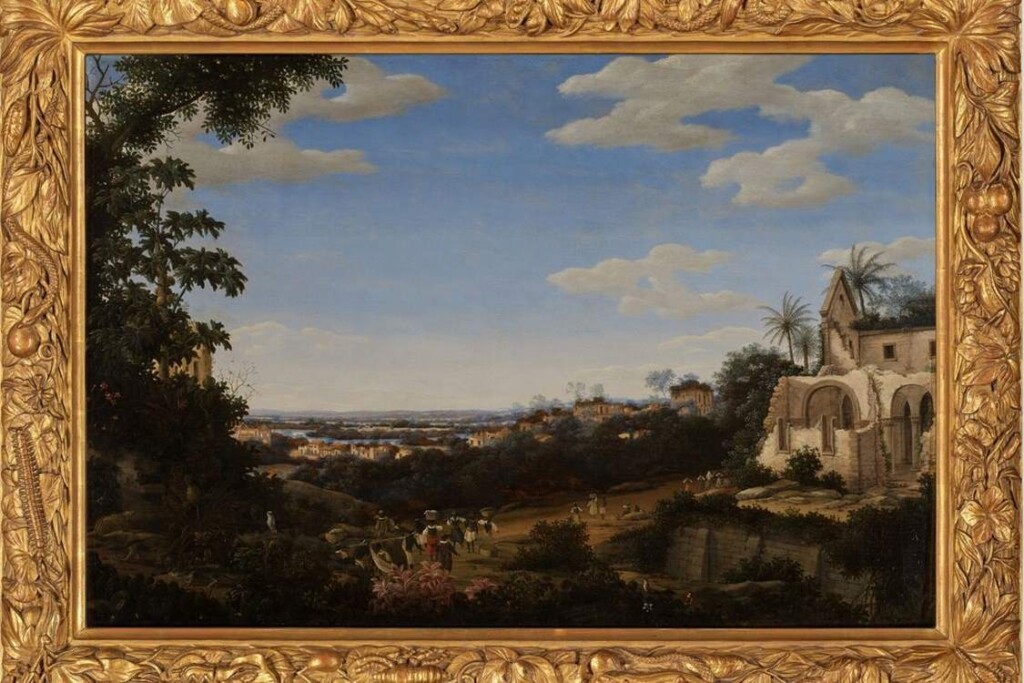
17th-Century Dutch Painting Rescued from a Dusty Attic in Connecticut Sells for $7 Million

View of Olinda, Brazil, with Ruins of the Jesuit Church, Frans Post, 1666 – credit, Sotheby’s

A painting by a lesser-known Dutch master has sold for $7 million at Sotheby’s more than 25 years after being found in the dusty attic of an old barn in Connecticut.

Proving themselves to be worthy of their status as the world’s top auctioneers, Sotheby’s managed to convince collectors to buy it for $2.2 million even though it was so covered in black grime it was hardly visible.

Owned by a series of Parisians, including Napoleon’s paternal uncle, it eventually ended up in the hands of a private collection in the US. Caked with grime, the collectors brought it to a leading New York art conservator, who managed to peel back the layers of time and filth to reveal a blue skies, black figures carrying baskets, and a variety of New World animals.

“Of all the paintings we put up at Sotheby’s… probably 40% are dirty,” said George Wachter, the chairman of Sotheby’s North and South America in a video released by the auctioneer. “Is it worth pursuing? That’s the question I need to ask, and with the Post there was no question we were looking at something beyond.”

It was Watcher who convinced Tom and Jordan Saunders III to buy View of Olinda back in 1998, despite barely being able to see it, and it was they who eventually benefitted when it set the record for a Post sale price just 2 minutes into the auction—$7 million.

The value in the work derives from something rather simple: exclusivity. Spending a sojourn of around 8 years in the former Dutch colony in northeast Brazil, Post would have been one of a tiny handful of European artists who could accurately depict the flora, fauna, and faces of South America in their art.

The surviving canvases from his long stay are fewer than its years, despite Post becoming an in-demand artist upon returning to Europe. Merchants and slave-traders wanted accurate images of the landscapes they knew, while well-to-do members of society wanted more evocative imagery crowded with fantastic animals, and less focus on realism.As a result, View of Olinda is something of the two together, with an armadillo, anteater, and alligator all clustered in the bottom left of the painting—an almost garish ornament to a normal country scene. 17th-Century Dutch Painting Rescued from a Dusty Attic in Connecticut Sells for $7 Million
Read More........

Painting Found in Italian Villa Basement Turns Out to Be Original Picasso

– credit, Andrea Lo Rosso, provided to the Media

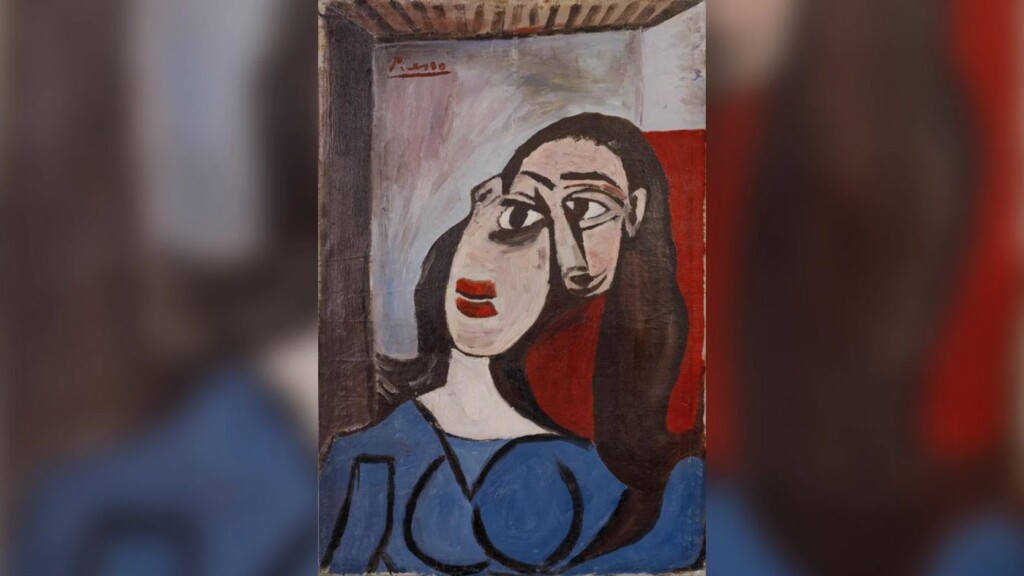
A painting that was found in a basement signed with the name “Picasso,” but that was dismissed, thrust into a cheap frame, hung in the family house, and then in a restaurant, has finally been recognized as an authentic piece by the Spanish artist.

The value is already estimated to be $6 million, but if recognized by the Pablo Picasso Foundation in Paris, it could be worth twice or thrice that much.

The painting is believed to be an asymmetrical image of Dora Maar, who was Picasso’s lover at a time when he spent a period on the Italian island of Capri, where in the 1950s, Luigi Lo Rosso, a local pawnbroker who used to comb dumps and abandoned houses for treasure, found it in the basement of an empty villa.

According to the story, reported stateside by CNN, Lo Rosso believed it to be authentic, but his wife was less impressed, and so Luigi stuck it in a frame and gave it to her as a present to her great chagrin.

Luigi’s son, Andrea, wasn’t even born at the time. He told CNN that his mother took the Picasso and another canvas covered in dust and lime her husband had found and washed them with detergent as if they were carpets.

In college, the younger Lo Rosso came upon another piece of Picasso’s depicting Dora Maar in an art history textbook, and learned he was in Capri at the time when it was made. Coming home, he told his mom they may have something special on their hands.

It took decades, but because Andrea went through the proper channels—namely treating it as if it were stolen and registering it with the patrimony police, more attention was given to it than the experts Andrea had first contracted were willing to offer.

Locked in a police vault in Milan until 2019, the quest for authentication of the work was concluded when Cinzia Altieri, a graphologist for a patrimony court in Milan, worked for several months to authenticate the Picasso signature in the corner—it was 100% real.

Andrea hasn’t stopped at Altieri’s examination, nor on the word of Luca Gentile Canal Marcante, an art expert and honorary president of the Swiss-based art restoration non-profit Arcadia Foundation, who also says it is doubtlessly authentic.

Andrea is seeking the approval of the Picasso Foundation in Paris—something his father always hoped might come to pass.

“I’m happy but let’s wait to toast, there is still one step to take before we consider this incredible story over,” Andrea Lo Rosso said.“I continue to work as I do every day in the hope that even in Paris they will be convinced of the authenticity of the painting.” Painting Found in Italian Villa Basement Turns Out to Be Original Picasso
Read More........

Back to Woodcuts, Again

Willow Flycatcher In Swamp Dogwood. Proof of Two Block Woodcut by Ken Januski.
By Ken Januski: So here it is with the unofficial start of summer (Memorial Day) and I've done just one print in 2016. Especially given what I said in last post about how much more successful I feel with prints than with watercolor it seems odd to have only done one. There are a couple of answers. One is that migration starts in March and builds to a crescendo in May. Each day there is the siren call coming from outside suggesting I check to see what has arrived, as well as what is in bloom, what insects are also in flight, etc., etc. But more important in the paucity of prints I think is procrastination. I've found a fairly easy way to experiment with watercolors, just do a small sketch on paper that is good but not so good as to be intimidating. That's the case with the Stillman and Birn sketchbooks as I've written before. So it is easy to make a non-committal foray. Though some people can do this with prints I'm sure, I haven't been able to. The few I've tried have looked exceptionally non-committal, too close to throwaway. The only print of 2016, the Black-crowned Night Heron with Yellowlegs and Short-billed Dowitcher was somewhat in this vein, but also successful. Still prints can be intimidating. And that leads to planning, which can then lead to interminable procrastination. Should I do this, or should I do that? One of the great pleasures of printmaking, when I finally do resume it each time, is that I'm no longer in dialogue with myself. Instead the physical print has something to say, often pleasantly surprising me in some way or another, and all of a sudden things flow smoothly. To quote a cliché: The Possibilities Are Endless. So now that I've proofed two colors on the woodcut above of a Willow Flycatcher in what I believe is Swamp Dogwood at Morris Arboretum I'm reminded again of how enjoyable printmaking can be once you actually get started printing, rather than just thinking (as with many things I suppose). This is an early stage. It may be hard to believe but I intend this to be a light, bright print. But I wanted black lines to function as outlines more or less. Then I wanted a light brown gray for most of the flycatcher. But in printmaking you generally need to mix your own colors and so you don't necessarily get what you wanted. This turned out to me a dark gray-blue rather than a light gray-tan. That will eventually change but it's fine for early proofing. Most of the rest will be yellow and green, at least that is my intention at the time. Of course the print will speak up soon enough and let me know how it foresees its future.Source: http://kenjanuski.blogspot.com
Read More........

Amazing Portraits Made with Screws


.Subscribe
Amazing Portraits Made with Screws by Andrew Myers California based artist, created some very unique portraits made using thousands of screws. Each portrait is made up out of about 8,000 to 10,000 individual screws, carefully placed into a sheet of plywood. Andrew Myers creates portraits using screws, which also allows the artist to get a “feel” of 3D into the work. The artist starts off with a plywood panel and covers it with pages of a phonebook (pages from the subject’s local area!) and then move.
Read More........

Girls Dancing to Music by a River, 1870

"The Mill: Girls Dancing to Music by a River", Edward Burne-Jones, 1870-1882, The Victoria & Albert Museum
Inspired by the art of the Italian Renaissance which looked to Classical subjects, this painting by Edward Burne-Jones (1833-1898) is entitled “The Mill: Girls Dancing to Music by a River.” The subject, clearly, is actually a depiction of “The Three Graces.” They’re dancing to the music of Apollo. Burne-Jones used, as models friends, and relatives of the prominent art collection Constantine Alexander Ionides. The woman on the far left, one Mary Zambaco, was for awhile, a lover of Burne-Jones. She was also Mr. Ionides’ granddaughter. It didn’t end well. In fact, in another painting of the same year, “Phyllis and Demophoon,” Burne-Jones inscribed of Zambaco, the epigraph “Dic mihi quod feci? Nisi non sapienter amavi” (Tell me, what have I done? Except that I have not loved wisely). The composition was started in 1870. But, it appears it wasn’t delivered to Ionides immediately. Burne-Jones took twelve years to finish it. Some feel that the artist developed an attachment to the painting because of his relationship with Zambaco. It was presented to Ionides in 1882 after being displayed at the Royal Academy. The inventory of Ionides’ collection as of 1882 lists that he paid £905 for “The Mill.” Source: Article
Read More........

World's largest coffee bean painting


Coffee beans are usually ground for making everyone's favorite morning drink. But they can also be put to other uses. In Russia, one million coffee beans are being used to make a giant painting. The art piece has even been registered in the Russia's Book of Records as the world's biggest. The picture, showing a face of a woman and a cup of coffee, was exhibited in Russia's Gorky Park in Moscow. The artist together withThe several assistants worked 10 days to create the picture measuring 30 square meters. editor-in-chief of Russia's Book of Records measured the painting and registered it as the biggest in the world. The previous one was made in Albania, which was 25 square meters. The creators of the painting said they had already applied to the Guinness Book of Records to register their achievement. Source; Sam Daily Times
Read More........

Da Vinci’s last painting discovered in Scottish farmhouse

Fragment of the cover of “Da Vinci's Last Commission: The Most Sensational Detective Story in the History of Art” by Fiona McLaren
A painting believed to be the last work by Leonardo da Vinci has been discovered in Scotland. The owner almost threw the old painting away, but money issues forced her to contact auctioneers. Fiona McLaren, 59, arranged a meeting with the Scottish director of Sotheby's Harry Robertson to value the picture, The People newspaper reports. "I showed it to him and he was staggered, speechless save for a sigh of exclamation,” Fiona told the newspaper. Old masters’ art experts are intrigued. Some believe the work is from the school of Leonardo and dates to the 16th century, others concede Da Vinci might have had a hand in it. “Experts have confirmed Leonardo at least did the under drawing,” Fiona McLaren said. She inherited the painting from her doctor father who received it from one of his patients. For 40 years the possible Renaissance marvel hung in the family’s London home before Fiona and her mother moved to Scotland. The painting might be 500 years old and worth millions, got covered with small stains of white emulsion paint when the McLaren house was redecorated. An examination of the painting will take place at the University of Cambridge's Hamilton Kerr Institute where experts will date and attribute the artwork. "Every time I thought to myself, 'This cannot be right,' I found more evidence that proved it was…I'm convinced without a doubt that it is a genuine Leonardo," McLaren says. Thrilled with possibility of holding Da Vinci’s masterpiece, Fiona McLaren has written a book “Da Vinci's Last Commission: The Most Sensational Detective Story in the History of Art”. Leonardo Da Vinci is widely regarded as one of the greatest artists and the greatest minds of all time. Source: SAM Daily Times
Read More........

Sotheby's brings Picasso, Miro to Moscow for 'priciest ever' show

Sotheby's brings Picasso, Miro to Moscow for 'priciest ever' show
Sotheby's on Thursday brought paintings by Picasso and Miro to Moscow for what it called its most valuable show ever in Russia, seeking wealthy buyers ahead of sales next month. The two-day exhibition at a gallery in central Moscow shows paintings including Picasso's "Tete de Femme" with an estimate of $20 to $30 million (14 to 22 million euros), and Catalan master Joan Miro's "Bonheur d'aimer ma brune". The auction house said the paintings on view in Moscow were valued at a total of more than $140 million. Moscow has joined a circuit of major world cities such as New York and Hong Kong where the top London auction houses Sotheby's and Christie's bring works for a preview ahead of sales for the convenience of wealthy clients. The Picasso and Miro paintings will be sold in New York on November 6.Paintings by Russian artists Semyon Faibisovich and Robert Falk will be sold on November 25 at a specialised sale in London, which Sotheby's said attracts mainly Russian buyers. The auction house is targeting Russian collectors who are growing in number and are the main purchasers of their national art, said Joanna Vickery, the head of Sotheby's Russian department. "The reason we're bringing them here to Moscow is that most of our buyers today are mostly based in Russia. And they're very busy. They don't always have time to travel to London for the sales," she said. "We see time and time again there's love for their own art," Vickery said of Russian art collectors, specifying that 90 percent of them came from Russia or other ex-Soviet countries. Voice of Russia, AFP.  Source: The Voice of Russia
Read More........

An Antique Collage, 18th-19th C.

Click on image to join the fun.Collage of Scraps, 18th-19th C., Germany?, The Victoria & Albert Museum
While at first glance, this looks like a single chromolithograph, it’s actually a collage which was assembled in the early Nineteenth Century from late Eighteenth Century scraps and hand-colored lithograph pieces. The different elements have been put together to create a scene of children watching a Chinese puppet show. We don’t know who created this collage, but it’s a great representation of the sort of artistic activities which people did at home. I wish we did more of this sort of thing today. Source: Stalking the Belle Époque
Read More........

The Mill: Girls Dancing to Music by a River, 1870

"The Mill: Girls Dancing to Music by a River", Edward Burne-Jones, 1870-1882, The Victoria & Albert Museum
Inspired by the art of the Italian Renaissance which looked to Classical subjects, this painting by Edward Burne-Jones (1833-1898) is entitled “The Mill: Girls Dancing to Music by a River.” The subject, clearly, is actually a depiction of “The Three Graces.” They’re dancing to the music of Apollo. Burne-Jones used, as models friends, and relatives of the prominent art collection Constantine Alexander Ionides. The woman on the far left, one Mary Zambaco, was for awhile, a lover of Burne-Jones. She was also Mr. Ionides’ granddaughter. It didn’t end well. In fact, in another painting of the same year, “Phyllis and Demophoon,” Burne-Jones inscribed of Zambaco, the epigraph “Dic mihi quod feci? Nisi non sapienter amavi” (Tell me, what have I done? Except that I have not loved wisely). The composition was started in 1870. But, it appears it wasn’t delivered to Ionides immediately. Burne-Jones took twelve years to finish it. Some feel that the artist developed an attachment to the painting because of his relationship with Zambaco. It was presented to Ionides in 1882 after being displayed at the Royal Academy. The inventory of Ionides’ collection as of 1882 lists that he paid £905 for “The Mill.” Source: Stalking the Belle Époque
Read More........

A Ball Scene, c. 1595-1605

A Ball Scene, Jacob Matham, 1595-1605, Crown Copyright, The Royal Collection, Image Courtesy of Her Majesty Queen Elizabeth II
This work of pen and brown ink is finished with a wash of brown and grey and touches of red and white chalk to add depth. The sketch is attributed to Jacob Matham (1571-1631) and it was acquired by King George III (1738-1820) around 1810, about two hundred years after it was created. The scene depicts a Renaissance-style room inhabited by an elegant party engaged in an elegant dance. As this is likely a cartoon for a later painting, the sketch is somewhat rough and displays a rather inconsistent perspective. The drawing has long been the subject of much interest, in large part because of the rather eerie appearance of some of the figures. Their ghostly look, it was discovered, owes to over-painting which changed their position—their original poses bleeding through the white gouache which was used to cover them. There’s also a problem with the signature. While the piece is signed by Matham, it is also inscribed, “Venice (vinetia), 1605.” This is problematic in that, in 1605, Matham was in Haarlem. He visited Venice in 1595, not 1605. Furthermore, the room in the composition is clearly not Venetian. Also, the size of the piece is not consistent with Matham’s other works. For these reasons, some question the veracity of the attribution to Matham. Still, it’s likely that the artist produced the piece ten years after his Venetian trip in an effort to remember what he’d seen as well as to capitalize on the growing popularity of ballroom scenes. Source: Stalking the Belle
Read More........

World Bodypainting Festival


The World Bodypainting Festival is an annual festival. From 1998 to 2010, the festival was held in Seeboden, Carinthia, Austria, near the Millstätter See, every year in July. The venue since 2011 is Pörtschach at lake Wörthersee. The World Bodypainting Festival was created in 1998 by Alex Barendregt. At the time, Barendregt was working in a local travel agency and was given the task of organising a new summer event in Seeboden. He chose body painting on a whim after seeing a photograph about it. Although the festival wasn't very popular at first, today it is the biggest annual event of the body painting culture and community. The festival is the first of its kind in the world and has become the Mecca of Bodypainting. It draws the best body painting artist from over 40 countries and models, as well as tens of thousands of visitors, from all over the world every year.
Read More........