
 India has many historical monuments, palaces and forts, some dating back to 100 AD. The pages of the Indian history have mostly been written in the Forts of India. Today, many of them are a reminder of the glory and the royal kingdoms of the past that India use to have. You have to see them to realize this fact. Most of these forts which were actually fortresses and castles to keep the enemy away. These forts and the places inside them are most fascinating. The most notable characteristics of these forts are the exquisite carvings on them that have survived over the ages and attracts visitors from all over the world. Most of the forts in India are in Rajasthan, Delhi, Madhya Pradesh and Agra. Two of these forts – the Red Fort, Delhi and the Agra Fort, in Agra are UNESCO world heritage sites. Here are some of the notable ones.
Mehrangarh Fort:
The Mehrangarh Fort, the largest in India, is situated in one of the most beautiful cities of India – Jodhpur, in Rajasthan. The foundation of this fort was laid by Rao Jodha - the Rajput ruler in 1459.Standing at 400 feet above the city of Jodhpur on a perpendicular cliff is a splendor. This colossal structure which Rudyard Kipling described as ‘the work of giants’, is made of red sand stone. Within its boundaries lie many places with intricate designs and carvings. There are seven gates leading into the fort and are called the victory gates. The museum inside the fort in one of the most well stocked museum in Rajasthan.
Red Fort:-

Built by the great Mughal Emperor Shajahan, Red Fort or the Lal Quila, became the capital of the Mughal Empire, after Enperor Shajahan shifted from the earlier capital of Agra. The walls of the fort is built in red sandstones and that is how it also got its name – the Lal Quila. This very famous citadel showcases the glorious Mughal architecture and is a UNESCO heritage site. Apart from the usual paraphernalia of the Mughal government halls for both public and private audience, it has arched domed palaces, gardens and a mosque. The public audience hall is known as Diwane Aam and the private audience hall as Diwane Khaas. It is believed that the famous diamond Kohinoor was once part of the furniture.
Gwalior Fort:-

The GwaliorFort was built by Raja Man Singh Tomar in the 15th century, covering 3 square kilometers and surrounded by sandstone concrete. It was passed on by the Tomar to the Mughuls, then to the Marathas and then to the British. It finally went to the Scindias. A temple, known as the Teli-ka-Mandir is the most famous of the many temples inside the Gwalior Fort. This fascinating Dravidian styled temple has an ornate exterior. Of the many palaces inside the fort, the Man Singh Palace is the most fascinating one. The other palaces inside the fort is the Karan Palace, the Shah Jahan Mahal, the Gujri Mahal, built by Raja Man Singh for love of his wife Mrignayani and the Jahangir Palace.
Jaisalmer Fort:-
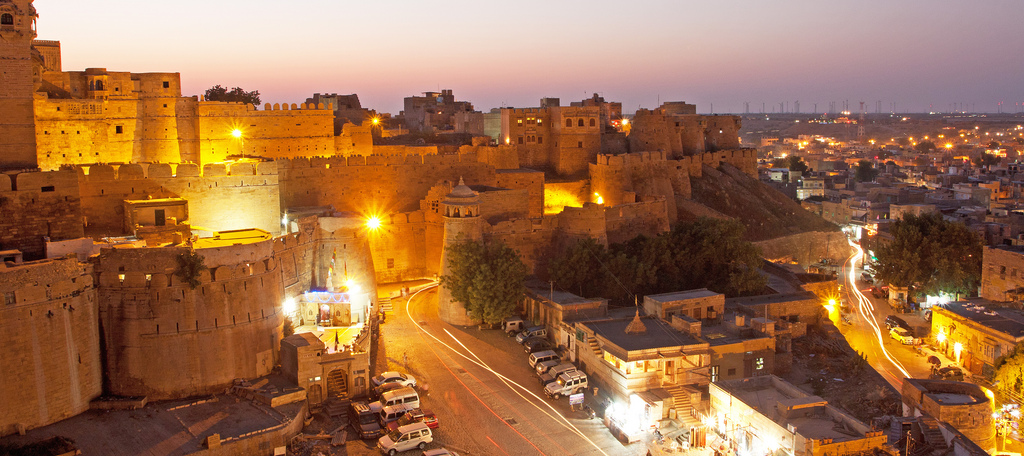
Located on a cliff top in the arid deserts of the Thar dessert, the Jaisalmer Fort is one of the largest in the world. Made of yellow sandstone, the fort becomes visible from a distant and shines when the sunlight hits the walls of the fort. With the setting sun the walls dissolves into a honey gold shade. The golden sand dunes surrounding the fort adds to the grandeur of this massive fort. During the medieval times, Jaisalmer was a trade route that made the Jaisalmer a prosperous town. The merchants and traders of Jaisalmer employed craftsmen who worked on the palaces, buildings and sandstone mansions within the walls of the fort. These palaces and buildings have ornate sculptural filigree work on windows and beautiful balconies. Some major attractions of the Jaisalmer Fort are the Raj Mahal (Royal palace), Jain temples, Laxminath temple, the four massive gateways and the Merchant Havelis.
Agra Fort:-
 Built by the great Mughul Emperor Akhbar in 1565, is a UNESCO world heritage site. The fort has only four gates but the most impressive one is the Delhi Gate. The Agra Fort has a double wall made of red sandstone. It is situated just 2 km away from the world famous Taj Mahal on the same bank of river Yamuna. You can get a beautiful view of The Taj Mahal from the balconies of Agra Fort. There are many awesome and impressive structures inside the Agra Fort, like the Khas Mahal, Diwan-i-Khass, Diwan-i-Aam, Jahangir Mahal, Moti Masjid and the Machchhi Bhawan. In the last days of Shah Jahan’s life, his son, Aurangzeb imprisoned him in the Agra Fort. Shah Jahan later died in the tower of Muasamman Burj which had a marble balcony with a stunning view of the Taj Mahal.Holiday India : Splendor Of Forts That Beautify India


