Famous monument in Artsakh vandalized


Azerbaijan has vandalized Artsakh's symbol, the We Are Our Mountains (Papik and Tatik) monument, the Geghard Foundation reports, citing social media footage.

In particular, an ethnic Talysh Azerbaijani journalist, Rahim Shaliyev, wrote about this on his microblog on X, posting a video of the monument. “The historical monument "We Are Our Mountains", considered a symbol of Artsakh, was vandalized by Azerbaijanis.” Shaliyev noted.

In the video he posted, various Azerbaijani inscriptions can be seen carved on the front of the monument.

In the comments of the journalist’s post, another user shared a video showing more Azerbaijani inscriptions carved onto other parts of the monument.

Since September 19, 2023, after Azerbaijan’s military aggression against Artsakh, followed by ethnic cleansing and the depopulation of Armenians, the We Are Our Mountains monument has been particularly targeted by Azerbaijanis. During this period, various photos and videos have repeatedly appeared online showing acts of vandalism against the monument, people taking photos next to it with the Azerbaijani flag, making insulting statements about Armenians, and leaving offensive inscriptions.

From time to time, statements are even made in Azerbaijan calling for the destruction of this Armenian monument.

In particular, this August, Gudrat Hasanguliyev, a member of Azerbaijan’s Milli Majlis and chairman of the “Justice, Law, Democracy” party, proposed demolishing the monument.

“The monument called We and Our Mountains, built in 1967 in Khankendi (referring to Stepanakert) and turned into a symbol of Armenian nationalism and separatism, must be demolished, and in its place a grand monument should be erected in honor of the Azerbaijani soldier,” Hasanguliyev said.

Azerbaijani political analyst Ramiz Yunus wrote:

“In medicine, when metastases spread throughout the human body, urgent surgical intervention is sometimes necessary. Likewise, in order for the contagious metastases of Armenian ‘miatsum’ to never again appear on Azerbaijani soil, they must be surgically removed from the root. This applies to all Soviet-era monuments, including the ugly pedestal of ‘Grandpa and Grandma,’ installed in 1967 in Khankendi (Stepanakert), which was depicted on the emblem of the so-called ‘NKR’.”

Another member of the Milli Majlis, Fazail Ibrahimli, has also supported statements about removing Armenian traces in Artsakh, especially in Stepanakert. Supporting Hasanguliyev’s proposal to dismantle the “We are our Mountains” monument, he stated that he considers important to completely remove the Armenian traces in Khankendi (Stepanakert).

“There are ugly scenes in Khankendi, and naturally, they must be removed from there…” Ibrahimli said, adding that those “who present this issue as cultural destruction are hiding their real intentions, and this should be understood as the elimination of separatist symbols.”

The “We are our Mountains” monument was erected in 1967. Its sculptor is Sargis Baghdasaryan, and its architect is Yuri Hakobyan. Located at the entrance to Stepanakert on a hilltop, the statue is made of red tuff. It symbolizes the connection between the land of Artsakh and its people. The monument depicts an elderly Artsakh Armenian couple in traditional attire—standing shoulder to shoulder, proud, steadfast, and with a firm gaze.

It is noteworthy that Azerbaijan is not restrained even by the decision of the International Court of Justice from December 7, 2021, which obliged Azerbaijan to “take all necessary measures to prevent and punish acts of vandalism and desecration affecting Armenian cultural heritage…”

Despite its policy of cultural vandalism in Artsakh, yesterday Azerbaijan was once again elected a member of the UNESCO World Heritage Committee, thereby formally committing itself to preserving cultural monuments."It is evident that Armenian religious, historical, and cultural heritage in Artsakh remains under threat. Baku has not abandoned, and will not abandon its efforts to erase Armenian traces from the settlements of Artsakh, change their Armenian character and “Azerbaijanize” them," the foundation said. Source: https://www.panorama.am/
Read More........

List of Tallest Statues in India that have become tourist destinations


By Bharat Gatha, Throughout history, various cultures have crafted statues with their inception beginning at ancient times to the contemporary era. The oldest statues date back to 30,000 years. Sculptures manifest in diverse forms, portraying a range of beings whether real or fantastical and often adorn public spaces serving as expressions of public art.
Tallest Statue in the in India and World;

As of 2024, the highest statue in the world is that of the Statue of Unity located in Gujarat, India. This colossal monument is of Sardar Vallabhai Patel, who played a prominent role in India’s independence and stands at a towering height of 182 metres (597 feet).

The statue is located along the banks of the Narmada river.

Next Top 5 statues in India;

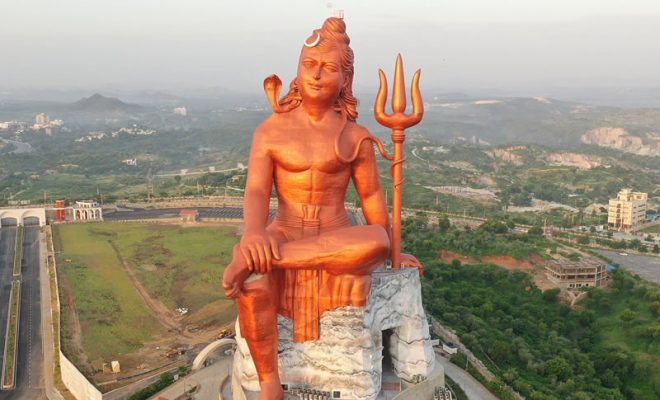
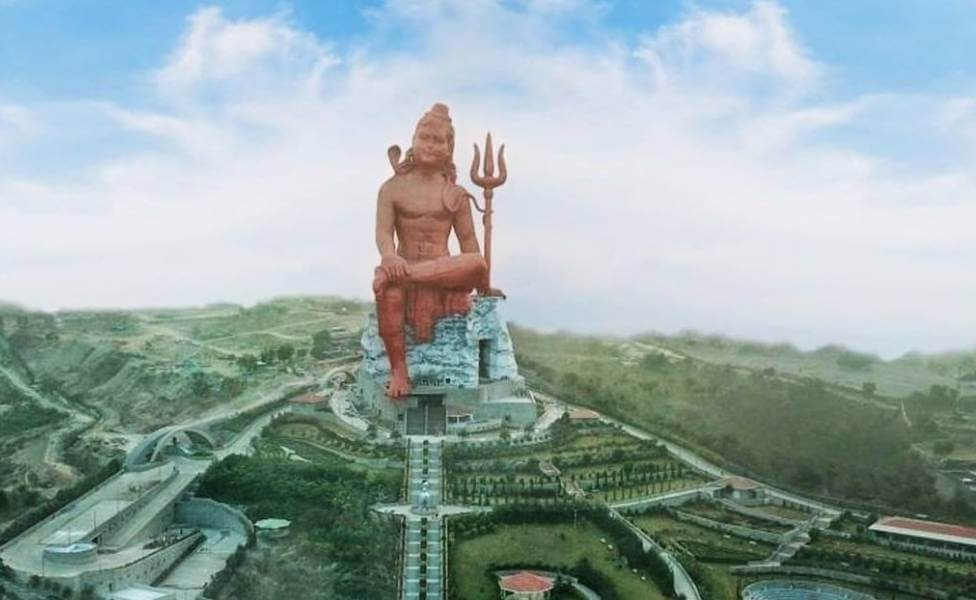
Statue of Belief (Viswas Swaroopam)


In April 2013, Indian businessman Madan Paliwal gave the instructions to build a Shiva Statue in Nathdwara, Rajasthan, at a height of 369 feet (112.4 metres). The statue was completed in August 2019. It was designed by sculptor Nagesh Kumawat.

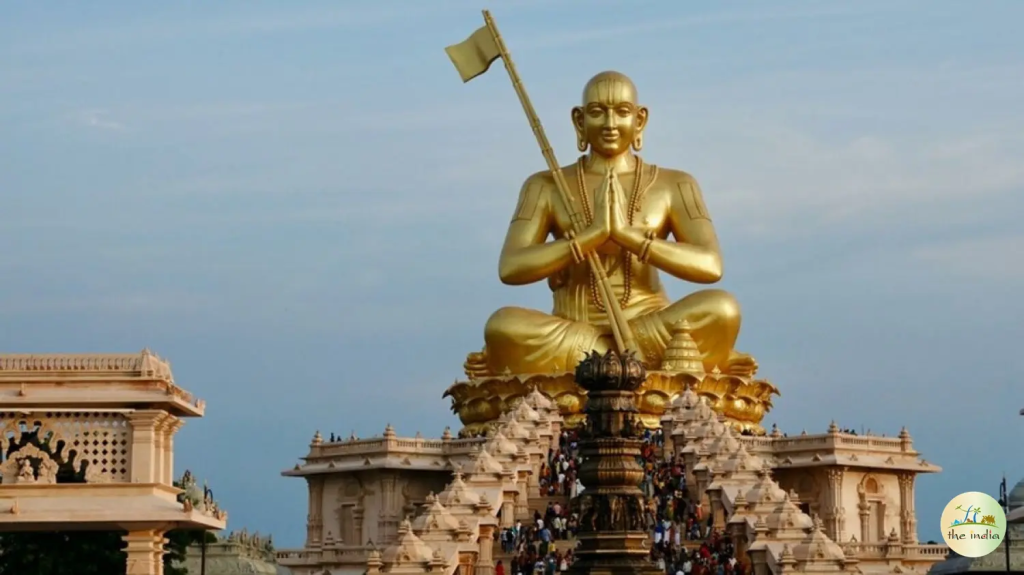
Statue of equality (Ramanuja)


The idea of this statue was conceived by ascetic Chinna Jeeyar who after getting the idea went up to architect DNV Prasad Sthapati. Construction began in May 2014 and is located at Muchintal, Telangana. The statue is a seated image of 11th century philosopher Ramanuja and reaches up to a height of 216 feet (66 metres).

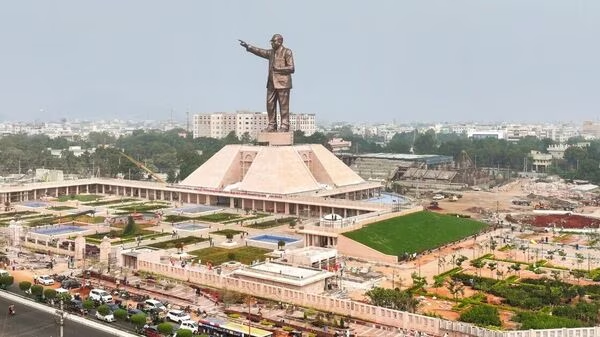
Dr Ambedkar Statue


Located at Hussain Sagar, Hyderabad, in Telangana, it is the biggest Ambedkar Statue in the country. It reaches a recorded height of 175 feet (55.34 metres). The statue is designed by Ram V Sutar alongwith his son Anil Ram Sutar.

Hanuman Statue


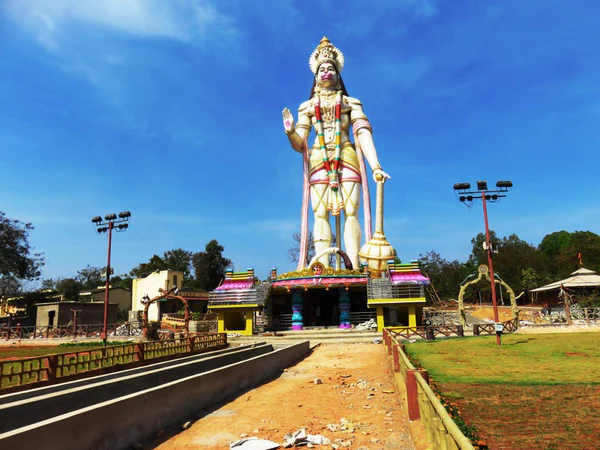
It is located along the banks of river Krishna, Andhra Pradesh. Started as a dream by Jayi, Ramanamurthy, a devotee soon received donations from his community and made it the highest Hanuman statue in India. Started in 2005 and finished in 2020, the height of the idol is 171 feet (52 metres).

Panchmukhi Hanuman Statue

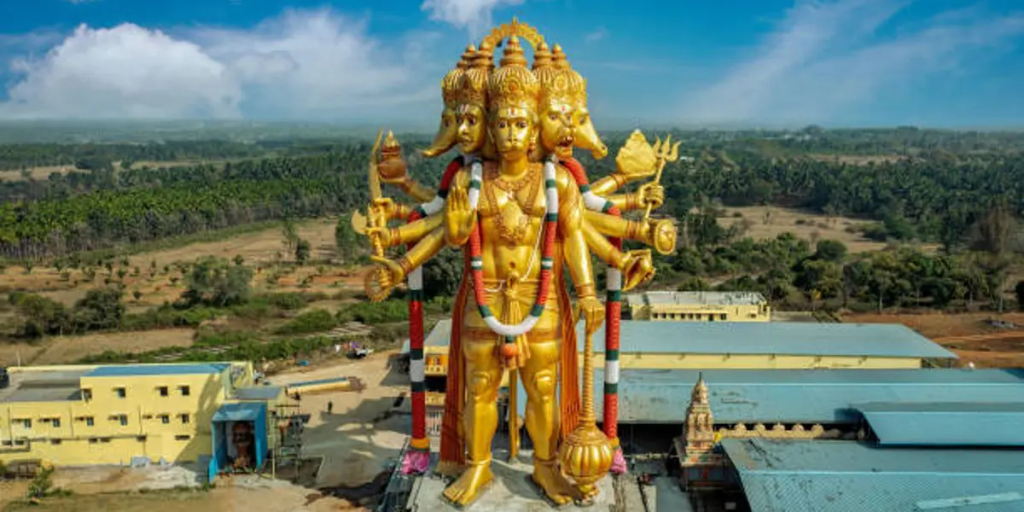
The Panchmukhi Hanuman statue is located at Bidanagere, Karnataka and is the second highest Hanuman statue in India. It is of a height of 161 feet (49 feet) and was unveiled by chief minister Basavaraj Bommai. List of Tallest Statues in India that have become tourist destinations
Read More........

The New 7 Wonders of the World

The Pyramid at Chichén Itzá (before 800 A.D.) Yucatan Peninsula, Mexico
MEXICO: Chichén Itzá, the most famous Mayan temple city, served as the political and economic center of the Mayan civilization. Its various structures - the pyramid of Kukulkan, the Temple of Chac Mool, the Hall of the Thousand Pillars, and the Playing Field of the Prisoners – can still be seen today and are demonstrative of an extraordinary commitment to architectural space and composition. The pyramid itself was the last, and arguably the greatest, of all Mayan temples.
Christ Redeemer (1931) Rio de Janeiro, Brazil
BRAZIL: This statue of Jesus stands some 38 meters tall, atop the Corcovado mountain overlooking Rio de Janeiro. Designed by Brazilian Heitor da Silva Costa and created by French sculptor Paul Landowski, it is one of the world’s best-known monuments. The statue took five years to construct and was inaugurated on October 12, 1931. It has become a symbol of the city and of the warmth of the Brazilian people, who receive visitors with open arms.
The Roman Colosseum (70 - 82 A.D.) Rome, Italy
ITALY: This great amphitheater in the centre of Rome was built to give favors to successful legionnaires and to celebrate the glory of the Roman Empire. Its design concept still stands to this very day, and virtually every modern sports stadium some 2,000 years later still bears the irresistible imprint of the Colosseum's original design. Today, through films and history books, we are even more aware of the cruel fights and games that took place in this arena, all for the joy of the spectators.
The Taj Mahal (1630 A.D.) Agra, India
INDIA: This immense mausoleum was built on the orders of Shah Jahan, the fifth Muslim Mogul emperor, to honor the memory of his beloved late wife. Built out of white marble and standing in formally laid-out walled gardens, the Taj Mahal is regarded as the most perfect jewel of Muslim art in India. The emperor was consequently jailed and, it is said, could then only see the Taj Mahal out of his small cell window.
The Great Wall of China (220 B.C and 1368 - 1644 A.D.) China
CHINA: The Great Wall of China was built to link existing fortifications into a united defense system and better keep invading Mongol tribes out of China. It is the largest man-made monument ever to have been built and it is disputed that it is the only one visible from space. Many thousands of people must have given their lives to build this colossal construction.
Petra (9 B.C. - 40 A.D.), Jordan
JORDAN: On the edge of the Arabian Desert, Petra was the glittering capital of the Nabataean empire of King Aretas IV (9 B.C. to 40 A.D.). Masters of water technology, the Nabataeans provided their city with great tunnel constructions and water chambers. A theater, modelled on Greek-Roman prototypes, had space for an audience of 4,000. Today, the Palace Tombs of Petra, with the 42-meter-high Hellenistic temple facade on the El-Deir Monastery, are impressive examples of Middle Eastern culture.
Machu Picchu (1460-1470), Peru
PERU: In the 15th century, the Incan Emperor Pachacútec built a city in the clouds on the mountain known as Machu Picchu ("old mountain"). This extraordinary settlement lies halfway up the Andes Plateau, deep in the Amazon jungle and above the Urubamba River. It was probably abandoned by the Incas because of a smallpox outbreak and, after the Spanish defeated the Incan Empire, the city remained 'lost' for over three centuries. It was rediscovered by Hiram Bingham in 1911. Source: Article
Read More........

Artist Makes Spectacular Sand Art Portraits That Sell for Thousands After Quitting His Engineering Job–LOOK

James Sun’s sand art – SWNS
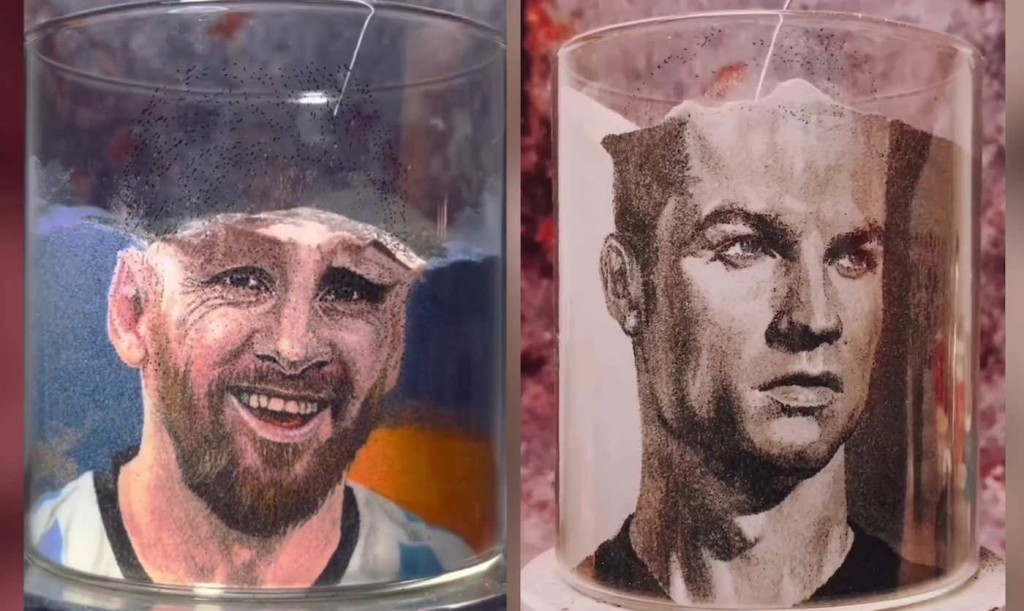
A man who quit his mechanical engineering job and is now earning thousands of dollars by creating stunning sand art portraits. James Sun was going through a difficult breakup in Toronto, Canada, when he began looking to make a new start that could reduce the stress. “I was heartbroken. I needed something to heal my heart, so I looked online, and when I saw sand art it really made me calm.” He searched online for people who made the type of art he envisioned, and spent $30,000 to travel to China and Japan to learn from the masters. The 36-year-old said he “just kept practicing”, and because he is a really big sports fan and passionate about pop culture, he started making celebrity portraits of sportsmen like Ronaldo and Messi, and TV characters like Wednesday Addams. “When I made the change everyone thought I was crazy,” he told SWNS news. “But, looking back, it was the best decision that I ever made.” James now has five employees and is also making sponsored sand art logos and character portraits forJames Sun’s sand art portrait of Wednesday Addams – SWNS
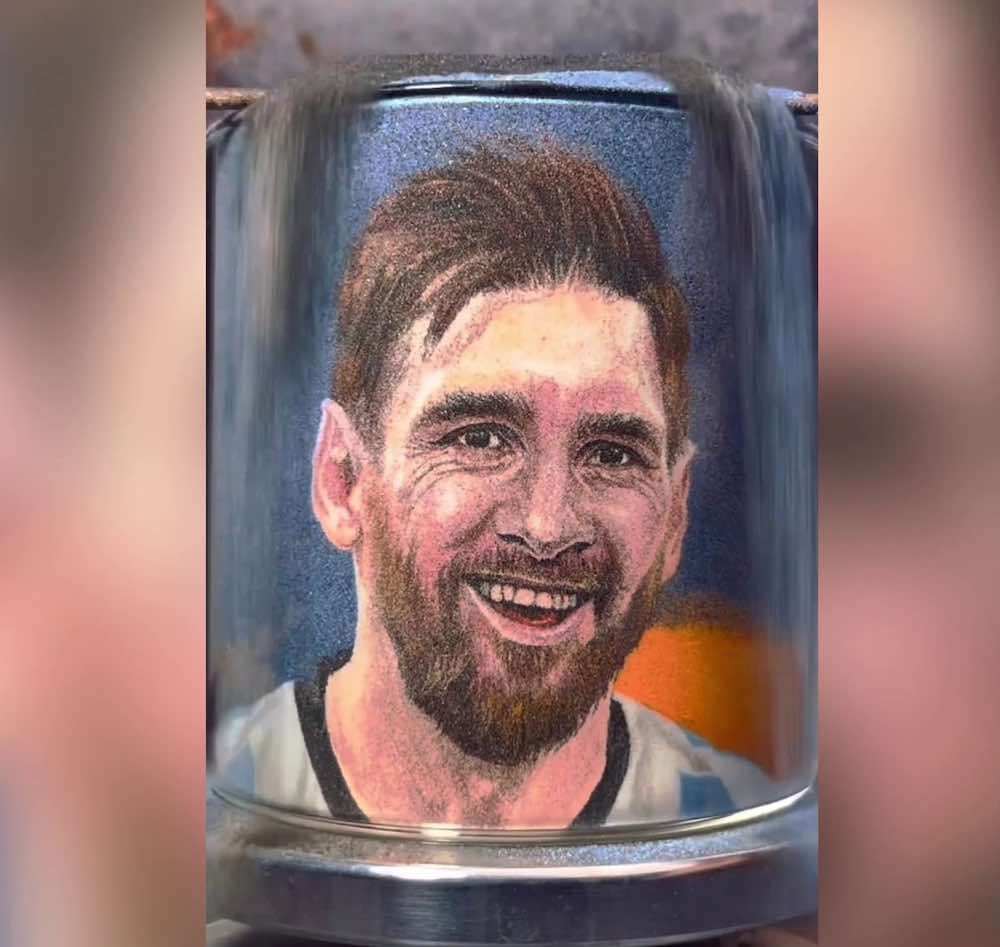
companies like BMW, F.C Barcelona, and Nickelodeon. After five years, his custom pieces now sell for $1,500, while his work for brand promotion costs upwards of $4,500. “I get the chance to work with all these great brands, and I make way more money than I used to.” It was 2018 when he started posting on TikTok. “That was when it really changed.” He amassed more than 3.4 million followers and now creates between 10 and 15 pieces a month, spending around 10 hours per day on his craft. He uses a small spoon to sprinkle colored sand into the container and a custom needle to pack it into the shape he needs. (See the process in the video below…) The pieces can take anywhere between a few hours, for the Argentina football star Lionel Messi sand art portrait by James Sun – SWNS
simpler logos, to three days for the more complex portraits. “I just do it one grain at a time,” Mr. Sun said. “I take breaks when I’m doing it, because I really need to focus, but I really enjoy it—it really relieves my stress so much.” “Mentally, it has healed me. It mended my broken heart.The doubters in his life have now turned into supporters—and James has become the master, fielding requests from others who want to learn how to do it.Artist Makes Spectacular Sand Art Portraits That Sell for Thousands After Quitting His Engineering Job–LOOK
Read More........

An accidental style

1 2 3 Next
Han Fang's Naughty Children series is popular among collectors. His works are characterized by an exaggerated style which makes his clay characters comic, almost grotesque. [China Daily]
China: The Shandong artist's works are characterized by an exaggerated style which makes his clay characters comic, almost grotesque. For this reason, his works are often described as "caricature-style" clay sculptures. They celebrate individual character and physical features, and his male figures boast large feet, hands and lips while his female figures are buxom images with plump breasts and barrel hips. It was not always that way. Han, 40, says the crucial change came in 2003. "I was working on the finishing touches to the head of a clay figure. I had almost completed it when it slipped and fell from my hands. It struck the ground and I thought it would be out of shape." Han picked it up, and to his surprise, he saw that the facial features were still intact, but they had become exaggerated - and in a way that he liked very much. It was exactly what he had been looking for. That little bit of serendipity changed his life. In 2000, Han was still a businessman in Jinan, the Shandong capital. He was running an advertising agency with an annual turnover of about 300,000 yuan ($47,640). But he shifted his career path after a trip to Henan province in 2002 and saw the porcelain products on sale in Yuzhou. A week later, he returned home with a collection of porcelain pieces and a 50,000-yuan gas kiln. He was determined to turn potter, a decision that appalled his family. "My family strongly opposed my idea of starting a clay sculpture workshop. They thought I knew nothing about the art," Han says. In spite of the opposition, Han went ahead and began making copies of antique porcelain. For several months, his workshop did not do well and Han had to offset losses by diverting the profits of his advertising agency. It got even worse in the next year as the SARS epidemic affected China and his pottery workshop lost workers. His advertising business took a hit as well. Han had to choose which he wanted to keep and he chose his workshop. He spent almost three weeks at home mulling over why his sculptures were not working. That was when that happy accident happened. "I could not describe how delighted I was. At that moment, I finally understood the nature of the clay," he says. Source: China.org.cn
Read More........

Dreaming of the Tiger Spring


.Subscribe
Dreaming of the Tiger Spring is a spring and scenic, as well as historic, location in southwestern Hangzhou, Zhejiang province, China. The water from the spring itself seeps out from quartzite and is regarded as among the finest in China. The water is popular for brewing teas, such as the local specialty, Longjing tea. Tiger spring is also the burial place of monk Jigong. The spring itself and its statues of tigers and a dreaming monk. Source: en.wikipedia.org/Image: https://upload.wikimedia.org,
Read More........

Jeu de l'Echarpe,' 1898-1904

This delicate figure of white biscuit porcelain is part of a grand table design of fifteen standing female sculptures of the “scarf dance” made famous by Loïe Fuller. The group was made between 1898 and 1904, designed by Agathon Léonard for the Sèvres porcelain factory in Paris. This fluid, elegant group was intended for display on a table or sideboard and depicts each step in Fuller’s celebrated dance—“Jeu de l'Echarpe.” Agathon Léonard was careful in the design of the group, mastering each motion and expression of Fuller’s dance. He was born Léonard Agathon van Weydeveldt of Belgian parents and trained as a sculptor, specializing in ceramic modeling. The group from which this sculpture comes is considered one of his great triumphs. The full group, fittingly entitled “Jeu de I'Echarpe,” was first shown in the Paris 1900 Exhibition at which Sèvres won a Grand Prix, and was described in the exhibition report as "elegant figures in a graceful and charming ensemble which were a great and deserved success.” This figure and its porcelain sisters typify the spirit of Art Nouveau style—undulation, movement, and the idealized female form. Léonard couldn’t have picked a better subject than Miss Fuller. The American dancer was a regular fixture at the Folies Bergère, Paris where her free-flowing, silk-clad dance caught the attention of many an artist, including the French artist Henri Toulouse-Lautrec who was also drawn to the elegant theatricality of the spectacle. The figure is marked number “12” of the group of fifteen and bears the marks “S” and “1904.” Source: Stalking the Belle Époque
Read More........

Awesome Matchstick Sculptures Art

The Scottish David Mach, 53 years old, has a passion for art and matches, so he decided to combine them and create unique works of art. Using a clay mold, David manages to create a fiberglass model of  what he wants to create, and then begins the phase of the introduction of the matches on it, one at atime. Most of his creations are made with tens of thousands of matches with color on top, imported from
Japan, and may take up to months to complete one of them. Marilyn Monroe, Gandhi, Charlie Chaplin and other characters look very realistic.icePice.blogspot.com: Awesome Matchstick Sculptures Art
Read More........

Sachin Tendulkar's Wax Statue Unveiled at SCG

A wax figure of India's legendry cricket star Sachin Tendulkar is displayed at the Sydney Cricket Ground in Sydney on April 20, 2013. The new wax figure of Tendular will be placed in the sports zone of Madame Tussauds in Sydney. AFP PHOTO / Saeed Khan (Photo credit should read SAEED KHAN/AFP/Getty Images)
Another honour comes Sachin Tendulkar's way. This time, on the cusp of his 40th birthday to be celebrated on Wednesday. On Saturday, cricket fans at the Sydney Cricket Ground in Australia will see the unveiling of Tendulkar's waxwork courtesy Madame Tussauds in Sydney.The waxwork which is expected to be a replica of the one in London, will later be displayed in the museum at scenic Darling Harbour, near the Sydney Aquarium. Members of the famous Swami Army have been invited to the official unveiling at the SCG. In an email communication, members of the support group have been told that this is a "once in a lifetime opportunity to take your photo with the life size figure of the greatest Indian cricketer ever."Tendulkar's waxwork will be displayed alongside statues of Sir Don Bradman and Shane Warne. The Mumbai master was delighted to receive another Bradman-related honour. To top it, this has come close to his 40th birthday (April 24). "It is," Tendulkar said when asked whether the honour was a fine birthday gift. "It is nice that it coincides with my birthday. It's a wonderful way to start," he said. Source: Article
Read More........

Incredible Sculptures made from Chains

Korean artist Yeong-Deok Seo creates imposing figurative sculptures using tightly knit configurations of welded bicycle chains and industrial steel chains. While impressive in their intricacy and the apparent skill required to create them, the artwork’s titles such as Infection – Anguish, Infection – Ego, and Addict, suggest the rippled surface created by the materials is not an arbitrary decision. These are figures of individuals in dispair, pockmarked with disease, the chains acting as a metaphor for the human condition. See such of Seo’s work spanning the past several years.
Read More........