List of Tallest Statues in India that have become tourist destinations


By Bharat Gatha, Throughout history, various cultures have crafted statues with their inception beginning at ancient times to the contemporary era. The oldest statues date back to 30,000 years. Sculptures manifest in diverse forms, portraying a range of beings whether real or fantastical and often adorn public spaces serving as expressions of public art.
Tallest Statue in the in India and World;

As of 2024, the highest statue in the world is that of the Statue of Unity located in Gujarat, India. This colossal monument is of Sardar Vallabhai Patel, who played a prominent role in India’s independence and stands at a towering height of 182 metres (597 feet).

The statue is located along the banks of the Narmada river.

Next Top 5 statues in India;

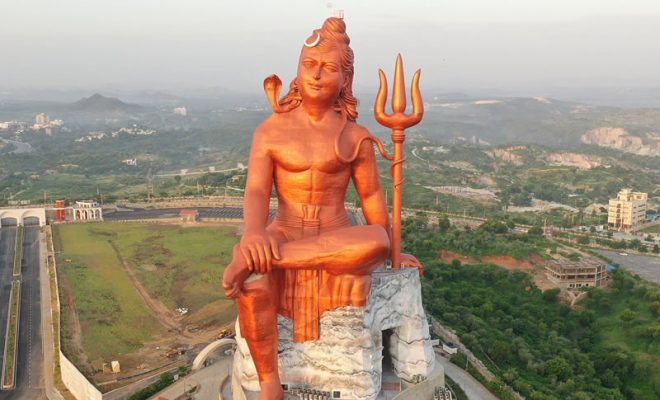
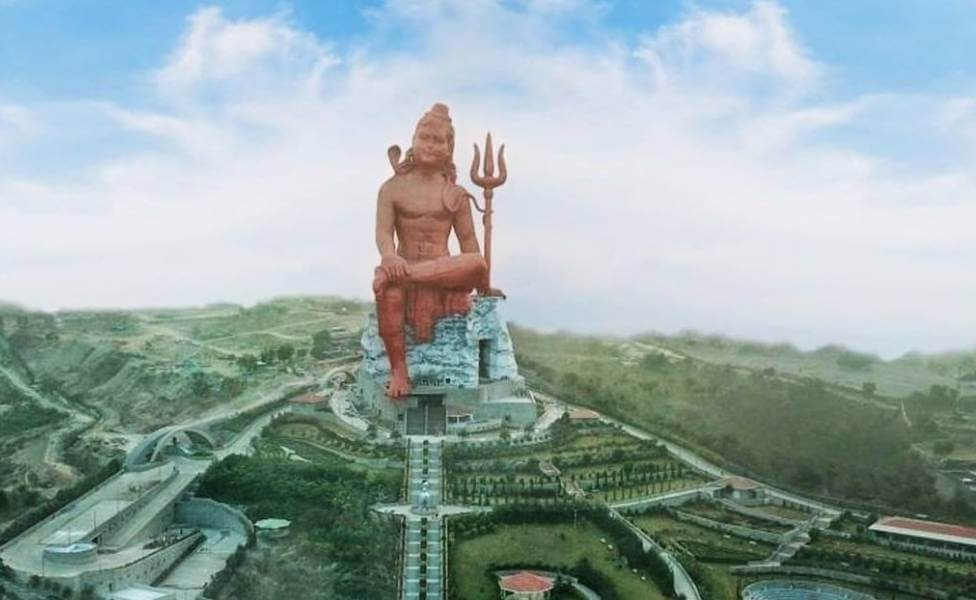
Statue of Belief (Viswas Swaroopam)


In April 2013, Indian businessman Madan Paliwal gave the instructions to build a Shiva Statue in Nathdwara, Rajasthan, at a height of 369 feet (112.4 metres). The statue was completed in August 2019. It was designed by sculptor Nagesh Kumawat.

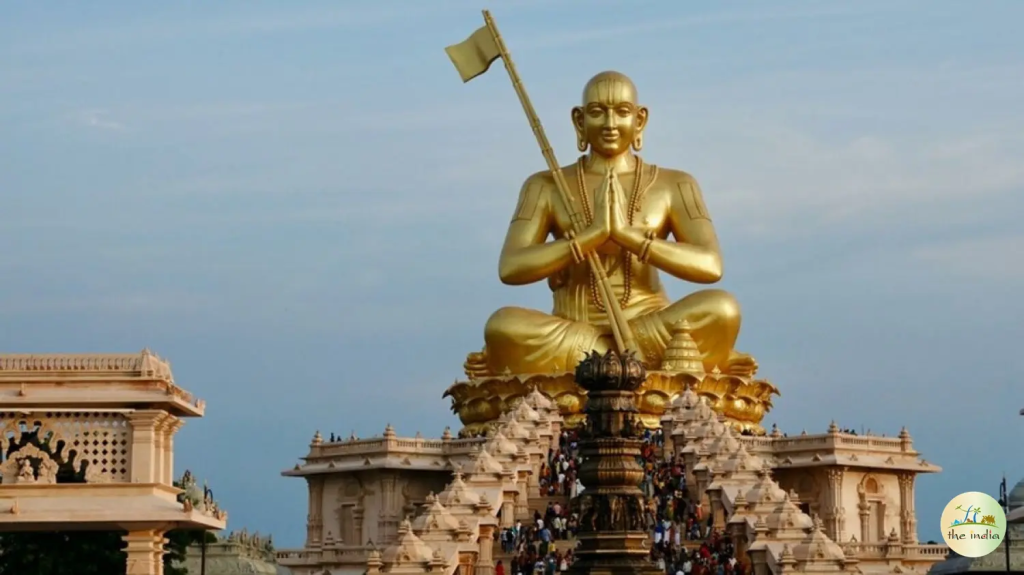
Statue of equality (Ramanuja)


The idea of this statue was conceived by ascetic Chinna Jeeyar who after getting the idea went up to architect DNV Prasad Sthapati. Construction began in May 2014 and is located at Muchintal, Telangana. The statue is a seated image of 11th century philosopher Ramanuja and reaches up to a height of 216 feet (66 metres).

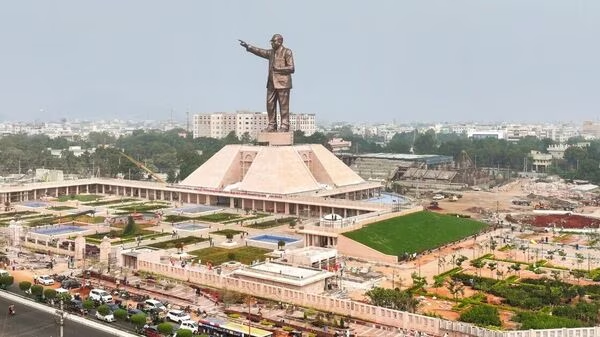
Dr Ambedkar Statue


Located at Hussain Sagar, Hyderabad, in Telangana, it is the biggest Ambedkar Statue in the country. It reaches a recorded height of 175 feet (55.34 metres). The statue is designed by Ram V Sutar alongwith his son Anil Ram Sutar.

Hanuman Statue


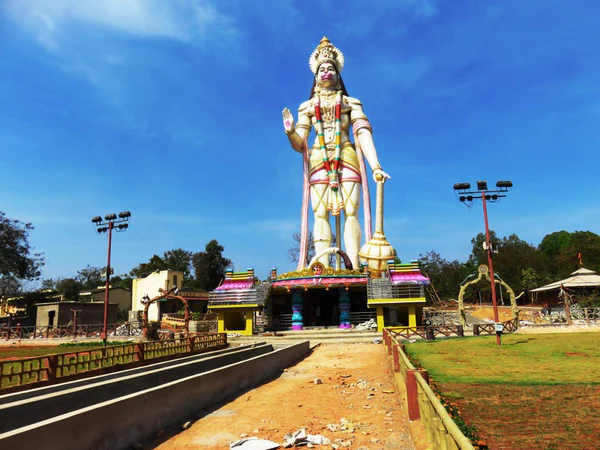
It is located along the banks of river Krishna, Andhra Pradesh. Started as a dream by Jayi, Ramanamurthy, a devotee soon received donations from his community and made it the highest Hanuman statue in India. Started in 2005 and finished in 2020, the height of the idol is 171 feet (52 metres).

Panchmukhi Hanuman Statue

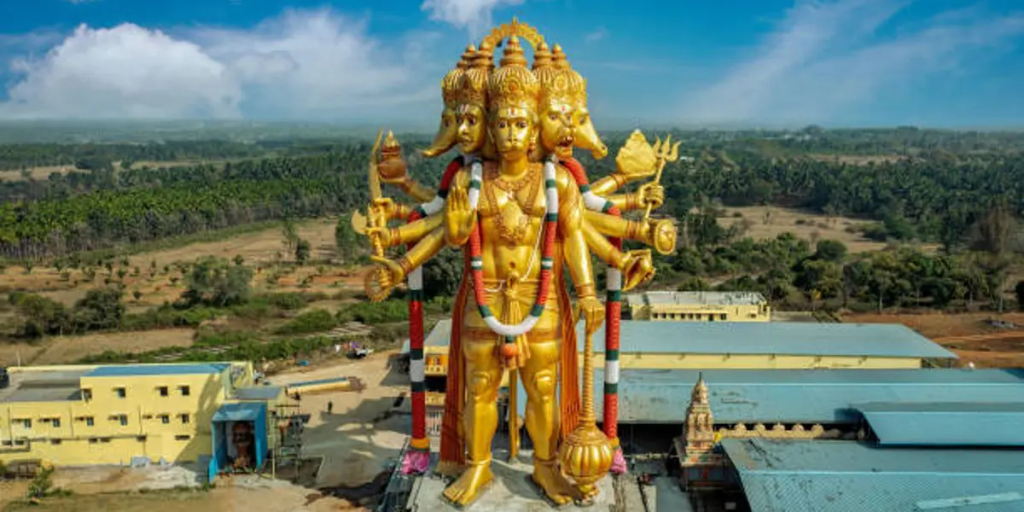
The Panchmukhi Hanuman statue is located at Bidanagere, Karnataka and is the second highest Hanuman statue in India. It is of a height of 161 feet (49 feet) and was unveiled by chief minister Basavaraj Bommai. List of Tallest Statues in India that have become tourist destinations
Read More........

Amazing vibes of the Music & Dance of Rajasthan

Posted by jinson, The people of Rajasthan live life to the hilt. After hard work under the scorching sun rays and on the rocky terrain whenever they take time off, they let themselves go in gay abandon. There is dancing, singing, drama, devotional music and puppet shows and other community festivities which transform the hardworking Rajasthanis into a fun-loving and carefree individual. Each region has its own folk entertainment, the dance styles differ as do the songs, interestingly enough, and even the musical instruments are different.  

Rajasthani music is very famous not only in India but also in the world. Music & dance are deeply integrated in Rajasthani Life. The stillness of the desert evening and the upsurge of life in the short-lived rainy season or spring are filled with soulful, full-throated music and rhythmic dance. Instruments such as Sarangi, Kamaycha, Satara, Nad, and Morchang create a wide range of lightning and melodious sound in accompaniment to the music of the Bhopas, Kalbeliyas, Langas and the Mananiyars. Professional performers like the Bhatts, Bholis, Mirasis, Nat, Bhands are omnipresent across the state.
They are patronised by the villagers who participate actively in the shows put up by these travelling entertainers. Their amazingly rich music has an extraordinary full individually, tradition and exotic flavour, which gives a distinctive feature and quality to their musical sounds. They have songs for every occasion with rich emotional content, almost an endless variety of tunes, quite a few delightful dance forms, and a large number of musical instruments, all a collective creation of the folks which is retained by them in its traditional form and character and passed from one generation to the other.

Rajasthani dances are a spectacular celebration of life and colour. The Thar Desert of Rajasthan gets life with its musicians and dancers, which are simple expressions of celebrations and festivity. The dancers, the dances and costumes have made Thar the most colourful desert in the world. Each region adding its own form of dance styles and performers, there are dances that follows a lineage of age old traditions, adhere to religious significance, display their daring attitude as well as complimenting various fairs and festivals.

Fire Dance: The Jasanthis of Bikaner and Chum are renowned for their tantric powers and this dance is in keeping with their lifestyle. A large ground is prepared with their live wood and charcoal where the Jasnathi men and boys jump on to the fire to the drum beats. The music gradually rises in tempo and reaches a crescendo; the dancers seem to be in a trance like state.

Ghoomer Dance: This is basically a community dance for women and performed on auspicious occasions. Derived from the word the “Ghooma”, this is a very simple dance where the ladies move gently, gracefully, in circles.


Giat Ghoomer: This one is one of the many dance-forms of the Bhil-tribal. Performed during Holi festival this is among a few performances where both men and women dance together.
Chari Dance: This is popular in the Kisherigarh region and involves dancing with a Chari, or pot, on one’s head. A lighted lamp is then placed on the pot.

Kachchi Ghodi: This is a dance performed on dummy horses. Men in elaborate costumes ride the equally well decorated dummy horses. Holding naked swords, these dancers move rhythmically to the beating of drums. A singer narrates the exploits of the Bavaria bandits of Shekhawati.


Drum Dance: This is a professional dance-form from Jalore. Five men with huge drums round their necks, some with huge cymbals accompany a dancer who holds a naked sword in his mouth and performs in his mouth and performs vigorously by twirling three painted sticks.

TerahTali: Performed by the female dancers while sitting, Terahtali is one of the fabulous dance forms. In this the women ties little brass discs called ‘manjeerans’ with long strings to their hands, arms, wrists, waists, and elbows. While their male partners sing and play ‘tandoora’, the women with manjeerans create a strong rytham with perfect balanced dance moves.


Music


Ragas : Folk music is the basic style of Rajasthani music, Also, different Raga and various instruments are other essential factors which form a fantastic @ unique music culture of Rajasthan. Bilawal, Kafi, Desh, Khamaj and Peelu are some ragas, most widely used in Rajasthani folk songs. Some in their pure forms and others in combinations. Many folk songs are tuned in Bilawal and Kafi. The folk songs of Rajasthan have maintained the elements of Indian classical music despite the fact that they are freely composed and sung, without any specific rules. Classicism in music have been framing and improving its form with the help of folk-songs.

Maand: Rajasthan's most sophisticated style of folk music and has come a long way from the time it was only sung in royal courts, in praise of the Rajput rulers. Professional singers still sing the haunting ballads of Moomal Mahendra, Dhola-Maru and other legendary lovers and heroes.

Instrument: The Thrilling melody of Rajasthan sounds in variety of delightful primitive instruments. The stringed variety is the mixture of Sarangi, Morchang, Ektara Rawanhatta and Kamahacha. Then Percussion instruments are in all shapes & sizes like huge Nagara( giant Drums) and Dhols to the little drums. Daf and Chang are the instruments which are mostly played in Holi.

Folk music of Rajasthan depicts multiple moods & shades including lonliness of lovers, their reunion, inter-personal relationship, laughter, joy, happiness & faith. This folk music also serves as educational purpose.Holiday India : Amazing vibes of the Music & Dance of Rajasthan
Read More........

Holiday India : Things To Experience While Visiting India

Any visitor to India is stunned by the richness of the land, by its lush beauty and exotic architecture. By its ability to overload the senses with the pure, concentrated intensity of its colors, smells, tastes, and sounds. Home to more than one billion people, this subcontinent bristles with a mix of ethnic groups, which translates into an intoxicating cultural cocktail for the traveller. Experience the Spiritual, Adventurous, Wild, Ancient, Unexplored - the Real India.

The Spiritual India:- India, known as the land of spirituality and philosophy, was the birthplace of three world religions, Hinduism, Buddhism and Jainism. The most dominant religion in India today is Hinduism and about 80% of Indians are Hindus. Spirituality and mystical charm have always drawn people from all over the world to India. As the world becomes increasingly capitalistic and materialist, the quest and urgency for spirituality grows more and more. The traditional Indian way of life has helped in the evolution and growth of Spiritualism. Arts like Yoga, Meditation and Ayurveda coupled with religion have played an important role in the evolution and existence of spirituality in India.

The Adventurous India:-Given the various geographical features like the mountain ranges, valleys, desert regions, tropical rain forests, fertile plains and the coastal regions, makes India one of the most attractive adventure destinations in the world. You may say, it is a warehouse of adventure. Whether it is a safari in a nature reserve, a camel ride through the desert or a trek through the mountains, India has a number of exciting and sensational places to offer in its network of adventure destinations. The islands of Andaman and Nicobar in the Bay of Bengal and Lakshadweep in the Arabian Sea are virtually un-spoilt and are some of the best spots for scuba diving and snorkeling.
The Wildlife of India

India is home to a rich diversity of wildlife supplemented by an equally rich variety of flora and fauna. The sight and sounds of a majestic elephant, a peacock’s dance, the stride of a camel, the roar of a tiger are unparalleled experiences in themselves. Watching birds and animals in their natural habitats is an experience in itself. The immense heritage of wildlife in India comprises of more than 70 national parks and about 400 wildlife sanctuaries including the bird sanctuaries. A paradise for the nature lovers, these forest areas are also crucial for the conversation of the endangered species like the Leopard, Lion, Asiatic Elephant, the Bengal tiger and Siberian Crane. Spread across the length and breadth of India, these reserves and forest areas, the Indian Wildlife circuit is an Incredible treat, unmatched by any other experience.

The Ancient India:- India is a diverse country steeped in history. Its past has seen a melting pot of different religions, rulers and empires -- all of which have left their mark on the countryside. Many historical places in India are listed as World Heritage sites due to their cultural importance. Visit popular historical places in India and take a trip back in time to ancient India. You'll marvel at the architecture of what are some of the most stunning and captivating historical attractions that India has to offer. Not surprisingly, the spellbinding Taj Mahal tops the list of India's best historical destinations. India also has some evocative, once powerful but now abandoned cities, which are architectural masterpieces. Incredible ruins, thousands of ancient temples, impressive deserted cave temples, immense forts, serve as a reminder of India's tumultuous history.
The Unexplored India 

From Kashmir in the North to Kanyakumari in the South, India has ample places, still left unexplored. It is an enchanting land for all seasons, from the snow clad mountains on one side, towards the desperate hot deserts which role down in the lap of cool coastal plains. While moving along the snow clad passes on winding mountain paths in Himachal Pradesh one can observe the landscape changing at every turn. Explore the secluded beaches in the Northern tip of Goa. Northeast India is Nature's own country-by and large, it is unpolluted, unvarnished and holds on to an aura of innocence. Khasi Hills nestled comfortably in the sub-Himalayan hill ranges of the northeastern region of India. See the pristine and quaint beach of Gokarna in North of Karnataka. The beach resembles, "Om", the Sanskrit symbol for the invocation, that is believed to have created the Universe.

The Art and Culture of India:- India's languages, religions, dance, music, architecture, food and customs differ from place to place within the country, but nevertheless possess a commonality. India is the only country in the world to have so many religions and beliefs. Indian traditional art forms are the most evolved and cultured systems in the world where carnatic music, classical dance styles like Bharathanatyam, Kuchipudi, Kathakali, Kathak, Manipuri, etc.. Indian classical arts like classical music, classical dance, theatre and drama possesses traditions and history dating back to several centuries. Indian culture is rich, diverse and unique in the whole world as the people in the country belong to different religions, castes, creed; speak different languages. Celebrate different festivals with great enthusiasm and zeal. Crafts and Handicrafts are an integral part in the life of an Indian. In the Western world, special artists create craft objects and they are considered as luxury items. Holiday India : Things To Experience While Visiting India
Read More........

Wander Into The Mist Of Lepchajagat , Darjeeling

Lepchajagat, is an offbeat destination in the district of Darjeeling in West Bengal. It lies on the road connecting Darjeeling (19 km) with Mirik. Located on a hill slope covered with rhododendron and oaks forests, Lepchajagat offers a rich diversity of nature. It is a place for those who enjoys serenity and calmness far from madding crowds, hotels, markets of popular hill stations. The town of Darjeeling is visible from this place and an illuminated Darjeeling in the night makes an eye-catching view.
The sight of the sunrise over Kanchenjunga is awe-inspiring. I often wonder why people visits Darjeeling and not Lepchajagat ..... But then, this is the reason you would enjoy this place so very much. The curious play of colors in the sky strikes you straight away. Partly black and white clouds drift from one hill to another. The other places close by that are not to be missed include Jorepokri, Mirik and Pashupati.
Lepchajagat, although a mere 16 km away from Darjeeling, this hamlet somewhat miraculously has been able to maintain its pristine atmosphere. The weather here is unpredictable - sunny spells interfered most of the times by the foggy surroundings. The enchanting thick foggy weather gives one a mystic feel. If ‘doing nothing’ is your holiday motto then Lepchaghat is the ideal destination for you. The skyscraping trees, clean mountain air and unpretentious natural beauty of Lepchaghat mesmerize the onlooker. The meaningless wandering in the village nestled in fog and mist also leaves a mark on one’s memory forever.
The view of Kanchenjunga turning red during sunrise is unforgettable. Watch the sun slowly come out and as soon as the crimson rays fell on the Kanchendzonga range, the magic begins. For the next 30 minutes or so will be your turn to get mesmerized by the amazing beauty of the mighty Himalayas. Slowly the snow peaks turn from pink to orange to gold and then the whole range come out in its dazzling white attire. The Kanchendzonga, Kabru, Kumbhakarna all are tantalizingly close, looking ethereal against a clear blue sky. No matter how many times you have watched this spectacle, this always comes up with an unprecedented beauty.
Lepchajagat could also be in a different mood the very next day. You may find it draped in thick fog and the visibility was almost zero and may realize that Lepchajagat with its misty mood is even more attractive than in a sunny day. So the next time you are in Darjeeling make sure to visit this sleepy serene hamlet.Holiday India : Wander Into The Mist Of Lepchajagat , Darjeeling
Read More........

Puri - The Home of Lord Jagannatha

Puri – The most sacred pilgrim center for Hindus in India. It is famous for being the abode of Lord Jagannath, Goddess Shubhadra and Lord Balarama. The main attraction of Puri is the temple of Lord Jagannath and the beach. The beach is famous for swimming and spending holidays. Most of the tourists come to Puri for Darshan at the temple of Lord Jagannath.

Jagannath Puri is one of the Char Dham of India. The Ratha Yatra, also known as Chariot festival, is one of the most famous festival in the Orissa. It is celebrated on a wide scale where devoteed from all across the world flock to Puri to participate in it. It is considered to be holy if a person touches the rope of the chariot while it is being drawn. Several priests visit the place during this time. It is beautiful to watch the sunrise and sunset there. The Prasad is called “Khaja” which is very tasty.

The most significant ritual associated with the Rath Yatra is the Chera Pahara. During this festival, the Gajapati king wears the outfit of a sweeper and cleans the road before the chariot with a gold handled broom and then sprinkles sandalwood water and powder with utmost devotion. This ritual shows that there is no difference between Raja Gajapati and humble sweeper.

One striking feature about Puri is that foreigners are not allowed to enter the temple.Numerous foreigners have tried to enter and visit this famous Dham but was not able to do so. The temperarture remains humid throughout the year as it is situated beside the sea. Holiday India : Puri - The Home of Lord Jagannatha
Read More........

Splendor Of Forts That Beautify India

India has many historical monuments, palaces and forts, some dating back to 100 AD. The pages of the Indian history have mostly been written in the Forts of India. Today, many of them are a reminder of the glory and the royal kingdoms of the past that India use to have. You have to see them to realize this fact. Most of these forts which were actually fortresses and castles to keep the enemy away. These forts and the places inside them are most fascinating. The most notable characteristics of these forts are the exquisite carvings on them that have survived over the ages and attracts visitors from all over the world. Most of the forts in India are in Rajasthan, Delhi, Madhya Pradesh and Agra. Two of these forts – the Red Fort, Delhi and the Agra Fort, in Agra are UNESCO world heritage sites. Here are some of the notable ones.

Mehrangarh Fort:

The Mehrangarh Fort, the largest in India, is situated in one of the most beautiful cities of India – Jodhpur, in Rajasthan. The foundation of this fort was laid by Rao Jodha - the Rajput ruler in 1459.Standing at 400 feet above the city of Jodhpur on a perpendicular cliff is a splendor. This colossal structure which Rudyard Kipling described as ‘the work of giants’, is made of red sand stone. Within its boundaries lie many places with intricate designs and carvings. There are seven gates leading into the fort and are called the victory gates. The museum inside the fort in one of the most well stocked museum in Rajasthan.

Red Fort:-
Built by the great Mughal Emperor Shajahan, Red Fort or the Lal Quila, became the capital of the Mughal Empire, after Enperor Shajahan shifted from the earlier capital of Agra. The walls of the fort is built in red sandstones and that is how it also got its name – the Lal Quila. This very famous citadel showcases the glorious Mughal architecture and is a UNESCO heritage site. Apart from the usual paraphernalia of the Mughal government halls for both public and private audience, it has arched domed palaces, gardens and a mosque. The public audience hall is known as Diwane Aam and the private audience hall as Diwane Khaas. It is believed that the famous diamond Kohinoor was once part of the furniture.


Gwalior Fort:-
The GwaliorFort was built by Raja Man Singh Tomar in the 15th century, covering 3 square kilometers and surrounded by sandstone concrete. It was passed on by the Tomar to the Mughuls, then to the Marathas and then to the British. It finally went to the Scindias. A temple, known as the Teli-ka-Mandir is the most famous of the many temples inside the Gwalior Fort. This fascinating Dravidian styled temple has an ornate exterior. Of the many palaces inside the fort, the Man Singh Palace is the most fascinating one. The other palaces inside the fort is the Karan Palace, the Shah Jahan Mahal, the Gujri Mahal, built by Raja Man Singh for love of his wife Mrignayani and the Jahangir Palace.


Jaisalmer Fort:-
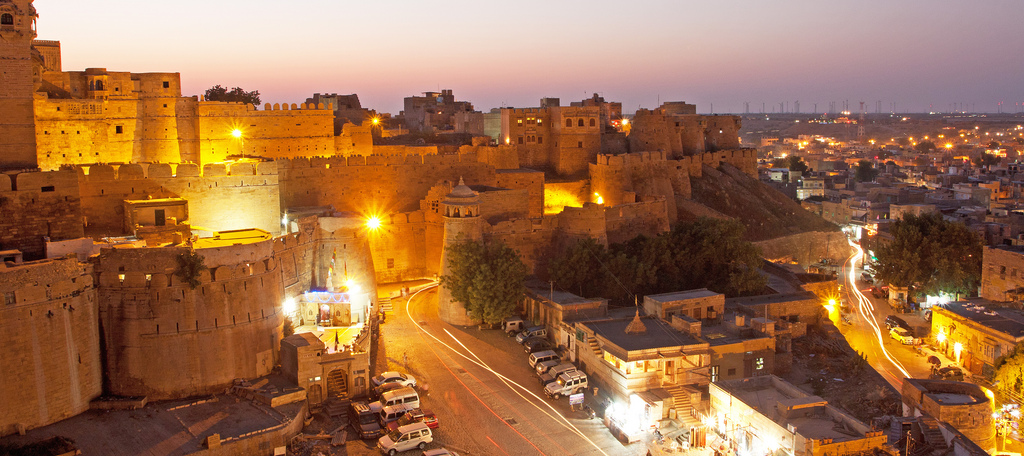
Located on a cliff top in the arid deserts of the Thar dessert, the Jaisalmer Fort is one of the largest in the world. Made of yellow sandstone, the fort becomes visible from a distant and shines when the sunlight hits the walls of the fort. With the setting sun the walls dissolves into a honey gold shade. The golden sand dunes surrounding the fort adds to the grandeur of this massive fort. During the medieval times, Jaisalmer was a trade route that made the Jaisalmer a prosperous town. The merchants and traders of Jaisalmer employed craftsmen who worked on the palaces, buildings and sandstone mansions within the walls of the fort. These palaces and buildings have ornate sculptural filigree work on windows and beautiful balconies. Some major attractions of the Jaisalmer Fort are the Raj Mahal (Royal palace), Jain temples, Laxminath temple, the four massive gateways and the Merchant Havelis.


Agra Fort:-
Built by the great Mughul Emperor Akhbar in 1565, is a UNESCO world heritage site. The fort has only four gates but the most impressive one is the Delhi Gate. The Agra Fort has a double wall made of red sandstone. It is situated just 2 km away from the world famous Taj Mahal on the same bank of river Yamuna. You can get a beautiful view of The Taj Mahal from the balconies of Agra Fort. There are many awesome and impressive structures inside the Agra Fort, like the Khas Mahal, Diwan-i-Khass, Diwan-i-Aam, Jahangir Mahal, Moti Masjid and the Machchhi Bhawan. In the last days of Shah Jahan’s life, his son, Aurangzeb imprisoned him in the Agra Fort. Shah Jahan later died in the tower of Muasamman Burj which had a marble balcony with a stunning view of the Taj Mahal.Holiday India : Splendor Of Forts That Beautify India
Read More........

The Dazzling Lake of Rewalsar in Himachal Pradesh

Rewalsar Lake is a mid-altitude lake located in the Mandi district of Himachal Pradesh INDIA. Located on a mountain spur, 12 miles (19 km) or about an hour's drive from Mandi, brings you to this sacred dark jewel-like lake. With water, woodland and high hills, it presents a variety of natural beauty. Rewalsar is sacred to adherents of three major Dharma religions - Hinduism, Buddhism and Sikhism.
The Hindu history of Rewalsar is found in Sakand Puran. Rishi named Lomas was searching for place to worship. He traveled and climbed the top of Drona mountain, from the top of mountain he saw a beautiful lake surrounded by beautiful trees, flowers and birds. He decided to meditate at the bank of the lake. He meditated here and according to Skand Purana Lord Shiva and Mata Parvati blessed him by telling the secrets of this place where all the Devatas and Ganas are in the form of flowers, floating lands and trees.
The famous Rewalsar lake ('Tso Pema' to Tibetans) is associated with Padmasambhava (also known as Guru Rinpoche), who is recognized as the second Buddha of this age. One version of a legend has it that the king of Mandi had Padmasambhava burnt alive after rumours that the Guru had attempted to teach his daughter the Dharma, which was not accepted then. The pyre burned for a full week, with great clouds of black smoke arising from it, but after a week, a lake appeared at the spot where he was burnt and Padmasambhava manifested himself as a 16 year old boy from within a lotus in the middle of the lake. The king, repenting his actions, married his daughter with Padmasambhava. It was from Tso Pema that Padmasambhava went to Tibet to spread Vajrayana Buddhism.
The tenth Guru of Sikhs, Guru Gobind Singh visited Rewalsar to consult with kings of the Hill states seeking support against Aurangzeb. He stayed at Rewalsar for a month The place is particularly sacred to Namdhari Sikhs due to its mention in Sau Sakhi as a sanctuary.This gurudwara was built in 1930 by Raja Joginder Sen of Mandi.
A country road winds up to the lake and right around the lakeshore, where you’ll find the ochre-red Debung Kagyud Gompa, with an active thangka (Tibetan cloth painting) school and a large central Sakyamuni statue. Just beyond is the pale blue gurdwara built in honour of Gobind Singh in the 1930s. In the other direction, the Tso-Pema Ogyen Heru-kai Nyingmapa Gompa has artful murals .Uphill from the lake is the towering white Zigar Drukpa Kagyud Institute, with outsized statues of Tantric deities. On the far side of the lake are a number of small Hindu temples dedicated to the sage Rishi Lomas, who was forced to do penance here as a dedication to Shiva. It is firmly believed that those who visit this holy lake and pays reverence towards Acharya Padmasambhav, his or her life certainly become meaningful by gaining wisdom, and eventually the state of Enlightenment. Holiday India : The Dazzling Lake of Rewalsar in Himachal Pradesh
Read More........

Single window system aims to ‘elevate’ Nagaland tourism

Welcome gate christened ‘Unity Gate’ at Patkai Bridge junction NH-29 onwards towards Kohima. (Morung Photo)
Touted as one of the most critical aspects and approach to ‘elevate the tourism’ industry, the State’s Tourism department is planning to introduce the “Nagaland Tourism Department Single Window System (NTSW).”

As per the Nagaland Tourism Policy (NTP) 2024, this system can be implemented by using Information Technology (IT) as an enabler to integrate all tourism related processes of the Department under a single platform.

This will facilitate and monitor all tourism related activities in Nagaland through a single online mobile app based integrated end-to-end platform, it said.

Among others, the system will register all tourism related businesses - home stays, tour operators, experience providers etc with the Department and regulate or monitor their activities.

Tourists can easily access any information, plans and book trips completely online, easily and conveniently while it would be “ease of doing business” for tourism based entrepreneurs, the NTP maintained.

Accurate tourism, e-Governance solution, facilitation and improved revenue generation are some of the benefits listed.

The NTSW is among the host of tourism infrastructure and services development the NTP envisaged to boost tourism in Nagaland.

In addition, the NTP called for introduction of the Nagaland Registration of Tourist Trade Act to provide for regulation and promotion of tourism by way of registration of persons dealing with the tourists and other related matters to ensure a coordinated and regulated development of the sector.

Facilitation and accommodation
The State’s policy also suggested for setting up proper Tourist facilitation amenities at all State’s entry exit points noting that a visitor’s “first impression” is very much based on at the facilities available at airport, railway and bus stations.

These points are especially important as permits are required to enter the State, it said.

It will be the State Policy to provide transport services, information counters, telephone and internet facilities etc which will contribute in generating a tourist friendly atmosphere, the NTP said.

Meanwhile, noting that hotels are vital segment of the tourism infrastructure, the NTP said that the State would endeavour to come out with list of Government approved or registered hotels and lodges under the State Tourist Trade Act.

These entities would be expected to function within the laid down norms/guidelines of the Government and be subjected to regular inspection by a Committee, comprising of the Department of Tourism, Food and Sanitation, and the Police Administration, it informed.

These approved hotels will feature in all the publication of the Department in the print as well as in the electronic media in India and abroad and will be eligible for incentives announced by the Government from time to time, it added.

The NTP also plans to introduce Home stays or Special Paying Guest Scheme at some selected places or villages for providing affordable and hygienic accommodation for both domestic and foreign tourists.

Selection of such places will be on need basis requirement and tourist potential area of the place. Appropriate regulatory guidelines will be brought out in this regard, it added.

Reputed private entrepreneurs from outside the State will also be encouraged in the setting up of and management of quality and standard tourist infrastructures on a joint ventures basis, it added.

It further asserted that all Tourist Lodges in the districts & sub- divisions should not be leased out to any sources or agencies.

Transport and Inland Waterways
The NTP noted that in the absence of other means of transport within Nagaland such as Railways, Waterways etc, the State needs a huge boost in the development of transport infrastructures.

The Department aims to address this by ensuring comfortable transportation options like coaches and taxis for tourists, whose services are mostly run by out-of-state companies, leading to revenue outflows, it said.

Accordingly, to enhance the tourism transportation sector, the NTP stated that the Department through NIDC, NEDFI etc aims to introduce suitable schemes to encourage private tour operators/travel agents to operate tourist taxi/coaches etc, within the State.

The Government may also take into account the possibility of procuring high-end tourist vehicles and minibuses on a subsidised model that may be run by locally registered tourism.

It also underscored to have a competitive pricing policy and stated that efforts shall be made to regulate such practices in collaboration with the relevant stakeholders.

The NTP also noted that developing inland waterways for tourism in Nagaland offer a wide range of opportunities as well as provide a sustainable, cost-effective, and environmentally friendly way to develop tourism.

To this end, the Department would aim to identify suitable rivers or water bodies for developing inland waterways for guided boat tours and collaborate with engineering and environmental experts to design sustainable and eco-friendly waterway routes.

Tour Operators and Agents
The NTP also plans to issue special permits to tour operators/travel agents who are registered with the Tourism Department in the interest of promoting tourism.

These travel agents and tour operators will be granted all possible assistance from the State Government for accommodation, transportation, travel permits, liaisoning etc and will be eligible for all incentives of the State Government, it said.

Barrier Free Access
To ensure inclusivity in tourism, the State will prioritise making tourist destinations accessible to people with different abilities and older persons, a growing group of consumers of travel, the NTP said.

This entails incorporating barrier-free designs in all infrastructure projects funded with central assistance, both indoors and outdoors, it maintained.

Staff training will emphasise treating individuals with courtesy and efficiency, providing comprehensive information on available services, and facilitating access to non-accessible services, including training guides in sign language, it added.

Additionally, the policy aims to develop State Tourism Circuits by connecting significant sites across borders with other circuits.

Leveraging social media for inspirational content and engagement is also part of the marketing strategy while educational and familiarisation trips for travel agents and tour operators will be organized to showcase Nagaland's diversity firsthand, it said.

Participation in international travel fairs and exhibitions will be pursued annually to enhance visibility and engagement, the NTP added.

Read More........

The Holy City of Haridwar

One of the 7 holy sites of Hindus in India. It’s a district in the Uttarakhand state of North India. River Ganga enters the north Indian planes for the first time in Haridwar. Pilgrims, tourists and enthusiasts visit the town in large numbers. It’s also a gateway to the holy city of Rishikesh, which is around an hour’s drive further to the north. It is known to be the site of the holy KumbhMela considered to be the largest peaceful gathering of people on the globe.
Places to Visit:

A) Numerous temples like:
  • Chanda devi temple,
  • Mansa devi temple,
  • Daksh mahadev,
  • Chandi devi etc.
B) Ashrams like:
  • Kanva rishi ashram,
  • Anandmayi ma ashram,
  • Patanjali yog peeth ashram
  • Prem nagar ashram
  • Saptarishi
  • Soham ashram etc.
C) Famous educational institutes like:
  • Gurukul kangri university,
  • State ayurvedic college etc.
  • Other famous places to visit are the nearby Rajaji National Park, Kankhal, to name a few.
Things to do:
  • Attend the Ganga Aarti at one of the Ghats in the evening.
  • Chat with a local pundit for spiritual know how.
  • Visit the holy town of Rishikesh- an hour’s drive towards north.
  • Meditation sessions in one of the ashrams.
  • Buy authentic Ayurvedic medicines in one of the local pharmacies.
  • Shop for souvenirs in Bada bazar, Moti bazar and Central bazar.
  • Visit Har ki Pauri- the most famous Ghat of Haridwar which is said to be the footsteps to the home of the lord.
  • Perform a ‘pooja’ at the Ghats, said to clear one’s karmic cycle of sins from the previous lives.
  • Take a dip in the holy Ganges for spiritual purification.
  • Something that is not well known to Indians settled abroad, the local pundits called pandas keep records of family genealogy of generations of millions of families throughout India, even for cases where the ancestral villages have been left behind in Pakistan and Bangladesh. An interesting thing is, to discover the roots of one’s ancestors through the registers of these Pandas.
Climate:
  • Summers: 25-44 degree Celsius.
  • Winters: 6-24 degrees.
Best time to visit:
  • October- March
How to reach:
  • Air: nearest airport is Jolly grant, Dehradun (35km).
  • Rail: Haridwar has a railway station having good connectivity with Delhi, Amritsar etc.
  • Road: well connected by roads to cities like Delhi, Dehradun. It is 220 km from Delhi via National Highway no.58. Holiday India : The Holy City of Haridwar
Read More........

Tiruchendur Temple

The Tiruchendur temple is an impressive shore temple dedicated to Lord Subramanya. It is one of the six Aarupadai veedu shrines of Murugan while the other five 'Padaiveedu' shrines are situated on hills or mounds. There are several literary works singing the glory of Tiruchendur. The temple also offers a spectacular sight with a mystical aura having the sea at the backdrop. According to legends this temple is said to have been formed when Lord Kartikeya halted at Tiruchendur on his way to kill the demon Surapadmam. At Tiruchendur he desired to have a temple to worship Siva and a temple was constructed on the seashore. The temple may also be considered as a commemoration of victory over Surapadman. In the course of the years the temple had many additions and alterations done by the Chera and the Pandya kings and other administrators from time to time. One significant feature of the temple is that the Gopuram is in the west when normally Gopurams are in the East. It is a nine storied structure. There are scenes depicted in the gopuram which are taken from its history. There are three circular corridors round the temple and several shrines in them for Gods. A lot of festivals are celebrated here throughout the year and the temple is very rich through its cash offerings from pilgrims. The shrine is connected to Tirunelveli junction by train. Buses also ply here in plenty, TOURISM: Tiruchendur Temple
Read More........

India – The Big Cat Country

At the onset of summer, the Tiger season sets off in India and tourists start to make a beeline to the jungles of India, to spot the big cats. India is home to world's largest population of tigers in the wild and has many wildlife parks one can choose from. Jim Corbett, Bandhavgarh, Sunderbans and Ranthanbore are the most visited wildlife Parks. But there lesser known parks, where one has a good chance to spot these predators and avoid the crowd too. Of the smaller and lesser known tiger territories, one can visit the Rajaji National Park in Uttarakhand which also has a large population of elephants and leopards. The unexplored Dudwa Tiger Reserve in Uttar Pradesh which has a great terrain for tiger watching. One of the rarest species of deer and swamp deer is also found in this area.
  • The Bandipur National Park in Karnataka is one of the finest tiger reserves and is home to several vulnerable and endangered species.
  • The Tadoba National Park in Maharashtra, the state’s oldest and the largest and supports India’s Project Tiger initiative. It is said that tiger spotting is almost guaranteed here.
  • The Manas National Park, in Assam is a UNESCO Natural World Heritage site, a Project Tiger reserve, an elephant reserve and a biosphere reserve.
  • Panha National Park in Madhya Pradesh is the 22nd tiger reserve in India and the fifth in Madhya Pradesh.
  • The Satpura National Park in Madhya Pradesh is an unexplored and an upcoming destination. It has a unique plateau and is highly recommended to see tigers in action.
  • The Parambikulam though based in Kerala needs to be entered from Tamil Nadu. The safaris here is very well managed.Since National Parks and Reserves have been steadily gaining popularity as holiday options, Holiday India offers customized packages to these offbeat reserves. Holiday India : India – The Big Cat Country
Read More........

Wander Into The Mist Of Lepchajagat , Darjeeling

Lepchajagat, is an offbeat destination in the district of Darjeeling in West Bengal. It lies on the road connecting Darjeeling (19 km) with Mirik. Located on a hill slope covered with rhododendron and oaks forests, Lepchajagat offers a rich diversity of nature. It is a place for those who enjoys serenity and calmness far from madding crowds, hotels, markets of popular hill stations. The town of Darjeeling is visible from this place and an illuminated Darjeeling in the night makes an eye-catching view.
The sight of the sunrise over Kanchenjunga is awe-inspiring. I often wonder why people visits Darjeeling and not Lepchajagat ..... But then, this is the reason you would enjoy this place so very much. The curious play of colors in the sky strikes you straight away. Partly black and white clouds drift from one hill to another. The other places close by that are not to be missed include Jorepokri, Mirik and Pashupati.
Lepchajagat, although a mere 16 km away from Darjeeling, this hamlet somewhat miraculously has been able to maintain its pristine atmosphere. The weather here is unpredictable - sunny spells interfered most of the times by the foggy surroundings. The enchanting thick foggy weather gives one a mystic feel. If ‘doing nothing’ is your holiday motto then Lepchaghat is the ideal destination for you. The skyscraping trees, clean mountain air and unpretentious natural beauty of Lepchaghat mesmerize the onlooker. The meaningless wandering in the village nestled in fog and mist also leaves a mark on one’s memory forever.
The view of Kanchenjunga turning red during sunrise is unforgettable. Watch the sun slowly come out and as soon as the crimson rays fell on the Kanchendzonga range, the magic begins. For the next 30 minutes or so will be your turn to get mesmerized by the amazing beauty of the mighty Himalayas. Slowly the snow peaks turn from pink to orange to gold and then the whole range come out in its dazzling white attire. The Kanchendzonga, Kabru, Kumbhakarna all are tantalizingly close, looking ethereal against a clear blue sky. No matter how many times you have watched this spectacle, this always comes up with an unprecedentedbeauty. Lepchajagat could also be in a different mood the very next day. You may find it draped in thick fog and the visibility was almost zero and may realize that Lepchajagat with its misty mood is even more attractive than in a sunny day. So the next time you are in Darjeeling make sure to visit this sleepy serene hamlet. Holiday India : Wander Into The Mist Of Lepchajagat , Darjeeling
Read More........

The Highest Pass in the World

The small town Leh is located in the Ladakh region of Jammu & Kashmir. Ladakh means “land of high passes”. It’s situated between Kulnun and the Great Himalayas mountain ranges. Leh is the second largest district in India after Kutch in Gujrat and the largest town in Ladakh. The people are of Indo Aryans and Tibetan descendants, though they are now either Tibetan Muslims or Shia Muslims. It’s also called ‘Little Tibet’ because of its strong influence of Tibetan culture. Over 1800 kms of motor able roads through beautiful mountains, make this an ideal destination for bikers and driving enthusiasts. It’s a little smaller than Scotland in terms of area. Other major parts of Ladakh region are Nubra valley, Pangong Lake and Zanskar. The region is gorgeous and is open only for a limited period time during the year, from May to September. It has one of the world’s highest airports and is the world’s highest motor able pass (Khardung-la, 5359m). The colorful prayer flags over houses and monasteries, fluttering in the air look amazing in the scenic backdrop of Leh. Buddhist chants add to the captivating sunsets in the valley. The ancient Gompas, serene valleys and the quiet monasteries leave a deep impact on tourists. The most appreciated fact is the status of women in the region. Unlike other north Indian states, the women enjoy a highly elevated status in the society of Ladakh.
Famous places to visit:-
Shanti Stupa, Leh Palace, Hemis gompha , Leh Trekking Trails, War Museum,Chamba Temple, Jama Masjid, Gurdwara Pathar Sahib Jo Khang Gompa, Namgyal Tsemo Gompa, Sankar Gompa, Stok Palace, The Victory Tower, Zorawar Fort, Magnetic hill .
The famous Magnetic hill is believed to have magnetic properties. Cars seem to get pulled uphill and aircrafts fly above their normal altitude to avoid the magnetic effect . In reality, it’s just an optical illusion. Gurudwara Pathar Sahib is situated 25 kms from Leh town. Guru Nanak is said to have vanquish a demon here. The Indian army manages it and it is used for worship by Sikhs and Buddhists alike. The Leh palace or the Potala palace, was once used to be the residence of the royal family.. Bikes are available on rent from INR 400-1500 per day. Pangong Tso (Pangong lake) is around 180 kms from Leh and is a very beautiful lake. It has been used as a location for several national and international movies. Visitors to the lake sometimes spend a night or two by the side of the lake in tents. It is 134 km long and upto 5 km wide. It has no aquatic life and freezes in winters, despite the water being saline.
Things to do:
Though the town is small enough to be navigated by foot in less than an hour, there are several unique things to do there.
1. Visit the sanctuary established by a South African journalist to save the lives of mules and donkeys that had been abandoned or injured. Several westerners adopt an animal there and donate them for their conservation.
2. Pay a visit to one of the local weaving centers where the ‘pride of Ladakh’- The Pashmina wool, is used to make shawls and other woolen items. See how the animals are sheered and the rigorous process of making Cashmere. This is where Cashmere- the softest wool in the world, begins its journey into the world of International fashion. The tribal people who produce this from their animals, live in freezing cold, sometimes under -45 degree Celsius for a couple of months and have no contacts with the rest of the world.
3. Help out LOTI – Leh Old Town Initiative, an organization in association with UNESCO, working for the restoration of the old Leh town. Several foreigners live and work there voluntarily to help the cause.
4. Visit Changs Pa- the famous market area, where one can shop for souvenirs, rent a bike or trekking equipment.
5. The Tibetan Buddhist deity- Rinpoche is said to have been born time and again and this year, he is said to be born as a child in Nubra valley, brought to Leh by H.H. Dalai Lama. The Spituk Gompa, the place where he lives, studies and preaches, is a center of attraction for tourists and pilgrims alike due to the obvious curiosity.
6. Take a heritage walk across the Leh old town.
7. Treks and expeditions are organized in the tourist season to several nearby mountains and glaciers, both guided and non-guided.
8. Take a Yak ride for less than a hundred rupees, something which is not found anywhere, other than Leh.
Climate: Long harsh winters from Oct to early March. Temperatures usually go below freezing points during these months. Other months are generally warm.
Height: The average elevation of the town is 11000 feet.
Wildlife: Includes black necked crane, snow leopards, Tibetan ass and yaks.
How To Reach Leh Ladakh :-
By Road:
Currently only two highways lead to Leh.
a) Srinagar- Leh highway (434 km)
b) Manali-Leh highway (473 km)
By Air:Flights operate to Leh airport in season time. The prices can be quite high as compared to other Indian cities due to limited number of flights. Holiday India : The Highest Pass in the World
Read More........

Holiday Vacation Tour in Goa

Buzzing with natural beauty and blissful ambiance Goa is the place to be this summers. Goa, a small beautiful state of India. Goa is a very blissful treat to souls. Goa offers sheer fun and enjoyment to the tourists. Goa famous for its long stretched golden beaches. Goa has been blessed with very attractive beaches viz. Arjuna beach, Baga beach, Bogmolo beach, Calangute Beach and Dona Paula Beach. Variously known as "Pearl of the Orient" and a "Tourist Paradise", Goa is located on the western coast of India in the coastal belt known as Konkan. The magnificent scenic beauty and the architectural splendors of its churches and old houses have made Goa a firm favorite with travelers around the world. But then, Goa is much more than just beaches and sea. It has a soul which goes deep into unique history, rich culture and some of the prettiest natural scenery that India has to offer. Much of the real Goa is in its interiors, both inside its buildings and in the hinterland away from the coastal area. Legends from Hindu mythology credit Lord Parshuram, an incarnation of Lord Vishnu with the creation of Goa. Over the centuries various dynasties have ruled Goa. Rashtrakutas, Kadambas, Silaharas, Chalukyas, Bahamani Muslims and most famously the Portuguese have been rulers of Goa. Goa was liberated by the Indian Army from Portuguese colonization on December 19, 1961 and became an Union Territory along with the enclaves of Daman and Diu. On May 30, 1987 Goa was conferred statehood and became the 25th state of the Indian Republic. Having been the meeting point of races, religions and cultures of East and West over the centuries, Goa has a multi-hued and distinctive lifestyle quite different from the rest of India. Hindu and Catholic communities make up almost the entire population with minority representation of Muslims and other religions. All the communities have mutual respect towards one another and their secular outlook has given Goa a long and an unbroken tradition of religious harmony. The warm and tolerant nature of the Goans allows them to celebrate and enjoy the festivals of various religions such as Ganesh Chaturthi, Diwali, Christmas, Easter and Id with equal enthusiasm. The state of Maharashtra borders Goa on the north, the state of Karnataka on the south and east. The vast expanse of the Arabian Sea on the west forms the magnificent coastline for which Goa is justly famous. Terekhol (Tiracol), Mandovi, Zuari, Chapora, Sal and Talpona are the main rivers which weave their way throughout the state forming the inland waterways adding beauty and romance to the land besides being used to transport Goa's main export commodity of Iron and Manganese ore to Mormugao Harbour. Along the way to the coast these waterways form estuaries, creeks and bays breaking the sandy, palm-fringed coastline behind which lie the fishing villages among the coconut groves. Anjuna Beach Market: Located in the heart of the 'backpackers' scene, the Anjuna flea market is the place to be on Wednesday. A beach town situated off the North of Goa, Anjuna became the hide-Western 'hippies' arriving in the 60's. Finding their wallets empty but wanting to stay longer, these early travelers auctioned off their belongings from guitars to jewelry and jeans to their compatriots. Thus began the infamous 'flea' market at Anjuna. Located on the sandy stretch overlooking the waves of the Arabian sea, what started as an open-air hippie exchange has become one of the most popular attractions for backpackers and tourists alike. And though a relatively new phenomena unlike the antiquity of the Mapusa market, the Flea market has a unique style and rhythm all its own. At today's Market, which during the peak season(October-April) covers almost the entire stretch of beach, one finds only a few Western residents and long-staying travelers on the selling side of the fence. The majority come to observe and buy, while the hawkers hail from Gujarat, Rajasthan, and the semi-nomadic Laminae in Karnataka. The latter make up the largest majority, selling thick silver jewelry, richly-dyed fabrics, and trinkets from all over India. They have a unique style of dress and culture all their own, and live on the fringes of Goan society much like the long-staying travelers who resie in Anjuna and frequent the market.With so much to offer Goa is a place to be for everyone. Don’t miss out your Goa trip with Holiday India. We at Holiday India offer the best packages for Goa and an experience with you will cherish your lifetime. For details on Goa and our exclusive Goa packages, contact us at or drop at enquiry hereHoliday India : Holiday Vacation Tour in Goa
Read More........

Kashmir - The Paradise on Earth

KashmirKashmir is in the north-western region of India. It’s also known as a Heaven on Earth because of its nature beauty. Some popular and most visited destinations in Kashmir are Srinagar, Pahalgam, Sonmarg and Gulmarg.

Srinagar: Srinagar city is known for its Gardens and Lakes. There are many Mughal Gardens like Nishat Bagh, Shalimar Bagh and Pari Mahal which were built by Mughal kings. Nishat Bagh is located in the bank of Dal Lake which was built by Asif Khan, the elder brother of Nur Jehan, He was ordered by Jahangir to built it, as a token love to his wife. Nishat Bagh is known for Chinar trees, which were imported to Kashmir from Persia by the Mughals. The best time to visit Nishat Bagh is between April to October, as summer is an excellent time to visit. The garden remains closed on Fridays.

Shalimar Bagh is considered to be the finest Mughal style hill garden and was made by Jahangir for his wife, Nurjahan. The Shalimar Bagh was built not merely for a garden but also served as the summer residence of the Mughals. The water canals and fountains cover a major area of the garden. The fountains, the flowers and the old architecture makes this garden a wonderful place to spend a fine sunny day relaxing. The Chinar trees changes their colours from green to orange to yellow, which gives a warm glow to the garden.

From the Pari Mahal you can see the entire view of Srinagar city and the best time to visit is in the afternoon. The Dal Lake from the Pari Mahal, is like a jewel lying in the heart of Srinagar city. The lake is spread over the 20 square km. It is the major attraction of Srinagar with lots of house boats which give a complete floating residential experience.

To enjoy a cruise in the Dal lake there are Shikhara , a manual boat with a roof on the top, painted and decorated. Sankaracharaya temple, the temple of Lord Shiva is situated at the top of the hill. This is the hill were Adi Sankara Bagwat meditated to revive Sanatan Dharma. The temple overlooks the Srinagar city. It is a wonderful sight to see Srinagar from the top of the hills. The temple not only of religious importance, but also known for its architectural beauty. A high eight octagonal platform supports the temples with hundred steps. Lal Chowk is a famous place for shopping were you can find local handicraft, handlooms and different varieties of Shawls like the Pashmina Shawl and Jamwar Shawl.

Apart from the natural beauty one can enjoy a round of Golf, a royal game introduced by the British in Kashmir. The golf season is in summer from April to November. The Gulmargh Golf Course is one of the highest golf courses in the world. The Pahalgam golf course is a nine holes course. The course is of a large plain area in a relatively narrow valley. The Royal Spring Golf Course is situated near the Mughal Garden spread over an area of 300 acres. Source: https://theholidayindia.blogspot.com/
Read More........

Khandala - A Popular Weekend Destination

This beautiful hill station is situated 90 kms from Mumbai and just 3 kms from Lonavala- another popular hill station of Maharashtra. Due to the ease of accessibility from the nearby cities Khandala is a popular weekend gateway for the local residents of Mumbai and Pune. Further it provides escape to the local people from the hustle and bustle of the city life. It is among the finest hill station of Maharashtra and is set in the hills of Shayadri Mountains.

The place is gifted with astound natural bounty. Here you will find beautiful hills, deep green valleys, fabulous lakes and historic forts. The place experiences a pleasant climate throughout the year and hence the place can be visited during any time of the year.

If you are a fan of Indian movies then you must have heard the name “Khandala”. The name of this town was mentioned in a popular song “aati kya Khandala” from the Hindi movie “Ghulam”.

Following are the major tourist attractions of Khandala that one must visit:
  • Shivaji Park: The statue of great Maratha ruler Shivaji Maharaj stands in the park and it is the perfect place to relax and enjoy the scenic beauty of surroundings. Earlier it was a playground and was converted into a park in the year 1956.
  • Duke’s Nose/Nagfani: It is a cliff & named after the Duke Wellington who had a pointed nose resembling the cliff. It is also known as “Nagfani” as it looks like the hood of a snake. The place provides amazing experience of the surrounding mountains, valleys and forests. One can also enjoy mountain climbing here.
  • Karla and Bhaja Cave: These are the historical rock cut caves and are situated at a distance of 16 kms from Khandala. The caves are the examples of Early Buddhist temple art in India. Due to their enormous antiquity and beauty these caves are the main attractions here and must be visited. The Karla Cave complex were completed in 80 BC and comprises of carved elephant heads [which once had ivory tusks], an aisle made up of 37 pillars and the representative of Lord Buddha whereas the Bhaja Cave complex comprises of 18 caves and 14 stupas dating from around 200 BC.
  • Tiger’s leap: From a certain point at this location if someone view the valley it will appear as if a tiger is leaping into the valley. For the same reason this fascinating place got its name as Tiger’s Leap. Throw a stone from this point and listen to the echoes caused by dropping rocks and see it topple down the valley and get destroyed.
  • Khandala Lake: The picturesque surroundings and tranquil environment of the lake will take away your heart. One must enjoy boating in the lake.
The nearest airport to Khadnala is Pune at a distance of 69 kms. The closest rail head is Lonavala at a distance of 5 kms. Khandala is well connected by road to the major cities.

Khandala offers a wide range of accommodation facilities ranging from Deluxe to Economy so staying here is not a problem. Source: https://theholidayindia.blogspot.com/
Read More........

Mulagumudu, Kanniyakumari, Tamil Nadu

Mulagumudu, also written as Mulagumoodu, is a small town in Kanniyakumari district, of the southern state of India, Tamil Nadu. The NH 47 passes through the town. It is spread over an area of 9 square kilometers and is surrounded by the towns of Keelkulam in the southeast and Kothanalloor (Kothinallur) in the northeast. The nearest international airport is at Trivandrum and the nearest railway stations are the Kuzhithurai Railway Station and Nagercoil Junction Railway Station. Mulagumudu is easily accessible from Nagercoil and Kuzhithurai via roadways. The Indian Census report of 2001 states, Mulagumudu had a population of 18,061. Males constitute 48% of the population and females` account for the remaining 52%. In Mulagumudu, 10% of the population is less than six years of age.The Census report also states that the average literacy rate of Mulagumudu is 82%, which is much higher than the national average literacy rate, which is 59.5%. The male literacy rate is 82% and the female literacy rate is 80%. Padmanabhapuram Palace, Sanguthurai Beach, Manavalakurichi, Colachel Port, Kanyakumari, Muttam and Nagercoil are prime attractions in the vicinity. Source: https://tourismindiaonway.blogspot.com/
Read More........