Western Tatami Mat Mania Keeping Alive Japan’s Traditional Woven Grass Flooring Industry

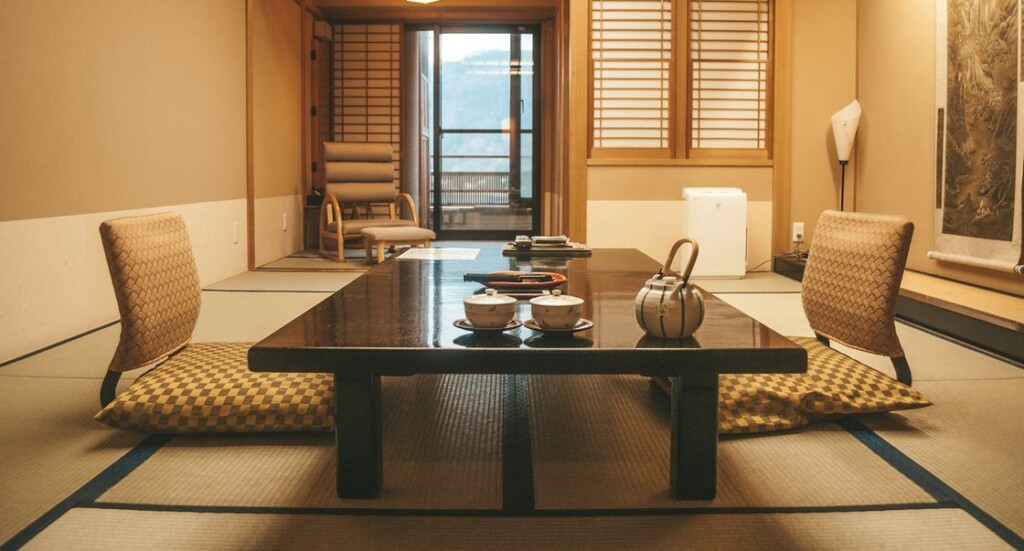
A modern tatami room – credit, Filiz Elaerts on Unsplash

Western admirers of Japanese aesthetic are keeping afloat tatami craftsmen in Japan, where modernity and maintenance requirements are driving down interest in this artisanal form of flooring.

From Europe to the US and even in the Middle East, eager importers of tatami mats now account for a sizable amount of orders from workshops like that run by Mr. Fumio Kuboki.

Kuboki is just the latest of his kin to run the family business which has been making tatami mats for 280 years. He still sells mostly to the Japanese market, but substantial help is coming from across the Pacific.

Half of the company’s international orders come from the US, Kuboki told the Japan Times.

For hundreds of years, a Japanese house wouldn’t be complete without wall-to-wall mats made of woven grass, called tatami. Made of tightly woven igusa grass, they were the standard feature in all dry rooms.

But one of Japan’s great marvels is that, even with as characteristic and attractive a traditional culture as it cultivated over the centuries, its modern aesthetic and lifestyle is almost just as iconic. As a result, the tatami mat has become somewhat neglected among Japanese crafts: reminiscent of your grandparents house and rural living.

Western-style flooring began to be the norm starting in the 1970s, and China began mass producing synthetic tatami that was easier to clean, longer-lasting, and cheaper to replace. As a result, it’s estimated that every year, 40 traditional tatami makers close up shop for good.

Yet for the increasing number of foreign residents, tatami represents the attractiveness of the Japanese aesthetic, and as well as installing it in their residences in the country, many of them bring it back to Europe or the US.

Arno Suzuki, a professor of architectural design at Kyoto Tachibana University who has studied the use of tatami in Spain, Italy and France, told the Times that seeing the appreciation for tatami among the rest of the world has somewhat reminded the younger generations of Japan of its value

Having a tatami “space” in an apartment or house is suddenly not as uncool as it once was.

“Nowadays they have a tatami space—not a tatami room, but at the corner of their living room they have three or four tatami mats, and they enjoy it. And also, many people realize that it’s better for when—especially when they have small kids, like toddlers and babies, it’s safer for them to crawl,” Suzuki told the Times.

In the city of Kobe, Taro Mano is the 4th in his family to take over the 70-year-old tatami business. He too has seen a rise from foreign buyers in countries like those Suzuki studied in.

“Tatami is a kind of symbol of Japan. It’s an easy way to express a Japanese atmosphere, even in other countries,” Mr. Mano said, adding that he first thought the interest would come from the United States, but it came to be far more diverse than that.

Mr. Kuboki makes some 10% of his revenues from overseas sales, with many of his products being stocked year-round at Japan House in Los Angeles. 100 years ago, no one ever wondered what else could be made of tatami, but now, whether it’s a coaster or a book cover, the artform is being reimagined.“Every day I talk with visitors and listen to what kind of tatami they want,” Mr. Kuboki said. “The products that are selected and loved by people are the ones that will naturally become the future of tatami. The future of tatami will be decided by customers.” Western Tatami Mat Mania Keeping Alive Japan’s Traditional Woven Grass Flooring Industry
Read More........

Visit famous Shiva temple at Tiruvannamalai and surroundings


How to reach TiruvannamalaiTiruvannamalai is on Katpadi-Vellore-Villupuram railway line, 68 km west of Villupuram and 83 km south of Vellore. Tirupati- Villupuram Passanger train leaving Katpadi at 6-40, reaches Tiruvannamalai at 9-30. Katpadi-Trichy Passanger leaving at 16-50 arrives at Tiruvannamalai at 19-25 via Vellore and then departs for Villupuram. The Passanger train that leaves Tiruvannamalai at 6-40 reaches Villupuram at 8-45 and then goes upto Pondicherry at 10-30. Buses take passengers from Tiruvannamalai to Jinji in 1 hour, Chennai in 5 hours and Pondicherry in 3 ½ hours. Tourists for Pondicherry are advised to go straight there by train or from Villupuram by a bus journey of 38 km. Railway station and bus stand at Tiruvannamalai is between 500 meters. To 100 km south of Kanchi, on the northern side of Shovaroi hill and around Arunchaleswar Temple Tiruvannamalai, a holy place dedicated to Lord Shiva. At the foothills 1.5 km from rail and bus stands, Tejalingam complex of over 100 temples has come up on 25 acre of land. This is towering temple, the largest in South India, built with the patronization of the Vijayanagar kings of the 16- 17th century.  What legend says about TiruvannamalaiLord Shiva emerges here as Agni Linga or one of the five sources of life in the midst of Lord Brahma and Lord Vishnu who clashed for supremacy. Lord Vishnu taking the form of a boar failed to bore the earth to determine the character of the Linga. Similarly, Lord Brahma in the form of a swan failed to scale the peak of the Lingam to do the same. Both accepted the superiority of Lord Shiva at Tiruvannamalai hill. The temple said to have taken 1000 years to built and Lord Shiva is worshipped here as Arunchaleswar. Other deities like Parvati, Subrahmanya (Kartik), Ganesh, Lakshmi, Venugopal are there in the temple.  The 66 meters high 13 storey Mandapam or Gopuram is a beautiful piece of art works. Carvings are simply marvellous. One will find after entering it on the east gate at the first courtyard the beautiful 1000 pillar Mandap built by the Vijayanagar  kings. To the north of the temple is a tree, a cross between Neem and Bodhi (Banyan). The holy tree is a symbol of peace, happiness and prosperity. Newly married women come and pray to the holy tree for happy married lives. In November-December on the occasion of Kartik full moon a grand Kartikai Deepam festival is organized. Lord Shiva travels around the town on a chariot alongwith Parvati, Kartik and Ganesh. People from far off places come here to take part in the 10-days festival. One has to make 14 km tour trek up the Tiruvannamalai hill to see the Shiva Lingam. Other attractions of Tiruvannamalai: Maharshi Raman's Ashram is another attraction. He died in 1950, cremated 2 km on the South West of the town. Further west is the
1100 meter high Shovaroi hill on the right side of the road and 300 meter high Kalrayan hill on the left side. Opposite the temple to the North West side is the holy hill with its Virupaksha cave. Further up Skandasraman cave. Places to visit surrounding Tiruvannamalai: 35 km west of Tiruvannamalai, in the Reserved Forest is Sathanur Dam (built in 1957) on the Ponnyar river which emerged out of North Bangalore. The lake created out of the dam has got a swimming pool and a crocodile project has also been taken up here. The park adjacent to the lake has a good ambience. Further south is Kuddalore. East India Company set up a commercial house here in 1684. Fort St David was also their creation. However, the French destroyed the fort in 1758. Tourists may visit by bus to sculpturally beautiful Krishna Temple 43 km west of Villupuram. South: Travel IndiaImage: https://upload.wikimedia.org
Read More........

Nirvana and Beyond: An Indian Journey


.Subscribe
Nirvana and Beyond: An Indian Journey' is a panoramic tale of the Indian civilisation beginning with the Harappan civilisation up until the formation of the Indian nation-state and thereafter. The film travels to different parts of the country and revisits the  rise and fall of empires and rulers; highlighting ancient Indian contributions to fields as diverse as economy, politics, religious and spiritual scholarship, medicine
and  science. It looks at monuments as testimonies to the flourishing diversity of cultures in India. And while drawing attention to this rich syncretic heritage, it also alerts one to the dangers inherent in a plural society. As the film traces the metamorphosis of the Indian civilization into a modern nation it essays some crucial concerns for India as a developing nation. Image: Screen Shot On Youtube Video
Read More........

Conversations with monks in Bylakuppe

By Lakshmi: Cosy , picturesque and quiet –  Bylakuppe  looks  like  another  village  lost   to   the 
My Photoworld. Flanked by mountains, dotted with corn fields, the little settlement combines both the ordinary and the exotica as it stands out in the coffee country of Coorg. First impressions change, as a riot of colours greet the unsuspecting traveller. The waving flags, red robes, golden Buddhas, prayer wheels, colourful paintings and smiling faces give you a glimpse of a mini Tibet in Coorg. Nestled amidst the verdant landscape , Bylakuppe or the “place of rains” is one of the first Tibetan settlements of Karnataka. The story began more than 50 years ago, during the Chinese aggression, when the Tibetan refugees flocked to India. Karnataka was one of the states to open up settlements for the Tibetans in villages like Bylakuppe, Hunsur, Mundgod and Kollegal. The hardy mountain folk were not used to the heat. They cut through the wilderness , cleared the forests and created a village. Most of them became farmers, cultivating barley and corn. “By the grace of the Dalai Lama , we have lived a contended life,” says Norbu a farmer who has lived here for the last sixty years. One of the earliest settlers, Norbu braved the cold and the Chinese to come here. “ But most of those living here today were born here and have not even had a glimpse of Tibet,” he adds. Walking around Bylakuppe, I see a Tanka artist , Namgyal, a second generation Tibetan who was born in Bylakuppe. “ I try to imagine what Tibet
 would look like- the nomads, the scenery,” he says, adding ,” and then I paint the images.“ Namgyal makes his living selling his paintings to monasteries, restaurants and to foreigners, while his family sells sweaters and woollen clothes during winters. I look around and see some beautiful paintings of Gods and Goddesses, embellished with small pieces of gold that comes from Nepal. I stop by at a small café owned by a small family and order a plate of momos. The elderly lady, Tsering sits with me as we talk about her life in Tibet . “ Its been a hard life, we left everything in Tibet . But yes, we are now busy with our day to day routine ,” It is business as usual for her, as she speaks to me about educating her daughters and helping them find jobs in Bangalore. Tucking in her apron, which she says is a sign of a married woman, she gives me a toothless grin and says,” It is like your mangalsutra or sindoor.” In Bylakuppe, time seems to stand still. Pottering around the narrow slushy lanes, life seems to follow a pattern of its own. Children playing at school, old women meditating with their prayer wheels, men playing shopara with marbles and the youth listening to some Tibetan music at local cafes – no one is in a hurry to get anywhere. You look up and see colourful flags fluttering everywhere. The village seems like any other , with medical centres, community halls, schools, playgrounds, shops and eateries. Tourism has
however created a steady flow of income for these people as tourists flock to the monasteries. Tall shimmering Buddhas smile at us from the Golden Buddha Temple. A miniature Tibet in itself, a visit to the Lama camp is all that it takes to realize the true essence of the settlement. Scores of boys and men in bright yellow and red robes pour forth from all directions and converge here. This is the centre of Buddhist studies as thousands of monks come here from all over the world . But it is not their story, but the tales of the boy lamas who had walked all the way from Tibet to India that touches our hearts. I meet them while they are returning from their schools , their backpacks flung carelessly around their shoulders, holding their red robes. We meet a 13 year old , Sherab who says he hates Maths . His subjects include English and Science besides Tibetan History and Buddhism . Ask him about Tibet and the playful grin disappears.” My father died in Tibet and I haven’t seen my mother for years. My brother and I escaped and came here a few years ago with many other people. We ran away and walked in the cold..I was scared..I do not remember much ..” His friend Tenzen has more vivid memories. “ I was five when we left
Tibet. It was very cold. We walked through the mountains, hid in the snow and it took us more than 20 days to reach Nepal .” A group of boys are playing cricket. Suddenly the conversation veers around Dhoni and Tendulkar. It’s a different world out here. The boys say that they take their vows when they are eight. “ We sometimes take as many as 200 vows .” they laugh , taking it very lightly. I learnt that celibacy is just one of them. Some young monks however merge in very easily with the Indian youth. They discuss Shah Rukh Khan and we speak about Bollywood. “ Sometimes we wear casual clothes when we watch a film in theatres, otherwise we often hear ,’ hey look, His Highness is watching a film !’ laughs one as they say they are a wee bit tired of the holy tag. Amidst all the laughter is the unspoken word that strongly echoes around – freedom. Tibet for some lies only in their imagination and dreams. As I leave Bylakuppe, I spend a few minutes with Norbu who holds a prayer wheel in his trembling hands and tells me , “ I am old, I cant see clearly, my legs are aching . But my last wish is that I hope I will see Tibet at least once more before I die .I am praying everyday.” Source: A travel blog of an Indian Backpacker
Read More........

Bollywood Marathi Brides

Genelia Dsouza Marathi wedding
Bollywood is truly an inspiration for all Indian weddings. We always look upto movies as an inspiration for our Indian weddings, be it wedding jewellery, bridal sarees or bollywood songs for sangeet functions. Take a look at how favourite bollywood belles dressed up as marathi brides for movies or for their traditional maharashtrian weddings & other Marathi Brides.
Urmila Matondkar in Traditional Marathi Paithani Saree
Kajol Marathi wedding
Priyanka Chopra Marathi bride

Read More........

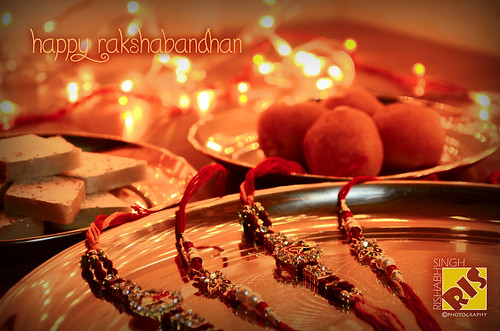
Raksha Bandhan being celebrated across India

Rakshabandha copy
.Subscribe
The school children tying ‘Rakhi’ to the President, Shri Pranab Mukherjee, on the occasion of ‘Raksha Bandhan’, in New Delhi
New Delhi, Aug 20 (ANI): RakshaBandhan, the festival of love between brothers and sisters, is being celebrated across the country today with full enthusiasm. The central ceremony involves the tying of a sacred thread, Rakhi by a sister on her brother's wrist. This symbolizes the sister's love and prayers for her brother's well being, and the brother's vow to protect her long life. President Pranab Mukherjee, Vice President Mohammad Hamid Ansari and Prime Minister Dr. Manmohan Singh have greeted the nation on the occasion. President Mukherjee in his message said the festival of Raksha Bandhan symbolizes the sacred bond of love, trust and commitment between sisters and brothers. "It is an occasion for us to dedicate ourselves to the well-being of women and in particular, the child. Women should be provided a safe, secure and congenial environment in which their talents can flower and they can contribute their full share in the building of our nation. Traditional cultural values of respect for women need to be fully entrenched in our minds," he said. "May this unique festival inculcate in every member of our society the highest respect for women, as we strive collectively for the prosperity of our people," he added. In his message, Ansari said called upon people to imbibe the valuable message of  Rakshabandhan to promote the spirit of amity, fraternity and harmony in our lives. "This festival not only celebrates the immaculate love between brothers and sisters but also transcends the confines of family to cover the entire society by underscoring the need for harmonious social life and peaceful co-existence," he said. In a separate message, Dr. Singh said that Raksha Bandhan is a festival celebrated to strengthen the bonds of love and affection in our family and society. "It is also an occasion to re-commit ourselves to ensuring the safety and security of women," he added. (ANI). Source: News Track India,
Read More........

Peking Opera, now fully translated in English


A media briefing is held at the Diaoyutai State Guest House in Beijing on Oct. 19 to celebrate the launch of The English Translation Series of 100 Peking Opera Classics.
Peking Opera, long a cornerstone of Chinese traditional culture, will now be more accessible to foreign audiences via a new series of published English translations. The project, entitled "The English Translation Series of 100 Peking Opera Classics" is co-written by the Renmin University of China and the Beijing Foreign Studies University and co-published by the Publishing House of the Renmin University of China and the Foreign Language Teaching and Research Press. The project, backed by state investment, drew from a stunning range of humanities, social science, English language research and translation resources of Chinese universities and Peking Opera circles. The Ministry of Education plans to utilize the project to promote cultural exchanges with other countries. 191 diplomatic envoys from 82 countries attended a media briefing at the Diaoyutai State Guest House in Beijing chaired by Chen Yulu, president of the Renmin University of China, on Oct. 19 to celebrate the launch of  the  series. Attendees were presented with a copy of the newly published work. Speaking at the conference, Sun Ping, editor-in-chief of the series, gave a brief introduction of the project, which began in September 2011. The English Translation Series uses a combination of books and videos of stage performances to combine the static and dynamic states to fully represent the artistic intent of the operas. A prominent feature of the series is complete bilingual and stereoscopic visuals, Sun said. "The whole translation series includes 100 classical Peking Opera plays which have been classified into 10 parts, each consisting of 10 plays. Each play has its own volume including preamble, script, music score, and dressing guide," Sun said. Editors of the series invited famous experts and scholars, including 96-year-old Guo Hancheng, opera artist and researcher of the Chinese National Academy of Arts, and 92-year-old Xu Yuanchong, translator and professor of Peking University, to be its advisers. "It was designed as a century project of the country, and State Councilor Liu Yandong attended its opening ceremony," Sun said. Sun, who is also a famous Peking Opera actress and executive director of the Research Institute on Chinese National Opera of the Renmin University of China, said that language was often the first hurdle and biggest obstacle in cultural exchanges. "The success of the project will accumulate valuable experience for Chinese operas to [gain prominence] in the world," she said.Source: China.org.cn
Read More........

Kumbh Mela the greatest show on Earth


The Kumbh Mela, one of the largest religious gatherings in the world, to be held at Sangam in Allahabad. Up to 100 million people will gather on the shores of the Ganges to celebrate the Hindu festival commencing on 14th January 2013. For four years the team of British and Indian researchers have been studying the event, seeking to understand how people treat each other, how they experience the crowd
and what impact the crowd has on their everyday lives. They will present their findings at a special event at Allahabad University on 24th January 2013. The study described the Kumbh Mela as an incredible event and the "greatest show on Earth". The Kumbh Mela attracts worldwide attention as a remarkable spectacle: millions of pilgrims bathing in the Ganges, parades of gurus on thrones, flanked by naked Naga Sadhus smeared in ash. This research, led by Nick Hopkins at the University of Dundee, Prof Stephen Reicher at the University of St Andrews, and Prof Narayanan Srinivasan at the University of Allahabad shows it to be remarkable in other ways as well. Source: Current AffairsImage: flickr.com
Read More........

Buddhist fest in Russia

Buddhists across Russia are celebrating Zula Khural, or the Candle Festival, dedicated to the passing into nirvana of the founder of the Gelugpa school, Bogdo Tsongkhapa.
It is believed that the philosopher went into meditation and reached nirvana on the 25th day of the first winter month in the lunar calendar. During the meditation, numerous rays were seen emanating from his body. A thousand candles will be traditionally lit to symbolize the light of the Buddhist teachings. For three days Buddhist temples will be holding divine services and Buddhist believers will be bringing their offerings to the Teacher. TASS, Source: Voice of RussiaImage: flickr.com
Read More........

Prez, VP, PM greet people on Guru Nanak Jayanti

Golden Temple
The President of India, Shri Pranab Mukherjee has sent his greetings to fellow countrymen on the occasion of Guru Nanak Jayanti . In a message, the President has said, "The life and teachings of Guru Nanak Devji are of profound significance to mankind. His message of love, harmony and brotherhood, his universal vision and compassion provide inspiration for all humanity. Vice President Mohammad Hamid Ansari on Tuesday greeted the people of the country on the auspicious occasion of Guru Nanak's birthday. Vice President Ansari in his message said  that 'Guru Nanak  Dev  Ji, the  founder of  Sikhism,showed us the path of peace, harmony and righteousness'. "I convey my greetings and good wishes to the people of our country on the auspicious occasion of Guru Nanak's Birthday. Guru Nanak Dev Ji, the founder of Sikhism, showed us the path of peace, harmony and righteousness. His message of devotion to God, excellence of conduct and tolerance has timeless relevance and can help in transforming our society," said Vice President Ansari. "Guru Nanak Dev Ji's Birthday offer us the opportunity to derive inspiration from his life and deeds by creating a just, peaceful and harmonious society," he added. Prime Minister Singh said the teachings of Guru Nanak Dev's teachings of religious harmony and peace still inspire everyone. "Guru Nanak Dev's life and message gives us the strength to face the challenges faced by our society even today", he said. (ANI), Source: News Track India , Image: flickr.com
Read More........

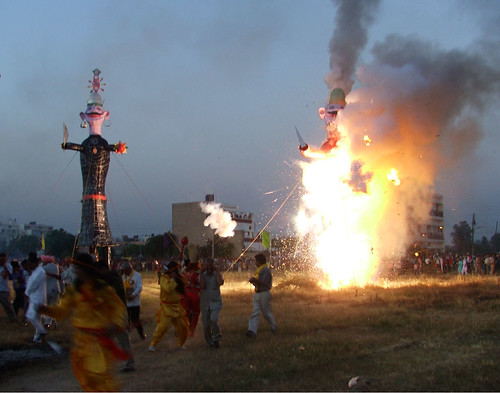
President, VP, PM, Sonia witness Dussehra celebrations at Delhi's Subhash Maidan

VIJAY DASHMI
New Delhi, Oct.24 (ANI): President Pranab Mukherjee, Vice-President Mohammad Hamid Ansari, Prime Minister Manmohan Singh and Congress president Sonia Gandhi attended the culmination of the annual Dussehra celebrations at the Subhash Maidan in the capital on Wednesday. The VIPS, who arrived as per protocol and amidst tight security arrangements, offered homage to statues of Lord Ram, his wife Sita and brother Lakshman, and performed the traditional aarti with lit lamps. They also applied vermilion streaks tothe foreheads of the dieties. They were then escorted to a flower bedecked stage and garlanded with flowers by the organisers of the event. Each VIP was also presented with a gift. Among the other important guests present were the Lt. Governor of Delhi Tejinder Khanna, Delhi Chief Minister Sheila Dikshit and Union Minister and local MP Kapil Sibal. The VIPS used the ceremonial bow and arrow to
start off the proceedings and celebrations in which the three cracker-laden effigies of demons - Ravana, Kumbhakarna and Meghdoot were set  alight. The atmosphere in  the ground was one of traditional gaiety, fun, frolic. Some of the participants were seen carrying and waving green, orange and white balloons. The effigies were set on fire at around 6.15 in the evening with commoners shouting Shri Ramchandra ki Jai amid Vedic chants in the background. Dussehra is the culmination of Navaratis in India. Popularly known as Vijayadashmi, Dussehra is celebrated with great enthusiasm, all over India. It is observed differently in different parts of the country,depending upon the legend that is followed in each region. In North India, Ramlila forms the  highlight of Dusshera, while in south India, it is the triumph of Goddess Durga over  Mahishasura that is celebrated. Eastern state of West Bengal has its own story connected to the festival, while in Mysore the concept of Shami tree is centered. Learn about the celebrations of Dussehra in different parts of India, by going through the following lines. (ANI), Source: News Track IndiaImage: flickr.com
Read More........

President greets people on Durga Puja


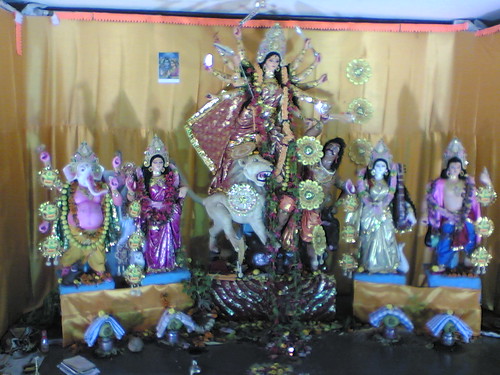
New Delhi, Oct 22 (IANS) President Pranab Mukherjee greeted  people on Durga  Puja  Monday  &  asked them to pray to Goddess Durga for peace, happiness and prosperity. In a message of greetings to the people, Mukherjee said: "The festival of Durga Puja marks the victory of good over evil. It is the celebration of shakti (power) and bhakti (devotion) and symbolises our inner struggle to rise to higher levels of consciousness. This is a festival in which every household brims with worship and merriment." "Let us pray to mother Durga, who epitomises female dynamism, that she guides us in the path of righteousness and blesses our land with peace, happiness and prosperity," said Mukherjee. The message added: "May this festival strengthen bonds of brotherhood and may Goddess Durga shower her blessings on all our people for years to come." President Mukherjee is celebrating Durga Puja at his ancestral home in Mirati village in West Bengal. Source: News Track IndiaDurgapuja : Bengali's Favourite Festival: Durga Puja is performed during the autumn season every year. For the Hindus, it is the greatest festival. The puja is held for  the three consecutive days :  the Saptami, the Astami and the Navami and the fourth day, the Dashami, the image is immersed in the water of a tank or a river. Sindur khela(vermilion play) is a major event of Dashami. Married women apply vermilion to each other and greet each other with sweets. It is in the evening when the image of Goddess Durga is immersed in the water. Bengalis greet each other with Bijoya Greetings and men follow the customary 'Kola-Kuli' (embracing each other). Durga Puja is a festival that the Bengalis celebrate without religious inhibitions. It is more of a socio-cultural celebration that tends to renew kinship with friends and relatives. The image is worshipped along with those of other deities like Lakshmi, Saraswati, Ganesha and Kartikeya. The frame, on which the said images are installed, contains also the image of Asura (demon) and the lion, the vehicle of Goddess Durga. There is also a rat at the feet of Ganesha. There is a Chal-Chitra which is a circular canvas of mat containing paintings of heavenly scenes placed at the back of the idols. The entire frame of the Gods and Goddesses is placed on a raised platform of altar made of wooden plunks. The Mandap is decorated savilion with beautiful illumination. Every evening, the priest performs aarati or greets the Goddess by waiving lamps and incense in accompaniment of the beating of drums, while the puja (worship) is held. During this great festival, the Hindus buy new clothes for their near and dear ones. they  want to forget their past differences with their rivals or enemies. After the immersion, on the occasion of Vijaya Dashami, the Hindus embrace one another as a token of love and affection, and distribute sweets among all. Durga Puja is now-a-days more a festival than a religious rite. Sometimes the non-Hindus are also found to participate in the festival as a social gesture. Durga Puja is more popular in Bengal. It is performed with more pomp and grandeur there than in any other state of India. People from neighbouring states come to Kolkata during the time, in order to witness the attractive Puja pavilion. Durga Puja is also held at Delhi, Mumbai, chennai and other important cities and towns of India, and also the villages. Durga Puja was first performed in Bengal by a Zaminder (Landlord). Then it came to be popular with the introduction of the Sarvojanin pujas performed with the joint effort of about twelve Zaminders; and hence it is called Barwari (twelve years or friends). Now-a-days, Durga Puja is also held at London and New York, where the Indians perform the puja every year. Mother Goddess Durga is considered as the most powerful Goddess who is the bestower of strength, prosperity and all the best gifts in life. So the devotees pray to Her for various boons. She killed the demon king Mahishasura who had been troubling the Gods and Goddesses and occupied Indra's throne in heaven. So the Gods and Goddesses also worship the great Goddess Durga. She is also known as Mahisasuramardini. The legend is incorporated inSri Sri Chandi, a chapter in the Markandeya Purana composed by sage Markandeya. Source: BengalMediaImage: flickr.com
Read More........

Popular Women Wears for Various Festival Celebration

The Indian culture and festival celebrations have a special place for colorful ethic clothes. Keeping in mind the modern tastes and preferences of women, the fashion designers in the country blend the traditional styles with the modern elements. The result is that women have some wonderful options to choose for the most popular festivals. Diwali is undoubtedly the most popular festival celebrated in different ways in various Indian states. High society women prefer to wear fashionable sarees that usually lack heavy work. Sarees with thread work, embroidery and a variety of motif designs are chosen by women participating in traditional poojas during the festival. Apart from Diwali, Navratri Pooja is another festival when women are highly enthusiastic in wearing colorful clothes. Chaniya choli is various impressive designs are the popular clothes for this festival. Lehanga cholis in all possible colors and styles are quite famous as well. Special dresses are designed for the women who wish to take part in the famous dance celebrations called dandiya. The significance of colors in the Indian festivals can also be experienced in festive clothes. Saffron and yellow colored clothes are popular for the festivals like teej and basant panchami. Interestingly, the exciting festival of colors called Holi requires the women to wear white clothes. White churidar suits, salwar kameez and kurtis are exceedingly fashionable clothes that women love to wear while playing with colors. The temple festivals of South India are the occasions for the women to wear heavy silk sarees with astonishing embroidery work. Ganesh Chaturthi is another festival of South where women can be seen dressed up in silk sarees and suits. On the other hand, women in Punjab and Haryana prefer to wear designer salwaar kameez with colorful dupattas to celebrate festivals like lohri and baisakhi. White and mustard yellow sarees with red borders are popular dresses for women while celebrating Durga Pooja in West Bengal. Another popular festival is Karvachauth for which women choose sarees and designer suits in bridal colors like red, maroon and pink. It is indeed amazing to see how the traditional and modern styles and designs are blended together to match the mood of grand festive celebrations. Source: B2B Market
Read More........

Thousands celebrate at Redhead Day Festival in the Netherlands

Crowds gather on Redhead Day, or Roodharigendag, in the Dutch city of Breda (Picture: EPA)
More than 1,400 redhead revellers from 52 countries took over the southern Dutch city of Breda, where the event has been held since 2005. With approximately just 1–2 per cent of the human population born with red hair, many participants head to Roodharigendag to meet up with like-minded, or like-haired, redheads.
Over 1,400 redheads attended the annual festival (EPA) 
'Getting a group of redheads together in this way is pretty rare, we lack the opportunity for community that most other minority groups have,' explained Jessica Shailes of online retailer Everything for Redheads. 'There will be a real opportunity to share experiences, opinions and sun block!' Another visitor added: 'It is a weird feeling to not stand out. It's good.' Festival organiser Bart Rouwenhourst added: 'We have families with children, we have older people who were teased as children and then we have many proud women who come to the festival. 'When people come together as redheads, they just look at each other,' he told the BBC. 'They have a certain bond.' The festival, paid for in part by the local government in Breda, offers cultural events, music, a fashion show and art exhibitions from and for the red haired community. Source:  Source: Sam Daily Times
Read More........

President, VP greet nation on Onam


The President and Vice President Tuesday greeted the nation on the eve of Onam, which marks the beginning of the harvest season. President Pranab Mukherjee in his message said, "On the joyous occasion of Onam, I offer my warm felicitations and heartiest greetings to all my brothers and sisters
Image Link Photobucket
belonging to Kerala." He said the festival brings out the rich cultural heritage of Kerala in its best form and spirit. "May this harvest festival instill in us the spirit of national integration and inspire us to work for further development of our country," Mukherjee said. Vice President M Hamid Ansari said Onam plays an important role in uniting people. He wished that the festival "may usher in peace, prosperity and happiness in the society and contribute in the nation's progress".Source: Indian Express
Read More........

The astonishing 2500 year old tattoos of a Siberian princess & how they reveal little has changed in the way we decorate our bodies


The Body of Princess Ukok, who died aged 25, had several tattoos on her body, including a deer with a griffon's beak and a Capricorn's antlers. The tattoos have been perfectly preserved for 2,500 years. 
The intricate patterns of 2,500-year-old tattoos - some from the body of a Siberian 'princess' preserved in the permafrost - have been revealed in Russia. The remarkable body art includes mythological creatures and experts say the elaborate drawings were a sign of age and status for the ancient nomadic Pazyryk people, described in the 5th century BC by the Greek historian Herodotus. But scientist Natalia Polosmak - who discovered the remains of ice-clad 'Princess Ukok' high in the Altai Mountains - is also struck about 
Researchers also found two warriors close to the Princess , and were able to reconstruct their tattoos. Here, one is shown with an animal covering the right side of his body, across his right shoulder and stretching from his chest to his back.
how little has changed in more than two millennia. 'I think we have not moved far from Pazyryks in how the tattoos are made,' she told the Siberian Times ( SiberianTimes.com ). 'It is still about a craving to make yourself as beautiful as possible.' 'For example, about the British. 'A lot of them go on holiday to Greece, and when I've been there I heard how Greeks were smiling and saying that a British man's age can be
Princess Ukok's hand with marked tattoos on her fingers. She was dug out of the ice 19 years ago, and is set to go on public display in the Altai Republic.
easily understood by the number of tattoos on his body. 'I'm talking the working class now.  'And I noticed it, too. 'The older a person, the more tattoos are on his body.' Dr Polosmak added: 'We can say that most likely there was - and is - one place on the body for everyone to start putting the tattoos on, and it was a left shoulder. 'I can assume so because all the mummies we found with just one tattoo had it on their left 
The tattoos of one of two warriors found on the ancient permafrost burial site at Ukok Plateau some 2,500 metres above sea level close to Russia's frontiers with modern day Mongolia, China and Kazakhstan
shoulders. 'And nowadays this is the same place where people try to put the tattoos on, thousands of years on. 'I think its linked to the body composition - as the left shoulder is the place where it is noticeable most, where it looks the most beautiful. 'Nothing changes with years, the body stays the same, and the person making a tattoo now is getting closer to his ancestors than he or she may realise.' The tattoo patterns are from the ancient 'princess' who died at around the age of 25 - and from two warriors found on an ancient permafrost burial site at Ukok Plateau some 2,500 metres above sea level
Tattoos are clearly visible on one of the warrior's shoulders. The designs are similar to those found on the Princess.
close to Russia's frontiers with modern day Mongolia, China and Kazakhstan. The reconstruction of the tattoos in the images shown here were released to coincide with the moving of the remains of the princess, dug out of the ice 19 year ago, to a permanent glass sarcophagus in the National Museum inThe Ukok plateau, Altai, Siberi, where Princess Ukok and two warriors were discovered. Their bodies were surrounded by six horses fully bridles, various offering of food and a pouch of cannabis.
Gorno-Altaisk, capital of the Altai Republic. Eventually she will be displayed to tourists. Buried around her were six horses, saddled and bridled, her spiritual escorts to the next world, and a symbol of her evident status, though experts are divided on whether she was a royal or a revered folk tale narrator, a healer or a holy woman. Next to hear body was a meal of sheep and horse meat and ornaments made from felt, wood, bronze and gold. And a small container of cannabis, say some accounts, along with a stone plate on which were the burned seeds of coriander.'Tattoos were used as a mean of personal identification - like
Princess Ukok: sculptor's impression of what she looked like 2,500 years ago
a passport  now, if you like,' said Dr Polosmak. 'On the man found close to the 'princess', the tattoos include the same fantastical creature, this time covering the right side of his body, across his right shoulder and stretching from his chest to his back. 'The patterns mirror the tattoos on a much more elaborately covered male body dug from the ice in 1929 whose highly decorated torso in reconstructed in our drawing here. 'His chest, arms, part of the back and the lower leg are covered with tattoos. There is an argali - a mountain sheep - along with the same dear with griffon's vulture-like beak, with horns and the back of its head which has griffon's head and an onager drawn on it.' Source: Travel Fwd Plus
Read More........

The Dazzaling Lake of Rewalsar in Himachal Pradesh

Lake in Himachal PradeshRewalsar Lake is a mid-altitude lake located in the Mandi district of Himachal Pradesh INDIA. Located on a mountain spur, 12 miles (19 km) or about an hour's drive from Mandi, brings you to this sacred dark jewel-like lake. With water, woodland and high hills, it presents a variety of natural beauty. Rewalsar is sacred to adherents of three major Dharma religions - Hinduism, Buddhism and Sikhism.  The Hindu history of Rewalsar is found in Sakand Puran. Rishi named Lomas was searching for place to worship. He traveled and climbed the top of Drona mountain, from the top of mountain he saw a beautiful lake surrounded by beautiful trees, flowers and birds. He decided to meditate at the bank of the lake. He  meditated here and according to Skand Purana Lord Shiva and Mata
Parvati blessed him by telling the secrets of this place where all the Devatas and Ganas are in the form
of flowers, floating lands and trees. The famous Rewalsar lake ('Tso Pema' to Tibetans) is associated with  Padmasambhava (also  known as Guru Rinpoche), who is recognized as the second Buddha of this age. One version of a legend has it that the king of Mandi had Padmasambhava burnt alive after rumours that the Guru had attempted to teach his daughter the Dharma, which was not accepted then. The pyre burned for a full week, with great clouds of black smoke arising from it, but after a week, a lake appeared at the spot where he was burnt and Padmasambhava manifested himself as a 16 year old boy from within a lotus in the middle of the lake. The king, repenting his actions, married his daughter with Padmasambhava. It was from Tso Pema that Padmasambhava went to Tibet to spread Vajrayana Buddhism.The tenth Guru of Sikhs, Guru Gobind Singh visited Rewalsar to consult with kings of the Hill states seeking support against Aurangzeb. He stayed at Rewalsar for a month The place
is particularly sacred to Namdhari Sikhs due to its mention  in  Sau  Sakhi  as a sanctuary.This 
gurudwara was built in 1930 by Raja Joginder Sen of Mandi. A country road winds up to the lake and right around the lakeshore, where you’ll find the ochre-red Debung Kagyud Gompa, with an active thangka (Tibetan cloth painting) school and a large central Sakyamuni statue. Just beyond is the pale blue gurdwara built in honour of Gobind Singh in the 1930s. In the other direction, the Tso-Pema Ogyen Heru-kai Nyingmapa Gompa has artful murals .Uphill from the lake is the towering white Zigar Drukpa Kagyud Institute, with outsized statues of Tantric deities. On the far side of the lake are a number of small Hindu temples dedicated to the sage Rishi Lomas, who was forced to do penance here as a dedication to Shiva.It is firmly believed that those who visit this holy lake and pays reverence towards Acharya Padmasambhav, his or her life certainly become meaningful by gaining wisdom, and eventually the state of Enlightenment. Source: The Holiday India Travel Blog
Read More........

Horse chase festival reinstated in Fukushima after decontamination

FUKUSHIMA — The Soma wild horse chase festival, a tradition dating back more than 1,000 years, resumed Saturday close to its usual size after being scaled down last year in the wake of the natural and nuclear disasters. Back in the saddle: Riders take part in the Soma Nomaoi wild horse festival Saturday in Soma, Fukushima Prefecture. KYODO The three-day Soma Nomaoi event in Fukushima Prefecture re-creates the act of warriors honing their battleground skills by chasing unleashed wild horses cast as the enemy. Last year, areas used in the event were turned into no-go zones due to the nuclear crisis, reducing the horse count to 82. Thanks to decontamination work and a redrawing of the hot zones, about 400 horses are expected this year, bringing the herd size back up to roughly 80 percent. Inaugural ceremonies were held at three shrines, including Soma Nakamura Shrine in the city of Soma. Local Mayor Hidekiyo Tachiya, who also serves as 'chief general' at the festival, commanded his troops to "march majestically." Minamisoma Mayor Katsunobu Sakurai, who heads the organizing committee for the event, said, "We would like to pray for the repose of the souls of those who perished and express our gratitude for having been able to stage this festival as a symbol of reconstruction." Kids get Italian vacation Kyodo CAGLIARI, Italy — Twelve children from Fukushima Prefecture have arrived in Cagliari, Italy, for a summer vacation at the invitation of a nonprofit group based in Milan. The children, six boys and six girls aged between 7 and 12, landed on the island of Sardinia Friday and will stay through Aug. 25. They will take part in vegetable farming, horse riding and exchanges with local children. "I want to take care of animals and swim in the sea," a 9-year-old boy from Shirakawa said upon arriving at the airport. A 10-year-old girl from Date said, "I'm looking forward to cooking vegetables." The Orto dei Sogni NPO, which was established last October by Japanese and Italians living in Milan to support children affected by the March 2011 quake and tsunami, collected contributions in the city to fund the visit. Source: The Japan Times Online
Read More........

Mongolians celebrate annual Naadam Festival

Wrestling at Naadam Festival
In Mongolia, people celebrate the annual Naadam festival on the grasslands of their home provinces, by holding traditional horse racing, wrestling and archery competitions. All are part of a ritual they hope to preserve in the face of rapid social change. This is a big day for Mongolians. Hundreds of people, many of them nomadic herders, gathered on the vast grasslands to celebrate Naadam, the country’s annual festival of all things Mongolian. They are here to enjoy what they call the "three men’s sports" -- horse-racing, wrestling and archery. A stampede of over 70 Mongolian horses and their jockeys, most of them under the age of ten, raced over ten kilometres before streaking across the finish line in front of a whooping crowd. Battulga Tsogbayar, winner of horse race, said, "Naadam is a tradition passed down from our ancestors to our parents, and it’s organized each year. Coming first in a horse race at Naadam makes my parents happy, and for me that’s the most important thing about Naadam." The other major
Horse Racing at Naadam Festival
draw of Naadam is traditional wrestling. Men of various sizes first mimic eagles in a balletic dance to show their physical prowess, and then try to take each other down in a series of rounds. Instead of gold, silver and bronze, the winner is ranked as Lion, the second as elephant, and the third as hawk. Both horse racing and wrestling are lucrative sports in Mongolia, where they are avidly watched by a people fiercely proud of their traditional nomadic culture. Although rapid economic growth is dramatically changing Mongolia’s traditional nomadic lifestyle, some are still optimistic that Naadam would live on in rural areas. Galtai Mukhbat, nomadic herder, said, "Naadam comes once a year and most people celebrate it in the area they grew up. For example, this year is the 89th anniversary of the founding of our Province, and next year will be the 90th, so I think people from the city will continue to come back to the countryside each year for Naadam." The national Naadam festival kicks off in the capital on July 11 with a grand televised ceremony attended by the Mongolian president. Source: Sam Daily Times
Read More........