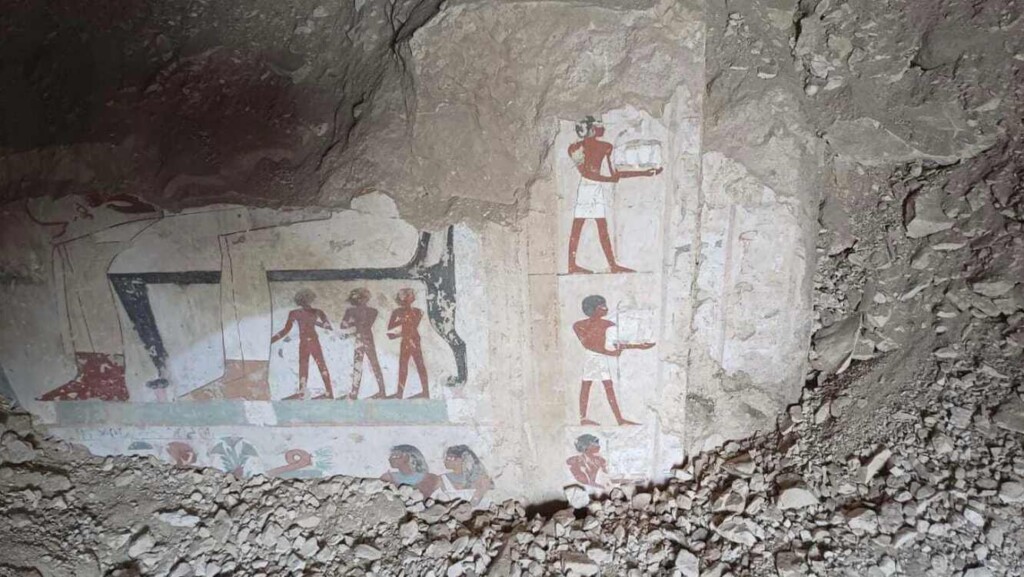
Ancient Tombs More Than 3,000 Years Old Unearthed in Egypt's Luxor

The walls of a New Kingdom tomb found in Luxor – credit, Ministry of Tourism and Antiquities, released

The tombs of three ancient Egyptian officials have been discovered in Luxor, the Egyptian government has stated, marking yet another discovery from the famous city on the Nile.

In February, the tomb of pharaoh Thutmose II was found not far from the Dra’Abu El Naga, an important non-royal necropolis where this new trio of discoveries was made.

Dating back to the era called the New Kingdom, starting from 1539 BCE and ending in 1077 BCE, the tombs belonged to several officials at the Temple of Amun, a deity worshiped as king of the gods at the time.

Inscriptions inside the tombs allowed the excavation team to identify the names and titles of their owners, said Mohamed Ismail Khaled, secretary-general of Egypt’s Supreme Council of Antiquities, in the statement.

The first was called Amun-em-Ipet, the second Baki, and the third Es. The three men held various positions, and their tombs were constructed in similar ways.

Es, the most important, was recorded as being a mayor of the northern oases, a scribe, and the supervisor of the Temple of Amun. Baki was a granary official charged with overseeing the collection and storing of the vast amount of grains and cereals produced from farming along the Nile.

Amun-em-Ipet by contrast is less known. He worked either in the temple or the estate of Amun.

According to Egypt’s Ministry of Tourism and Antiquities, the excavations that uncovered the tombs were conducted by an entirely-Egyptian team, and marked a “significant” discovery for the country’s archaeological record.

Amun-em-Ipet’s tomb consists of a courtyard, entrance portal, and long hall ending in a niche, but is in poor condition.

Baki’s tomb was larger, and consists of a long, corridor-like courtyard followed by another courtyard leading to its main entrance. Entering the interior, a rectangular hall leads to another of the same, wherein lies the official’s burial niche.

The tomb belonging to Es also has a small courtyard containing a well, followed by a main entrance, and a transverse hall leading to an incomplete hall longer than the first, CNN reports.One wonders if we will ever run out of these discoveries, which if found in many other countries of the world would be labeled as monumental, but, since being from the time of ancient Egypt, are relegated to acknowledgment via a simple statement on the Antiquities Ministry Instagram page. Ancient Tombs More Than 3,000 Years Old Unearthed in Egypt's Luxor
Read More........

World's Most 15 Greatest Living Rocks


1. Great Sphinx of Giza (Egypt): A reclining lion with a human head that stands on the Giza Plateau on the west bank of the Nile, near modern-day Cairo, is the largest monolith statue in the world. Standing 73.5 m (241 ft) long, 6 m (20 ft) wide, and 20 m (65 ft) high, the Great Sphinx of Giza is also the oldest known monumental sculpture, and is commonly believed to have been built by ancient Egyptians in the third millennium BCE. The Great Sphinx faces due east and houses a small temple between its paws.
 2. Petra (Jordan): Famously described as "a rose-red city half as old as time" by John William Burgon, UNESCO has described Petra as one of the most precious cultural properties of man's cultural heritage. In 1985, Petrawas designated a World Heritage Site, and recently designated as one of the “new wonders” of the world. Located in Arabah, Ma'an Governorate, Jordan, lying on the slope of Mount Hor in a basin among the mountains, the large valley running from the Dead Sea to the Gulf of Aqaba is renowned for its rock-cut architecture. The Nabateans constructed it as their capital city around 100 BCE, after their decline, the site remained unknown to the Western world until 1812, when it was introduced to the West by Swiss explorer Johann Ludwig Burckhardt. The picturesque site was featured in various films such as Indiana Jones and the Last Crusade, Mortal Kombat: Annihilation and Sinbad and the Eye of the Tiger.

 3. Mount Rushmore (USA): A famous monumental granite sculpture created by Gutzon Borglum, Mount Rushmore is located within the United States Presidential Memorial that represents the first 150 years of the history of the United States of America with 60-foot (18 m) sculptures of the heads of former United States presidents (left to right): George Washington, Thomas Jefferson, Theodore Roosevelt, and Abraham Lincoln. The entire memorial covers 1,278.45 acres (5.17 km2) and is 5,725 feet (1,745 m) above sea level. The memorial attracts approximately two million people annually.

 4. Leshan Giant Buddha (China):  Built during the Tang Dynasty, the Leshan Giant Buddha is carved out of a cliff face that lies at the confluence of the Minjiang, Dadu and Qingyi rivers in the southern part of Sichuan province in China, near the city of Leshan. The sculpture, which is seventy one meters (about 230 hundred feet) tall dwarfs the tourists that flock to see it. It is positioned so that it faces Mount Emei and stands at the meeting place of three rivers. Although the Government of China has promised a restoration program, the statue has suffered from the effects of pollution, particularly over the last twenty years. Fortunately, the statue was not damaged in the Sichuan earthquake of 2008. 5. Mahabalipuram Shore Temple (India): Built on the shores of the Bay of Bengal in Mahabalipuram (India) in the early 8th century by the Pallava King Rajasimha. The shore temple
actually consists of 2 back to back shrines, one facing the east (the Bay), and the smaller one facing west. It stands on the edge of the Bay of Bengal. At high tide, the waves sweep into its compounds. The walls and their sculptures have been battered and eroded by the winds and waves for thirteen hundred years. Yet they stand intact. Mahabalipuram was a flourishing sea port in the times of Periplus and Ptolemy (140 AD). There is an old legend here that originally there were seven temples; of these, six have been swallowed by the sea and only one temple -the Shore Temple- remained. There are evidences of submerged structures under the waves and sporadic excavations are going on, but it is too early to say whether there really was a glorious city and six more temples which now lie submerged under the waves off the coast off Mahabalipuram.

6. Abu Simbel (Egypt): A set of two temples near the border of Egypt with Sudan, Abu Simbel was constructed for the pharaoh Ramesses II who reigned for 67 years during the 13th century BC (19th Dynasty). The temples were cut from the rock and shifted to higher ground in the 1960s as the waters of Lake Nasser began to rise following completion of the Aswan High Dam.The Great Temple is dedicated to Ramesses II and a statue of him is seated with three other gods within the innermost part of the rock-cut temple (the sanctuary). The temple's facade is dominated by four enormous seated statues of the Pharaoh (each over 20 metres or 67 feet high), although one has been damaged since ancient times. The Small Temple was probably completed ahead of the Great Temple and is dedicated to Ramesses' favorite wife, Nefertari. At the entrance stand six 10-metre-high (33 feet) rock-cut statues - two of Ramesses and one of Nefertari on either side of the doorway. 

7. Dazu Rock Carvings (China): The Dazu rock carvings in Chongqing, China are hewn from the cliffside, featuring more than 5,000 statues and over 100,000 Chinese characters of inscriptions or epigraphs. It is reputed as 'the county of rock carving' and it’s located at the southeast of Sichuan province. The Dazu Rock Carvings was built from 650 in the Tang Dynasty and continued to the Ming Dynasty (1368-1644) and the Qing Dynasty (1616-1911). Among the rock carvings, there are more than 5,000 statues and over 100,000 Chinese characters of inscriptions and epigraphs. 8. Church of St. George (Ethiopia): The Church of St. George is a monolithic church in Lalibela, Amhara Region, Ethiopia. It is the most well known and last built (early thirteenth century) of the eleven churches in the Lalibela area, and has been referred to as the "Eighth

Wonder of the World". The dimensions of the complex are 25 meters by 25 meters by 30 meters, and there is a small baptismal pool outside the church, which stands in an artificial trench. According to Ethiopian cultural history, Bete Giyorgis was built after King Gebre Mesqel Lalibela of the Zagwe dynasty had a vision in which he was instructed to construct the church; Saint George and God have both been referred to as the one who gave him the instructions.As of 2006, Lalibela is still a pilgrimage site for members of the Ethiopian Orthodox Tewahedo Church; the church itself is part of the UNESCO World Heritage Site "Rock-Hewn Churches, Lalibela".

9. Borobudor (Indonesia): Officially, Borobudur is a ninth-century Mahayana Buddhist monument in Magelang, Central Java, Indonesia. Actually,  it is much older than that. The monument complex comprises six square platforms topped by three circular platforms, and is decorated with 2,672 relief panels and 504 statues of Rama citizens. Each wall has a story that relates to the stories of the birth of Buddha and other Buddha figures. A main dome, located at the center of the top platform, is surrounded by 72 Rama citizens seated inside perforated stupa.

10. Cappadocia (Turkey): Cappadocia lies in the mid-western part of Turkey. Anextraordinary landscape formed millions of years ago by the combined work of lava spitting volcanoes, wind and water, there is culture too: the inhabitants of the area hew rooms, chapels, even whole villages out of the rocks. Religious Byzantine paintings can be found on the walls of the churches and monasteries.
11. Bingling Temple (China): The Bingling Temple is a series of grottoes filled with Buddhist sculpture carved into natural caves and caverns in a canyon along the Yellow River. It lies just north of where the Yellow River empties into the Liujiaxia Reservoir created by the Liujiaxia Dam at Yongjing, about 80km from Lanzhou. The caves were a work in progress for more than a millennium. The first grotto was begun around 420 CE at the end of the Western Jin Dynasty. Work continued and more grottoes were added during several dynasties. The style of each grottoe can easily be connected to the typical artwork from its corresponding dynasty. The Bingling Temple is both stylistically and geographically a midpoint between the monumental Buddhas of Bamiyan in Afghanistan and the Buddhist Grottoes of central China, Yungang Grottoes near Datong and Longmen Grottoes near Luoyang. Over the centuries, earthquakes, erosion, and looters have damaged or destroyed many of the caves and the artistic treasures within. Altogether there are
12. Hypogeum of Hal-Saflieni (Malta) 183 caves, 694 stone statues, and 82 clay sculptures that remain. Each cave is like a miniature temple filled with Buddhist imagery. The sculptures, carvings, and frescoes that remain are outstanding examples of Buddhist artwork and draw visitors from around the world. The Hypogeum in Hal-Saflieni, Paola, Malta, is a subterranean structure dating to the Saflieni phase in Maltese prehistory. Thought to be originally a sanctuary, it became a necropolis in prehistoric times. It is the only prehistoric underground temple in the world. The Hypogeum was depicted on a 2 cents 5 mils stamp issued in the Maltese Islands in 1980 to commemorate the acceptance by UNESCO of this unique structure in the World Heritage Site list. It was closed to visitors between 1992 and 1996 for restoration works; since it reopened only 80 people per day are allowed entry and there can be a 2-3 weeks wait to get a ticket. It was discovered by accident in 1902 when workers cutting cisterns for a new housing development broke through its roof. The workers tried to hide the temple at first, but eventually it was found. The study of the structure was first entrusted to Father Manuel Magri of the Society of Jesus, who directed the excavations on behalf of the Museums Committee.
13. Buddhas of Bamiyan (Afghanistan) The Buddhas of Bamiyan were two monumental statues of standing Buddhas carved into the side of a cliff in the Bamiyan valley in the Hazarajat region of central Afghanistan, situated 230 km (143 miles) northwest of Kabul at an altitude of 2500 meters (8,202 ft). Built during the sixth century, the statues represented the classic blended style of Indo-Greek art. The main bodies were hewn directly from the sandstone cliffs, but details were modeled in mud mixed with straw, coated with stucco. They were intentionally dynamited and destroyed in 2001 by the Taliban, on orders from leader Mullah Mohammed Omar, after the Taliban government declared that they were "idols" (which are forbidden under Sharia law). International opinion strongly condemned the destruction of the Buddhas, which was viewed as an example of the intolerance of the Taliban and of fundamentalist Islam. Japan and Switzerland, among others, have pledged support for the rebuilding of the statues.

14. Mada'in Saleh (Saudi Arabia): Located in northern Hejaz (modern day Saudi Arabia), Mada'in Saleh --also called Al-Hijr ("rocky place")-- is an ancient city that was inhabited by Thamudis and Nabateans and was then known as Hegra. Some of the inscriptions found in the area date back to the 2nd millennium BC. However, all the remaining architectural elements are dated to the period of the Thamudi, Lihyan and Nabatean civilizations, between the 1st millennium BC and the second century AD. Mada'in Saleh is not only Saudi Arabia's most spectacular touristic site; it is also one of the greatest historic sites in the world. The rock tombs in this early morning light are of such an extraordinary beauty, consisting of different shapes and sizes, that gives Mada'in Salih a truly charming feeling. This historic sister city, Petra the former capital of Nabataean Kingdom, is located only 150 miles away to the north across the border with Jordan.

15. Naqsh-e Rustam (Iran): Naqsh-e Rostam is a site believed by archaeologists to have been a cemetery for Persepolis, where Achaemenid, Parthian and Sassanid royalty were laid to rest. Located about 3-4 kilometers northwest of Persepolis in Iran's Fars province, the site contains funerary related works belonging to the Elamite (second millennium BCE), Achaemenid (550-330 BCE) and Sassanid (226-651 CE) eras. The only surviving monument from the pre-Achaemenid period is a relief which was almost completely obliterated when the court scene of Bahram II (276-293 CE) was carved over it. The Naqsh-e Rostam structures have been built from white and grey Limestone without the use of mortar. It is believed that Persians were the first to use colors to decorate stone carvings. A particularly striking feature of Naqsh-e Rostam stone carvings is the use of color; many of the site's inscriptions and carvings are covered with Lapis lazuli. Evidence shows that the carving of Darius had a lazuline beard and mustache, black hair and eyeliner, red eyes, lips and shoes as well as colorful robes, although the passage of time has left the colors at Naqsh-e Rostam unstable. World Amazing Information | Funny Pictures | Interesting Facts: World's Most 15 Greatest Living Rocks
Read More........

Kenya wildlife reserves threatened as tourists stay away

Female elephants get into a protective formation around a pair of calfs on a grassy plain at the Ol
Female elephants get into a protective formation around a pair of calfs on a grassy plain at the Ol Kinyei conservancy in Maasai Mara, in the Narok county in Kenya

AFP/Talek, Kenya: In the majestic plains of the Maasai Mara, the coronavirus pandemic spells economic disaster for locals who earn a living from tourists coming to see Kenya's abundant wildlife.

Even before the virus arrived in Kenya mid-March, tourism revenues had plummeted, with cancellations coming in from crucial markets such as China, Europe and the United States.

According to the tourism ministry, the sector has lost $750 million this year -- roughly half of the total revenue in 2019.

‘We were fully booked in June but now we have zero bookings. Nothing. It's terrible,’ said Jimmy Lemara, 40, the manager of an eco-lodge in the private Ol Kinyei conservancy.

In the Maasai Mara, one of Africa's most highly-rated wildlife reserves located in the vast flat plains of the Great Rift Valley, the local Maasai community, traditional herders who make up 2.5 percent of the population, now depend almost exclusively upon tourism for their livelihood.

In a unique model set up to engage local communities in tourism, enabling them to see the value of wildlife and thus protect it, the Maasai now get revenue from renting their land to form private wildlife conservancies.

Some work as cooks, guides and security guards in the lodges while others give tours of their traditional homes or sell homemade crafts to tourists.

- 'Survival mode' -

People in Talek, a dusty town situated at one of the entrances to the Maasai Mara national reserve, are gloomily buckling down, hoping for better days.

Kenya has announced international flights will resume on August 1, but the high season is already lost.

‘Since December, work has been extremely low, and now we're in survival mode hoping to make 150 to 200 shillings ($1.4 to $1.9) a day, to be able to buy a meal,’ said Ibrahim Sameri, 38, whose small mechanic workshop can generate up to $30 a day in the high season.

Nalokiti Sayialel normally sells bead necklaces and bracelets to tourists passing through.

‘It's been three months that I haven't sold anything,’ the 45-year-old told AFP.

‘This is terrible. Everything is stuck. Everything is shut down. (I have) never seen something like that’, said tour guide Petro Nautori who has had no work since January.

The Maasai Mara national reserve, run by the Narok county government, extends to the north with several privately-managed conservancies renting land from the Maasai who in exchange do not graze their cattle or settle there.

This model has since 2005 allowed the doubling of the habitat for wildlife in this area.

On average, each land owner earns $220 per month, far more than the minimum wage in the area.

However like other conservancies, Ol Kinyei is struggling and has agreed to only pay half the usual rent to the Maasai, after having to pay back deposits to tourists who cancelled their holidays.

The salaries of lodge employees have also been cut by half.

- Forced to sell livestock -

Some Maasai families are having to turn to selling their precious livestock to earn money.

‘Because we're getting little and it's not enough to sustain the family for a living, I had to sell two goats worth about 12,000 shillings to put on top of what I'm getting to keep me going,’ said Julius Sanare, 41, head chef at the eco-lodge in Ol Kinyei.

However livestock markets have been shut due to coronavirus prevention measures.

Residents said the Maasai are instead selling their animals on the black market for a pittance to unscrupulous buyers taking advantage of their desperation.

Mohanjeet Brar, managing director of Porini safari camps which run two conservancies and several lodges in the Mara, said the ‘catastrophic’ situation could threaten the existence of the reserves.

‘If the landowners are not getting any revenue, they can't feed themselves, they can't send their kids to schools, they would have no option but to look at other forms of land utilisation,’ he said.

‘Fencing it off, selling it to people, building businesses... all those alternate land uses don't go together with wildlife and elephants and big cats and so this would be completely lost,’ he said.

‘And once it's lost, if you look at Kenya and its very fast population growth rate and good economic growth over the last few years, it would be lost forever. It would be a real shame. ’Source: https://www.gulf-times.com/
Read More........

Baby Whispering

Broken down into easy-to-follow time frames from preparing for arrival and birth right through to 12 months, there are answers to everything you need to know: • baby’s basic needs and development • common problems and solutions • techniques for breast feeding and bottle feeding (expressed milk and formula) • crying and settling, plus dealing with colic • Sharlene’s technique to bring up wind • sleeping patterns and suggested routines • developmental play, For years, Sharlene has been travelling the world helping new parents. Now Baby Whispering offers you the same skills, confidence and information which can be personalised to suit you and your baby. About the author: From an early age Sharlene Poole knew she was going to work with babies or children and is now a postnatal advisor and considered the authority on the subject in New Zealand. She has over 20 years experience working in postnatal care, as a Supervisor of an early childhood centre and then a British maternity nurse. In 2000 she based herself in the UK where she quickly forged a unique market for herself as a maternity nurse. Her reputation grew quickly through word-of-mouth and soon Sharlene was being flown around the world to ex-pat clients in countries such as Japan, India, South Africa, Australia and Dubai. Baby Whispering | RRP$40.00 - Penguin Books, Source: Beattie's Book Blog
Read More........

Health Benefits of Castor (Ricinus communis) Oil

Castor oil is a Storehouse of Health Benefits!
Castor (Ricinus communis) of the Euphorbiaceae family, is an evergreen perennial shrub, with palmately lobed leaves and unisexual flowers. Though it is a native of India and North Africa, today, castor is cultivated in tropical and subtropical regions of the world. Castor seeds are a rich source of ricinoleic acid, linoleic acid, palmitic and stearic acid. The seeds contain ricin and allergin, the toxic proteins that are denatured during oil extraction from the seeds. Folk healers around the world have used castor oil to treat a wide variety of ailments for centuries for its therapeutic and medicinal benefits. The antioxidant and anti-inflammatory properties of castor makes it an excellent massage oil for curing joint pains and arthritis, nerve inflammations and sore muscles. Studies have shown that Castor Oil is a strong laxative, which makes it effective against constipation. A tsp of castor oil taken with warm milk before sleep helps cure
Leaves of Castor 
constipation. To cure stomach ache, a tsp of castor oil with curd helps treat the same. Also, a tsp of castor oil taken with honey twice daily is believed to kill intestinal worms. Castor Oil is also used to treat skin problems such as sunburn, abrasions, acne, dry skin, boils, warts, stretch marks, age spots, ringworm & athletes foot. Application of the oil over the affected area is said to cure such skin ailments. Being a natural emollient, it works as a beneficial remedy for wrinkles! Topical application of small amounts of oil before bedtime, softens and hydrates the skin and reduces wrinkles. The anti-bacterial components of castor oil have been found to be effective against stye (oil gland infections on eyelids). Application of a drop of oil directly onto the stye twice daily is known to relieve the eyes. A cotton ball soaked in warm castor oil and applied over eyelids is said to give relief from pain and inflammation of the eyes. Side Effects of Castor Oil: Pregnant/ lactating women and people with intestinal blockage, acute inflammatory intestinal disease, appendicitis or abdominal pain should not take Castor Oil without their physicians/doctor's approval! The recommended dosage for the castor oil is no more than 1/2 to a tsp per day. Over dosage of Castor oil may cause diarrhea, nausea, vomiting and abdominal pain .Source: HerbHealtH
Read More........

Masterpiece of the Week: Gone with the Wind, 1939

I’m always shocked when someone tells me that they haven’t seen Gone with the Wind. The idea of never having seen one of the most famous, celebrated, successful, enduring and innovative films in American cinematic history, is astonishing to me. Yet, there is a contingency that has not seen this film. Gone with the Wind was producer David O. Selznick’s great triumph, and he didn’t mind destroying myriad people in the making of it. Adapted from Margaret Mitchell’s 1936 best seller of the same name, the script was written repeatedly by an ever-changing team of people (with a lot of interference from Mr. Selznick). Of the many who worked on the script, only Sidney Howard is credited. The writers weren’t the only people suffering behind the scenes. The film had more than its fair share of directors as Selznick grew
Olivia de Havilland: Turner Entertainment
increasingly dissatisfied with what he was seeing in the “rushes.” While Victor Fleming (who also directed another film in 1939 that you may have heard of—The Wizard of Oz) is credited as director, both Sam Wood and George Cukor sat in the director’s chair for awhile. The film boasts one of the most famous casts in film history, and, one of the most famous searches for a leading lady. One of the first to be cast was the exceptional Olivia de Havilland as the gentle Melanie Wilkes (the sympathetic antithesis of the film’s lead, Scarlett). Casting the other leading roles posed some considerable debate amongst the production team. Finally, Leslie Howard was cast as the rather ethereal Ashley Wilkes (the object of
Scarlett’s affections), and—another great triumph for Selznick Many —Clark Gable agreed to play Rhett Butler, the uber-masculine blockade runner. But, who was to play Scarlett? Many tested. were considered. At one point, early on, it was rumored that Warner Brothers would lend Bette Davis to Selznick for the role of Scarlett, providing Errol Flynn would play Rhett Butler. Selznick declined. Other finalists included Jean Arthur and Joan Bennett. Only two of the finalist were tested in Technicolor: Paulette Goddard and a lesser known British actress Vivien Leigh whom Selznick’s wife referred to as
Leigh and Howard: Turner Entertainment
“The Scarlett dark horse.” The dark horse won the race. Completing the cast were Hattie McDaniel as “Mammy”, Thomas Mitchell and Barbara O’Neill as Scarlett’s parents, Alicia Rhett as “India Wilkes,” Butterfly McQueen as Prissy and a host of other popular character actors of the era too numerous to list here. This was the most highly anticipated film of the 1930’s and is part of the reason that 1939 is considered the greatest year in motion picture history. Of course, even if you’ve not seen the film, you’re aware of its plot. Gone with the Wind follows the lives of two intertwined Southern families before, during and after the Civil War. While some will argue that the film glorifies the South, it also shows much of the
Leigh as Scarlett: Turner Entertainment
turmoil of that period in American history in great detail.Technically revolutionary, the picture employs techniques that were unheard of at the time—combining layers of motion picture film with glass paintings, trick shots and even an unusual title sequence. The film swept the academy awards that year. However, the most notable Oscar win was the award for Best Supporting Actress which went to Hattie McDaniel—the first African American to win an Academy Award. I really feel that everyone should seeGone With the Wind at least once. It’s a masterpiece—like watching a living painting set to an amazing score by the brilliant Max Steiner. However, if those of you who have not seen it still refuse, well, “frankly, my dear, I don’t give a damn.” Source: Stalking the Belle
Read More........

CNNGo lists world's best Chinatowns


CNN's travel site, CNNGo, recently published an article titled "World's Best Chinatowns."
There is a Chinatown in almost every major city in the world, and such is the huge footprint of overseas Chinese. CNN's travel site, CNNGo, recently published an article titled "World's Best Chinatowns." The following are some of the best Chinatowns in the world, according to CNNGo. Havana, Cuba – Havana's Chinatown is called "Barrio Chino" in Spanish by locals. It was started by coolies brought in from Guangdong in the 1840s to work on the sugar plantations, and was once Latin America's largest Chinatown. There are about 150 native Cuban Chinese left in Havana. Kolkata, India – Many Chinese people, predominately from South China, fled early 19th-century war and famine in their homeland, and found their way to Kolkata. There are still some Taoist temples in the city, and Chinese food is the most popular cuisine there. Bangkok, Thailand – At night, Bangkok's Chinatown resembles Hong Kong in 1960s. The main attraction is the food. One of the easiest ways to enjoy it is to sign up for a tour with Bangkok Food Tours' Chinatown Foodie Walk. Manila, Philippines – Binondo in Manila is the world's oldest Chinatown, established in the 1590s by the Spanish colonists as a settlement for Catholic Chinese. One can find some of the best Chinese food there. Johannesburg, South Africa – Transvaal was found in the 1880s to lay the largest deposits of gold in the world, which attracted many Chinese gold diggers. Johannesburg is actually home to two Chinatowns. Most residents of the Chinatown in the suburbs are recent Mandarin-speaking immigrants. A growing number of Chinese people have moved to South Africa either for work or study in recent years. One can find authentic Shanghainese and Sichuan food in the city. Melbourne, Australia – The first batch of Chinese migrants went there mainly due to gold rush. Beginning in 1851, ships laden with gold diggers began to set sail from Hong Kong for Melbourne. Today, the historic three-story brick buildings in Melbourne's Chinatown remain home to various Chinese restaurants, groceries, and herbal medicine shops. It holds the world's largest dragon boat race every year. Vancouver, Canada – Chinese people account for nearly 50 percent of the residents of Richmond, modern-day Chinatown in Vancouver. In recent years, a reverse brain drain has seen Canadian-born Chinese moving back to Hong Kong and the Chinese mainland in search of better job opportunities. San Francisco, United States – After more than 150 years in San Francisco, Chinese have become an integral part of the rich fabric of the city. In the late 1880s, San Francisco's Chinatown was the city's sleaziest area, and was best known for authentic Cantonese food. London, England – London is home to Europe's largest Chinatown, which attracts 300,000 people for the Lunar New Year celebrations every year. The Chinese community in the city is mainly made up of migrants from Hong Kong. Attracted by cheap rents and short leases on offer, many of them have opened restaurants, teahouses, Chinese medicine clinics, and supermarkets in the city. Source: China.org.cn
Read More........

Mantel bags second Booker

Hilary Mantel did not figure on a list of the 20 best young British novelists published by a literary magazine in 1983. On Tuesday, she became the first British novelist to bag the prestigious Man Booker prize twice. The 60-year-old writer, whose Booker award was her second in only three years, stood up and folded her hands in a courteous 'namaste' to fellow diners at the gala banquet at Guildhall in central London. "Well, I don't know," she said. "You wait 20 years for a Booker Prize and two come along at once." "In (Mantel's novel) Bring Up the Bodies, our greatest modern writer retells the origins of modern England," said chairman of the judges and editor of the Times Literary Supplement, Peter Stothard. The nominees included the Indian poet and writer Jeet Thayill, who had an outside chance of winning the award that goes out every year to the best novel in English by a writer from the Commonwealth and Ireland. She becomes only the third author, after Australian Peter Cary and South African JM Coetzee to win the prize twice and is the first to win with a sequel - Bring Up the Bodies is the second in a trilogy that began with the Booker-winning Wolf Hall in 2009. "There is the last volume of her trilogy still to come so her Man Booker tale may yet have a further chapter," spokesperson for the Man Booker said. "I assure you that I have no expectations I will be standing here again," Mantel joked as she accepted the award. Central to the Tudor trilogy is the anti-hero Sir Thomas Cromwell - King Henry VIII's chief minister, spymaster, torturer and of the most ruthless and powerful men ever to dominate British politics. Source: Hindustan TimesImage: upload.wikimedia.org
Read More........

A big cuddle from Mum... just like 25 years ago: Woman who was first UK baby to have heart transplant celebrates anniversary of historic surgery


Mother Carol cuddles her daughter while in hospital for her transplant (left). Miss Davidson-Olley has just been picked to represent Great Britain at the World Transplant Games in Durban, South Africa in July next year
The UK's first ever successful baby heart transplant survivor has celebrated the 25th anniversary of her operation. Kaylee Davidson-Olley made medical history when she had the transplant aged just four months on October 14, 1987 at the Freeman Hospital, Newcastle. Since then 112 children in the UK under the age have received new hearts. Miss Davidson-Olley said: ‘I can’t believe I am fit and healthy 25 years after my heart transplant. I feel overwhelmed, excited and very emotional. ‘This was only madeKaylee Davidson-Olley, pictured with her mother Carol, has celebrated her 25th anniversary of becoming the UK's first ever successful baby heart transplant. She was just four months old when the had the operation at the  Freeman Hospital, Newcastle.
Kaylee Davidson-Olley, pictured with her mother Carol, has celebrated her 25th anniversary of becoming the UK's first ever successful baby heart transplant. She was just four months oldwhen the had the operation at the Freeman Hospital, Newcastle.
 possible because of the generosity of a family who made that important decision about organ donation, a decision that saved my life. Without that family discussing organ donation, I simply wouldn’t be here.’ The 25-year-old balances studying at college with a busy athletics schedule, has just been picked to represent Great Britain at the World Transplant Games in Durban, South Africa in July next year. She added: ‘I hope that my own story and that of all the children at this special event will encourage others to be involved, if only to just talk about organ donation with their family.’ This week there are six babies on the organ donor register awaiting new hearts and two children have already died this year whilst waiting for organs. At the 25th anniversary of the first successful baby heart transplant held today, Miss Davidson-Olley was joined by medical experts from around the world and more than 30 people who since have had the operation as babies. Dr Richard Kirk, a consultant paediatric cardiologist at Freeman Hospital, said: ‘The 25th anniversary of Kaylee’s operation is a celebration of both her life, the skills of the medical team who have looked after her and Kaylee and her family’s determination to make the most of the gift of life from her donor. Source: Travelfwd+, open images in new tab or window to find its source of sharing
Read More........

Your body talks

Body can express your thoughts and ideas to the person you are communicating without uttering a  word. Here are a few signs and languages to help your body convey right messages Did you know that your body has a language? It is a very important medium of communication which constitutes to 60 per cent of what your communicating. Also known as ‘non-verbal communication’, in this type, communication happens via body postures, gestures, eye movement, facial expression, movement of hands, shrugging the shoulders, standing or sitting postures, etc. If you wish to communicate well, then it makes sense to understand how you should use your body to say what you mean. Behavioural psychologists have conducted considerable research programmes on non-verbal communication and have studied human behavioural clues that could be useful for developing a better rapport with the person one is communicating with. Unintentional human gestures such as making an eye-rub, a chin-rest, a lip-touch, a nose-itch, a head-scratch, an ear-scratch, crossing arms, and a finger-lock have been found conveying some useful information in a specific context. Experts say first impression is the best impression. So, let us practice how to give the best first impression to others by altering/improving our body language. While our parents taught us to use physical expressions like waving the hands, pointing fingers, thumbs up, touching, shaking hands, folding hands, etc, it is necessary to practice accepted international gestures also. This will help you communicate with everyone more effectively. For instance, in India most people nod their head horizontally in a slow motion to say ‘Yes’ and in a fast motion to say ‘No’. Please note that the international practice is different. They nod their head vertically to say ‘Yes’ and horizontally to say ‘No’. Well, I didn’t know it myself when I first visited America in 1985. These are the common gestures in most of the countries. There is no specific universal sign for any expression. For instance, when you show two fingers, ‘V’, it is a sign of victory, whereas in some of the African countries, it is a sign of accepting defeat. During the seminars, group discussions and in interviews, your body language is being observed by the other participants to know your real intention. Therefore, mind your language and body language too. The body language can be altered and improved on practice. (Dr BV Pattabhi Ram is a renowned personality developer who holds a PhD from Osmania University. He conducts workshops on Soft Skills / HRD; and motivates students and teachers on study skills. Contact him at bvpattabhiram@yahoo.com), Source: The Hans India
Read More........

A Victor Steibel Day Dress, 1947

Day Dress, Victor Steibel, 1947, This and all related images from: The Victoria & Albert Museum
With this theatrical day dress, designer Victor Steibel nods to Victorian fashions by attaching an oversized bustle-like bow to the rear of the dress. The dress was made in 1947 as a response to Christian Dior’s “New Look” of pinched waists and full skirts. Steibel wasn’t out to make practical dresses. He wasn’t interested in 
the continuation of war time rationing. Both of these concepts are evident with this dress and it’s almost comic bow which was so heavy with material that it had to be supported by a hidden horsehair frill beneath the skirts. South Africa-born Steibel studied fashion at Cambridge and apprenticed with the House of Reville and 
Rossiter before opening his own couture house in 1932. He became especially known for his use of striped fabrics and his dramatic, yet, feminine evening and day wear. This very-Steibel striped dress is constructed of silk grosgrain and is given body with net petticoats. It was made for and worn by Lady Cornwallis. Source: Stalking the Belle Époque
Read More........

Life up in the treetops

News photo
Woodsman: Takashi Kobayashi, Japan's pioneer tree-house maker, with one of his constructions at Mount Takao, Tokyo. SATOKO KAWASAKI
By ERIKO ARITA, Staff writer, Imagine strolling through a forest and coming across a hut supported by four trees 8 meters off the ground. With its triangular roof, stained-glass door panels and timber decking, at first sight it's like something in a fairyland. Rope work: Participants in a tree-house workshop learn how to climb really tall trees at Mount Takao. SATOKO KAWASAKI This is, however, the latest lofty abode built by Takashi Kobayashi, Japan's pioneer tree-house creator. Completed on June 20, the hut in a valley in Takikawa, Hokkaido, is the fruit of cooperation between Kobayashi and Solaputi Kids Camp, an organization that runs a camping facility there for children with life-threatening diseases. "There are children who have never played outdoors because they have to stay in hospital or wear breathing or other medical tubes. This tree house is for such children," Kobayashi said in a recent interview with The Japan Times. He explained that the hut is spacious enough for kids in wheelchairs or on stretchers along with medical staff from the organization — and that it is accessible horizontally via a bridge. "I hope the children enjoy the view from up in the trees and the way the suspension bridge swings, too," Kobayashi enthused with a childlike glint in his eye. He also explained that the idea for the tree house came from the founder of the camping organization, Ryota Hosoya, who is also a vice director and pediatrician at St. Luke's International Hospital in Tokyo. "Dr. Hosoya told me that the children's parents, and the medical staff involved, tend to be very serious," the 54-year-old said. "But he stressed that people need to consider the element of play for the children and he said he'd like me to work with him for the kids." After scouting around in 2010, Kobayashi found a suitable site with four adjacent Japanese poplar trees for support, and the following year he began putting together the base of the house. Then, this spring, construction began in earnest, with the house designed to ensure it would bear the weight of Hokkaido's heavy annualNews photo
Rope work: Participants in a tree-house workshop learn how to climb really tall trees at Mount Takao. SATOKO KAWASAKI
snowfalls — and with a wood-burning stove installed for warmth. "And in June it was finally done and is set to be officially opened in August," said self-taught Kobayashi, a native of Izu, Shizuoka Prefecture, who is neither a trained architect nor carpenter, though he has been building tree houses since he was 34. "In my childhood," he explained, "I loved watching TV travel and nature documentaries, and I wanted to do insect research in the Amazon. But I wasn't good at science so I studied TV broadcasting at university." That led to a job producing TV programs, but Kobayashi soon found it didn't suit him, so he quit and started traveling in Asia, Africa and Europe for several months at a time. When he ran out money, he'd return to Japan and do part-time jobs to top up his funds, and one time he started selling things at flea markets in Tokyo. Through his travels, Kobayashi had become good at speaking English, and when some used-clothes dealers at the flea markets realized this, they commissioned him to go and buy clothes in the United States for them to sell in Tokyo. Around the same time, Kobayashi often visited an antique shop in Tokyo's trendy Harajuku district, where he found an enamel sign showing a hut in a pine tree. Because he loved the sign, the shop owner gave it to him — and also suggested that he open a used-clothes store in a vacant premises next to hers. So he did. However, after about 18 months Kobayashi got tired of selling used clothes and, as he was thinking what to do next, he said his eye fell on that enamel sign of a tree house. Inspired by this, he built a bar around a tree on his shop's site — and in 1992 that opened. It was named Escape. "I found it exciting that the tree exists inside the room. The tree moved in the wind and rainwater came into the room," the nature lover said. While running the bar and shop, in 1994 Kobayashi went to Boston, Massachusetts, to buy used clothes. While he was there he stumbled across a new book titled "Treehouses" written by an American tree-house builder named Peter Nelson. "In the book, Nelson wrote the stories of many people who had built tree houses. I found there were similarities between the minds of those people and my own," he said. He bought the book and returned to Tokyo. Luckily, Kobayashi learned through an outdoors magazine that Nelson was coming to Japan the following year, in the spring of 1995, to build a tree house. After Kobayashi contacted the magazine's publisher for help in contacting Nelson, the publisher asked him to work as the interpreter as Nelson built the tree house in Tochigi Prefecture. "I met Nelson and told him I had his book and had built my own tree house, and he asked me to assist him on that project," Kobayashi said. During his stay in Japan, Nelson visited Kobayashi's tree house in Harajuku and loved it. "Nelson also told me he was organizing the first World Treehouse Conference that November in Oregon, and he said, 'You should come as the representative of Japanese tree-house builders ! So I did." "The event was held at a kind of sacred place for hippies in the mountains, and I felt very close to the tree houses I saw there, and realized they were a kind of symbol of primitivism," Kobayashi said. While he was there, he made an intensive study of trees, had training to climb forest giants as high as 80 meters — and joined in on the construction of several tree houses. After that, when he returned to Japan, Kobayashi started building tree houses that aren't actual residences but huts where people can stay for leisure. Then, in 2000, he formed an organization named Japan Treehouse Network, which promotes tree houses by holding construction workshops and facilitates networking between people who enjoy building and hanging out in tree houses. Then another of those lucky moments befell Kobayashi in 2005, when he was contacted by the huge Dentsu advertising company and asked to build a tree house to be the main feature of a TV commercial for Nescafe coffee. With the ¥20 million he would earn for that, Kobayashi started a firm named Tree House Creations Co., whose first project was to build the artistic, cocoon-like tree house he designed for the commercial — complete with a wooden staircase circling the oak tree he'd selected in the wide open spaces of Kamishihoro, Hokkaido. "The commercial, which ran in 2006, let viewers understand easily what a tree house is. Before that, people never understood what I was creating and they probably thought of me as a rather strange man," Kobayashi said — adding that since then he has received an increasing number of requests to build tree houses. "Today, the tree house has become a kind of icon of LOHAS (lifestyle of health and sustainability)," he said. Currently, Kobayashi designs and builds four or five tree houses a year — whether for private use, for public parks, schools or resort hotels. In addition, he creates some temporary tree houses for events. As for costs, Kobayashi said the price of a tree house can range from several hundred thousand yen to ¥10 million, depending on the interiors and the facilities. But tree houses aren't about spending or saving money — they're about "a smallness that's akin to the aesthetic of a tea-ceremony room," as Kobayashi lyrically put it. Hundreds of years ago, even samurai entering that small room had to take off their swords to make everyone there equal. "It's the same in a tree house, said Kobayashi. "Everyone enjoys the scenery together and can get rid of ordinary life, which is anyway too loaded down with information and other things. "In fact," Kobayashi remarked with considerable candor, "a tree house is not a daily necessity — and it's even a rather useless thing in our capitalistic world. But I believe it is a big plus to have something useless in society." Source: The Japan Times Online
Read More........

1 in 6 cancers caused by infection which can be prevented: study

Cancer
Indian Express, By Abantika Ghosh : New Delhi, One in every six cancers is caused by an infection that is preventable or treatable, according to a study conducted by researchers at the International Agency for Research on Cancer in France. The study, published in The Lancet Oncology journal on Wednesday, looked at incidence rates for 27 cancers in 184 countries in 2008. While the research did not take India into account, doctors here said the figure is likely to be much higher than the global average of 16 per cent. According to the study, of the 12.7 million new cancer cases in 2008, 16.1 per cent (around 2 million cases) were caused by infections. “This fraction was higher in less developed countries (22.9 per cent) than in more developed countries (7.4 per cent), and varied from 3.3 per cent in Australia and New Zealand to 32.7 per cent in sub-Saharan Africa,” said the report. Of the 2 million cases, 1.9 million infections were caused by human papillomaviruses, helicobacter pylori and hepatitis B and C viruses — mainly causing gastric, liver, cervical and uterine cancers. Nearly a third of the cases occured in people of ages less than 50. Among women, cancer of the cervix accounted for about half of all infection-related cancers. In men, more than 80 per cent were liver and gastric cancers. Drs Catherine de Martel and Martyn Plummer, who led the research, were quoted by BBC as saying, “Infections with certain viruses, bacteria, and parasites are some of the biggest and preventable causes of cancer. Application of public health methods for infection prevention, like vaccination, could have a substantial effect.” Dr Shyam Aggarwal, consultant oncologist at Sir Ganga Ram Hospital, said: “Hepatitis B and C infections are among the leading precursors of liver cancer and are very common in southeast Asia. In fact, I would say in India viral infections account for 25-30 per cent of all cervical cancers and there is a reasonably effective vaccine, though it is expensive.”Source; Indian Express
Read More........

Towering above the competition: 2012 list of best tall buildings in the world is revealed

Winner: The Absolute Towers in Mississauga, Canada, a fast-growing suburb of Toronto, were named the best tall buildings in the Americas
By TAMMY HUGHES: Dramatic skyscrapers in Canada, Qatar, Australia and Italy have been named the best tall buildings in the world for 2012 by the Council on Tall Buildings and Urban Habitat. The four regional winners include the Absolute Towers in Mississauga, Canada (Americas), 1 Bligh Street, Sydney (Asia and Australia), Palazzo Lombardia, Milan (Europe), and Doha Tower/BurjQatar, Doha (Middle East and Africa). The Al Bahar Towers in Abu Dhabi won the CTBUH’s first Innovation award for the project’s
The Absolute Towers are set to be completed in August 2012, and will reach a height of 179.5 meters (589 ft.) and 158 meters (518 ft.)
remarkable computer-controlled sun-screen. While Palazzo Lombardia is the first tall building in Italy to earn CTBUH recognition and 1 Bligh is the first building in Australia to be honoured. A record number of towers taller than 200 meters were completed in 2011 - 88 compared to 32 in 2005. Another 96 are due to be completed this year. An overall winner for the 'Best Tall Building Worldwide' will be named at the CTBUH 11th Annual Awards Ceremony and Dinner at the Illinois Institute of Technology, October 18.
Striking: 1 Bligh Street was named the best tall building in Asia and Australasia. This 28-story elliptical tower stands out from the boxy structures nearby, in the heart of Sydney¿s central business district
The centerpiece of 1 Bligh Street is the glass- and aluminum-lined atrium, Australia¿s tallest naturally ventilated sky lit atriumImpressive: The centerpiece of 1 Bligh Street is the glass- and aluminum-lined atrium, Australia¿s tallest naturally ventilated sky lit atrium
The CTBUH Best Tall Building Awards are an independent review of new projects, judged by a panel of industry executives. Projects are recognised for making an extraordinary contribution to the advancement of tall buildings and the urban environment, and for achieving sustainability at the broadest level. This year the CTBUH Board of Trustees also awarded the Lynn S. Beedle Lifetime Achievement Award to Helmut Jahn, the architect known for his simple and elegant designs
Skyline: Palazzo Lombardia, in Milan, was named the best tall building in Europe. This 40-story government building is the first CTBUH award winner from Italy
Distinct: The Doha Tower in Qatar was named the best tall building in the Middle East and Africa
Al Bahar Towers in Abu Dhabi was named the most innovative tall building in the world
The Council received 78 entries from around the world for the Best Tall Building awards. The majority of the entries were from Asia, followed by the Middle East. The number of entries from the Americas continued to decline, reflecting the impact of the recentglobal recession. Winners and finalists are featured in the annual CTBUH Awards Book, which is published in conjunction with a major global publisher and distributed internationally each year. Source: Travelfwd, Open Images In New Tab To Find Its Source Sharing
Read More........

The Sins of the Father

JEFFREY Archer had, at the last count, sold 270-million books, which puts him up there with some of the world’s bestselling novelists. I’d not read one until I devoured two over a weekend, namely Only Time Will Tell and The Sins of the Father. The latter is his latest and 17th novel and the second in his ambitious, five-part Clifton Chronicles series. It opens with Harry Clifton, the main protagonist, as a desperate young man at the beginning of the Second World War. Not much better, actually, than he was at the beginning of the series. Back then he was an orphaned, Bristol, England dockland boy, whose father died after being welded into a ship. Now Harry is walking down a ship’s gangplank in New York, straight into the arms of the police. He’s assumed another man’s identity while at sea to protect the woman he loves. He’s horrified when, masquerading as Tom Bradshaw, he is arrested for murdering his "brother".  Nobody back home in Bristol knows he’s alive, let alone in jail. They believe he drowned when his ship sank during the early salvoes of the war. Determined to survive, Harry learns fast how prisons work and manages to get into the library. So did his creator, Archer, when he was imprisoned for perjury in 2001. This followed a libel case involving a prostitute whom, it was alleged, Archer bribed to leave England. Harry had made good in Only Time Will Tell, due to his angelic voice, an asset that got him into a top school. But as he languishes, impoverished and desperate in a US jail, he is unaware that the woman he was separated from at the altar has borne him a son. She refuses to believe he’s dead, relying solely on an unopened letter she briefly spies on the mantelpiece of Harry’s mother. She too sets sail for New York. Both books are written through the eyes of each of the main characters. One of them is his feisty, gorgeous mother. She will, and does, go to any lengths to help her son. The Clifton Chronicles saga, which will eventually span a century, from 1920 to 2020, has all the ingredients of compelling novels — rogue aristocrats, low-life scoundrels, wars and excellently drawn characters. The first two chronicles feature cliff hanger endings and when, on meeting Archer, I suggest there is a whiff of the soapie about them, he’s indignant, pointing out they have won awards and high praise. It’s true that both Clifton Chronicle books have gone to number one within weeks of their release. The Sins of the Father shot to the top of the hit parade on four continents a week after going on sale. It is outselling its predecessor by 170%. This is probably because Archer’s readers know the characters well and are comfortable with them as they plunge into the second book. If this is the case, his publishers must be drooling at the thought of the next three books. Archer, who turned 72 during his recent South African visit, is writing one book a year of his saga. The next one is due out in March next year. The wildly wealthy author says he is constantly besieged by readers wanting to know who is going to survive his five-part saga. One desperate fan e-mailed him a picture of his dying mother, who wanted to know if Harry would make it. Archer remarks testily that he doesn’t know what will happen. This is the hallmark of a true yarn spinner: "I am not a brilliant writer, I just love to tell stories," says Archer. "I have a simple gift and I work extremely hard at it".  He’s as famous in the UK for his flamboyant life — he’s written three books about it — as he is for his novels, plays and screenplays. He lost a fortune then made one with his first novel, Not a Penny More, Not a Penny Less (1976). But it was Kane and Abel that outstripped everything, with 37-million copies sold. It seems as if his Clifton Chronicles might follow suit in the fullness of time as it, siren-like, lures its readers deeper into the lives of its characters. Just like a soap opera. Source: BusinessDay
Read More........

Miss Universe Jamaica 2012, Chantal Zaky

Travelfwd: Road to Miss Universe 2012: Chantal Zaky was crowned Miss Universe Jamaica 2012 at the National Indoor Sports Centre in Kingston on May 12, 2012. Chantal Zaky is 24 years old and stands 1.76m. She will represent Jamaica in Miss Universe 2012 this December. Raquel Jones was the first runner-up and Sherce Cowan was the second runner-up. Top 5 completed with Amanda Mitchell and Danisha Scott. On Saturday a new Miss Universe Jamaica was crowned and 24 year Chantal Zaky walked away with the title, which was held at the National Indoor Sports Centre in St Andrew. Chantal was placed third when she entered the competition last year who amongst the crowd’s favourite, and proved herself worthy of this coveted title from a field of 16 beauties. She will represent Jamaica at the Miss Universe Pageant which will be held in South African this year. First runners up went to Racquel Jones and second runners was Sherece Cowan, who also won the award for People Choice Rounding up to the top five were Amanda Mitchell and Danisha Scott. Source; Travelfwd+
Read More........

High Blood Pressure Affects 1 in 3


One in three adults suffers from high blood pressure, a key cause of strokes and heart disease, according to World Health Organization figures released on Wednesday. Canada and the United States have the fewest patients, at less than 20 percent of adults, but in poorer countries like Niger the estimated figure is closer to 50 percent, the UN body said. While wealthier countries have seen their cases drop thanks to effective, low-cost treatment, in Africa many remain people undiagnosed and are not getting help, according to the WHO. Source: The Coming Crisis
Read More........

Eyeballing the lions on big game safari in South Africa

Bikya Masr, Sabi Sand, South Africa (dpa) – Just one swipe of the paw, a bite in the neck or a leap forward and my first African big game safari would have been by last. Only a few meters separated me from the lion. Sitting in an open Land Rover I feel like a meal on wheels. Yet it seems the king of the beasts has lost his appetite today. He lies calmly under a bush in the Sabi Sand Game Reserve. More than 60 years ago this park pioneered safari tourism in South Africa. Back then a group of 14 landowners put their faith in photo-safaris. Among the first to take part was sugar baron William Campbell, whose Mala Mala Camp became South Africa’s first private wild animal reservation, the Londolozi family and the Bailes, who owned the chain of Singita Lodges. “When things first got going you had to be grateful for a scruffy bed and mediocre food,” said Singita Director Mark Whitney. It was only in the 1980s that the accommodation improved. Since the 1990s a number of lodges have sprung up. These are not luxury hotels but have the advantage of being located in the middle of the wilderness which makes up most of the Sabi Sand Game Reserve on the south-western edge of the Krueger National Park. It dates back to 1926. From the vantage point of a lodge, visitors can often spot apes, hippos, crocodiles and elephants. Yet to venture farther into the bush without guides like Wade and his tracker Johnson would be to court disaster. With these men at hand the visitor is safer here than on the streets of any European capital city. “Don’t worry. The vultures up there are not waiting for us,” says Wade in a bid to assure the rookies who are about to embark on their first-ever big game safari just after sunrise. Wade carries a gun for emergencies. “Not that anyone from Singita has ever had to shoot an animal,” he says. The guides are skilled at avoiding such confrontation by anticipating the behavior of the wild creatures and by reading the gestures they make. The group of wide-eyed safari guests sets off slowly in the open Land Rover and soon finds itself in the midst of a herd of elephants. They approach a rhinoceros to within a few meters, past by a group of buffalo before fording a river where the hippos are bathing. Even in a zoo you cannot get this close to these creatures. The genuine safari feeling comes from trips through the bush country and rare sightings such as watching a pair of lions mate. “I’ve only ever seen that once myself,” comments Wade. The lions are unfazed by the whirr of the cameras even though we are hardly five meters away. The open car offers no protection against attack but we are justified in feeling secure. “The animals can smell us but when we are in the car they don’t regard us as humans. All they can see is a large box which poses no threat,” he said. When the sun goes down, Wade halts the car in a clearing. Johnson sets up a small table on the Land Rover bonnet and invites us all to a Sundowner. As night falls the air is filled with the sounds which grow in intensity. The apes and birds screech, the elephants bellow and lions roar. We start at the slightest sound in the undergrowth and comfort ourselves with the knowledge that no-one will be left alone in the bush. Since the lodge is not surrounded by a perimeter fence no guest is allowed outside in the dark without an escort. This is purely a precaution since lions or other large animals seldom come by. On the rare occasion, when they do show up, the results are usually spectacular, said Collin, a guide from the Lebombo-Lodge in Krueger National Park on the border with Mozambique. “A zebra fleeing a lion once galloped into the lodge and ended up in the swimming pool,” he recalled. Source: Bikya MasrImage
Read More........

turmeric benefits (Kunyit)


Tips for more healthy: Kunyit or (Curcuma longa Linn.) or Curcuma domestica Val. Familia: Zingiberaceae turmenic(Curcuma domestic) including one of the spices and medicinal plants, native habitat of this plant covers an area of Asia, especially Southeast Asia. These plants then have spread to the Indo-Malaysia, Indonesia, Australia and even Africa. Almost everyone Indonesia and India as well as Asian nations generally have to consume this herb plants, either as a complement cooking, herbal medicine or to maintain health and beauty. Local Name: Saffron (UK), turmeric (Netherlands), Kunyit (Indonesia); Kunir (Java), Koneng (Sunda), Konyet (Madura); Chemical Ingredients: Kunyit contains medicinal compounds, called curcuminoids consisting of curcumin , desmetoksikumin , bisdesmetoksikurkumin and other useful
substances. Kunyit or turmenic one spice plants that have been commonly used, both as a spice in cooking, natural dyes, cosmetics and for treatment. Some chemical constituents of rhizome of Kunyit is known that as many as 6% volatile oil composed of monoterpenes and sesquiterpen compound classes (includes zingiberen, alpha and beta-turmerone), yellow dye called as much as 5% curcuminoids (including curcumin 50-60% , monodesmetoksikurkumin and bidesmetoksikurkumin), protein, phosphorus, potassium, iron and vitamin C. The efficacy of Kunyit in health care, among others: overcoming various types of diseases such as diabetes mellitus, typhoid, appendicitis, dysentery, leucorrhoea, menstruation is not smooth, stomach pains during menstruation, facilitate breastfeeding, tonsils, swollen gums, swollen foot and leg injuries , drug hepatitis, skin diseases, rheumatism, and other properties. Read Full Article At: Tips for more healthy
Read More........

International visitors to Vietnam rise 20 percent

Bikya Masr, Hanoi (dpa) – The number of foreigners visiting Vietnam increased nearly 20 percent from the same period last year as the global tourism industry saw a recovery, authorities said Tuesday.  Vietnam held a ceremony to welcome its 6 millionth international visitor, Frenchman Curvalle Barnard Francois, on Monday, the Vietnam National Administration of Tourism said. Last year the country attracted more than  5  million
Read More........