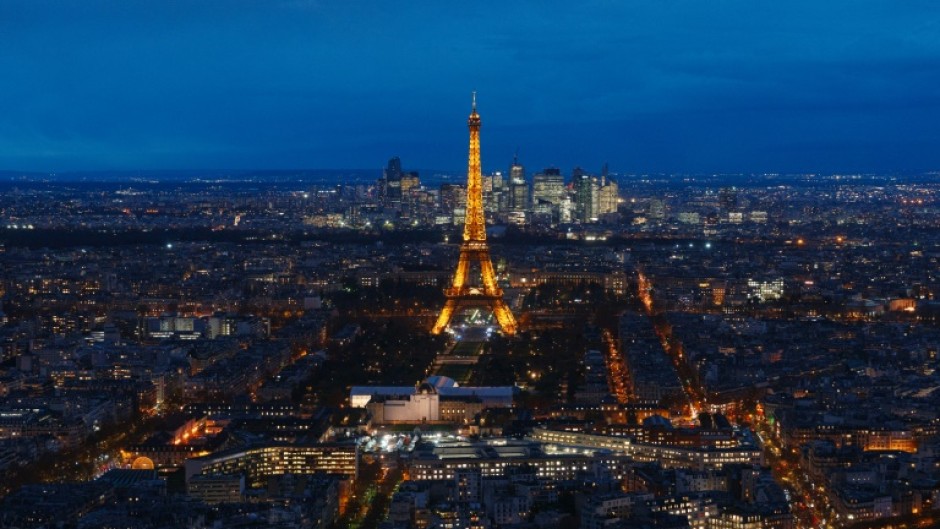
PARIS - Olympic host France retained its spot as the world's top tourist destination in 2024 with 100 million visitors, holding off stiff competition from countries including Spain.
As world tourism returned to pre-pandemic levels with 1.4 billion people taking a trip abroad, according to the UN, both France and Spain announced record visitor numbers.
"While France is still the world leader in this sector, we are facing fierce competition, particularly from Spain," said French Tourism Minister Nathalie Delattre in an interview on Tuesday with the daily Le Figaro.
Spain said last week that a record 94 million foreign tourists flocked to the Iberian nation in 2024, a 10 percent increase from the previous year.
France, which hosted the Olympic Games in July - September 2024, welcomed two more million visitors in 2024, an increase of two percent compared with 2023.
But although France had more visitors, they spent less than those in Spain -- 71 billion euros ($74-billion) compared with 126 billion euros in Spain.
"We need to work to increase the average each visitor spends and get our visitors to stay longer," Delattre said.
France's takings from international tourists rose by a total of 12 percent year-on-year, driven largely by Belgian, English, German, Swiss and US citizens, the tourism ministry said in a statement.
Overnight stays by US tourists rose by five percent, the ministry added, calling the Americans "a key clientele" with strong purchasing power.
Despite the return of customers from Asia, the number of Chinese visitors to France remained 60 percent lower than before the pandemic.
Thirty percent fewer Japanese visited the country than in 2019.
Good snowfall in late 2024 meanwhile drove a rebound for the end-of-year holidays as snow sports lovers flocked to the French ski slopes."The outlook for the first quarter of 2025 is very good, with visitor numbers on the rise," the ministry statement added. France holds off Spain as world's tourist favourite
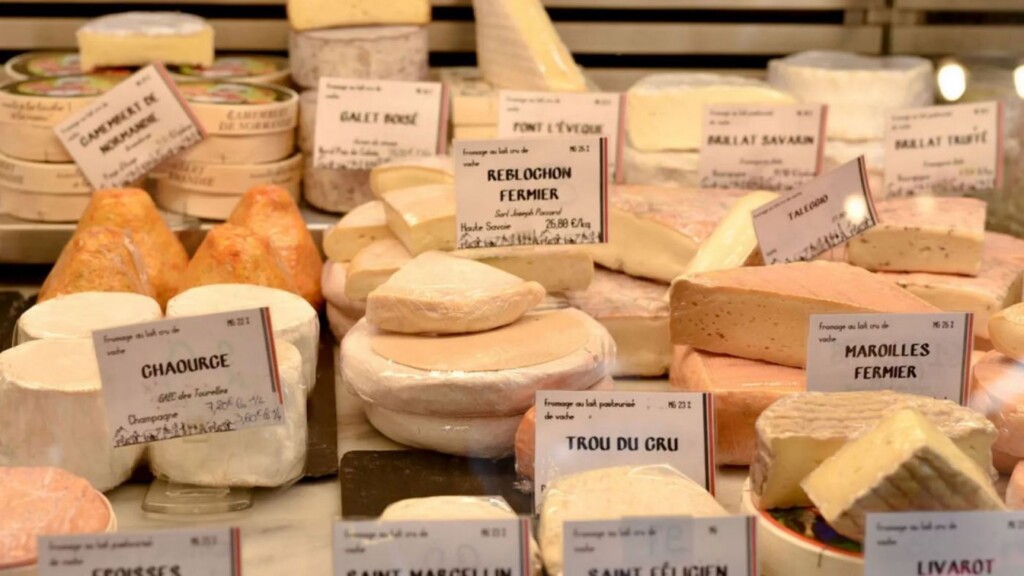
A display case at the Museum of Cheese in Paris – credit, Musee du Fromage, released to the media
Fromage, Formaggio, Käse, Queso: cheese—one of the Old World’s great romance stories.
In the heart of Paris, a new museum has opened dedicated to the ages-old craft of cheesemaking in France, the second most prolific producer on the continent (behind Italy).
At the newly-opened Musee du Fromage, visitors can learn about the history of cheese making, something which may have been going on for 5,000 years. They can learn about the story of various famous French cheeses, see cheese made, talk to real cheesemakers, and yes, taste them.
The mastermind behind the museum is Pierre Brisson—who remembers Sunday afternoons at the market standing on his tippy-toes to look into the display cases of the cheesemakers and marveling at the variety.
Coming to Paris 15 years ago, he saw how developed the Parisian pride and museum scene was for the showcasing of wine, but cheese, perhaps an even more iconic French symbol, was notably absent.
“People can see cheesemaking live and also talk to the cheesemaker,” Brisson told Euronews. “We are working with many traditional farmers, so we want people [to feel like they’re] kind of traveling when they taste the cheese. We are opening a little window in the heart of Paris to the rural side of France.”
The French have invented some of the world’s most beloved cheeses and just to name the headliners, there’s Camembert, Brie, Epoisses du Bourgogne, Roquefort, Ossau Irati, Comte, La Tur, and so many others that French readers are no doubt hollering to be included here.
“[The process] depends on so many things, even the humor of the animals whose milk is being used,” Agathe de Saint-Exupéry, one of the experts at the museum, tells the Guardian. “You can make the same good cheese every day, and every day it will taste different. It just cannot be done industrially.”
Cheesemaking is a good profession in France that makes a better living than other rural activities. Even so, Brisson knows firsthand it’s a productive, sometimes grueling job that is currently experiencing a labor shortage.
Like many nations, there is a continuous movement in France from the countryside to the cities, and Brisson hopes the museum will help people connect with their countryside heritage—and understand its value and what it contributes to French life even in the cities.
“Now, we are able to know, thanks to science, a lot of things about cheese. But our ancestors, they didn’t know all these details, but they still could make amazing cheese and develop very amazing skills of cheesemaking. So there is a know-how that’s developed for centuries that we kind of inherited today. We have a responsibility to keep this alive and to continue to pass to new generations the passion.”First Ever Cheese Museum Opens in Paris: ‘It’s Gouda Brie a Delicious Visit’
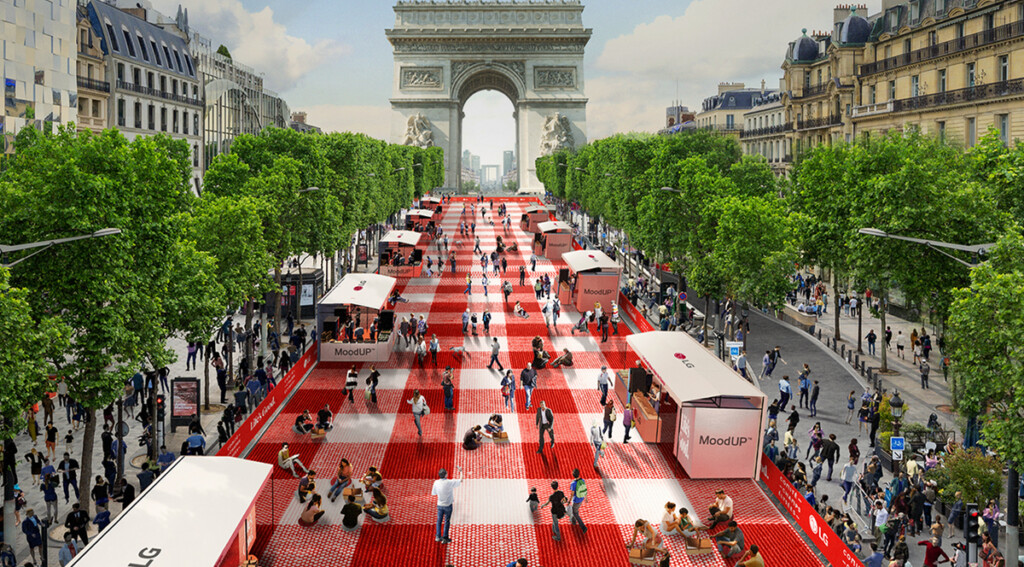
Le Grand Pique Nique, credit – Ubi Bene, released by Paris.fr
Are you in Paris in late May? Well make sure you stay around for Le Grand Pique Nique, or for those of you who chose German, Spanish, or Italian to learn in high school, “The Grand Picnic.”
From the Arc de Triomphe to the intersection of Avenue George V, nine ephemeral kitchens will punctuate a journey along the famous Champs-Élysées for a gastronomic picnic on the largest picnic blanket in the world.
On Sunday, May 26th, LG Electronics is sponsoring this massive eating and promenading event, when 4,000 lucky tourists and locals will have the opportunity to gather around a giant, traditional red and white checkered picnic rug to sample Parisian cuisine.
While it’s a shame that the event is a contest determined via a ballot system, the Champs-Élysées is perhaps the most thoroughly trodden thoroughfare in all Europe, where 100,000 pedestrians passed daily in pre-COVID times.
Today, with tourism more popular and in demand than ever, and with Paris still holding its spot as the most-visited destination on Earth in terms of visitors per square kilometer, prudence is warranted.
Each chosen visitor is given a picnic basket to enjoy samples from the nine kitchens, and each square on the giant checkered rug can accommodate 6 people.
There are also musical events, games, and other outdoor ambiance setters.
As well as giving foodies domestic and international alike the time of their lives, the city is also aiming to set the Guinness World Record for the largest picnic blanket, which they claim their rug will count as.
Those attending may see in advance some of the renovations that architect Philippe Chiambaretta is planning for the €300 million, post-Olympics makeover for the Champs-Élysées, which the mayor’s office admitted to looking “worn out” back in 2021.
They’re known as ‘oily fruits’. Because of their numerous health benefits, notwithstanding their high fat content, almonds, hazelnuts and other nuts are among foods recommended for consumption in Canada, the US, France and across the EU – to the tune of a small handful each day.
From a nutritional standpoint, these hard-shelled fruits are distinguished by high levels (50-75%) of unsaturated fats (which are seen as ‘good fats’), significant protein content (10-25%), plus minerals (sodium, magnesium, potassium), vitamins B3, B9, B6 and E, fibre, antioxidants and vegetable oils. A stack of data suggests that they could help us age well and protect us from a range of chronic conditions.
Stripping out ‘bad’ cholesterol
If there’s one area where shelled fruits [JN1] have proved their worth, it’s bringing cholesterol down. Reducing the amount of animal fat in your diet and eating fibre are, for certain, effective ways to cut levels of LDL-cholesterol, that’s to say ‘bad cholesterol’. But many studies have also shown the benefits of a daily handful of almonds. The same seems true of all nuts.
In 2010, a study of the collected data over the course of 25 clinical trials involving men and women with high cholesterol showed that eating 67g of nuts every day for 3-8 weeks could cut LDL-C levels by 7.4%, with more sizeable effects than this on symptoms since the patients were over healthy limits previously.
Another systematic data reviewconfirmed this, albeit at a more modest rate. Carried out in 2018, it analysed results from 26 clinical trials: the authors in this case detected a 3.7% fall in LDL-C levels for a diet rich in shelled fruits (15-108g per day) over a period of one to 12 months. It’s known that lowering LDL-C levels is linked to a reduction in total mortality and in deaths from cardiovascular disease, particularly if levels were high to start with. Even if no clinical study has yet shown that eating nuts can reduce the risk of heart failure, there’s no shortage of arguments to support such a hypothesis.
Lower risk of cardiovascular disease
First one might point to the results of a meta-analysis published in 2019. Applying the criteria used by Canada’s Cochrane Centre, the authors chose 19 studies, and evaluated that a 28g daily portion of shelled fruits is associated with a 13% fall in cardiovascular disease, and 29% in deaths from heart disease.
You could also refer to a huge randomised and controlled study across many different locations on the role of a Mediterranean diet enriched with nuts in reducing the risk of heart disease. Participants in this, aged 55-80 and registering a significant risk of heart disease were assigned one of three diets – low-fat, a Mediterranean diet rich in olive oil, and a Mediterranean diet with added nuts. They were tracked for almost 5 years on average. At the end of the research, it was shown that heart problems were less frequent among the two groups following the Mediterranean diet.
Fat that doesn’t make you put on weight
On the energy side, 30g of almonds, peanuts, pistachios or cashews work out as a 180 calorie snack; the same quantity of pecans or Brazil nuts come to 220-230 calories. These figures are roughly equivalent to 30-40g of milk chocolate. Since the calorific content is essentially made up of fats, one might be given to think one must beware of ‘oily fruits’ if weight-watching. But that assumption would be wrong…
In fact, a recent piece of research closely analysed six cohort studies and 62 randomised diet tests. This concluded that regularly eating nuts for a longer or shorter period of time (between 3 and 336 weeks) is linked to very slight weight loss (an average of 200g) and a shrinking waistline (by an average of 0.5cm).
If the reasons for these counter-intuitive outcomes haven’t been adequately explained yet, various theories can be put forward. For one, the matrix that encases the oils in nuts limits, to an extent, their absorption in the gut. To put it simply – some of the fat content in nuts is eliminated in the body’s cells, rather than being absorbed. Meanwhile, thanks to how they blunt our appetite, almonds and other nuts reduce the amount we eat at meals, so much so that our overall calorie count is no greater, or perhaps less than it would have been without them.
Do nuts have anti-cancer properties?
Other benefits are attributed to shelled fruits – notably around cancer prevention, although the evidence for this is weak. The relevant studies rely on observations alone, and suffer from various interpretation biases.
Thus, according to an analysis of 33 studies published before June 2019, increased consumption of nuts is demonstrably linked to a 10% fall in cancer risk; and the effect is more marked for cancers of the digestive system, with a risk reduction of 17%.
Nuts’ high antioxidant content might be one of the drivers for this. But before exploring this hypothesis further, we need to check the observed data with verifiable controlled and randomised clinical trials. For the moment, there’s nothing that allows us to say that eating nuts protects against cancer.
Fewer neurodegenerative conditions
Oils and fats are vital for the brain. After fat tissue, it’s the organ in the body richest in lipids: they can be found in the neuron membranes and related cells, but also in the myelin which speeds up the transmission of electrical impulses through the nervous system.
Several research teams have set out to evaluate the benefits of nuts for the central nervous system. What have they learned?
Their notable discovery was that after a few weeks of a diet more or less rich in nuts, 19 month-old rats performed better on psychometric tests. A diet of 2% nuts boosted their performance on a rod-clambering test, one of 6% nuts saw them do better on a plank-walking test, and at both these levels their powers of short term memory were heightened. These results have been confirmed by a study of shorter duration, with a marked improvement detectable in the rodents’ learning and memory.
As for humans, a study of the PREDIMED diet intervention has shown that a Mediterranean diet rich in nuts improves short-term memory. It has also offered evidence, at a biological level, of a reduced risk of low BDNF plasma – a protein which helps the growth and vigour of new neurons. Nuts seem to have a beneficial role at warding off age-related cognitive decline. However, we don’t have direct proof that if one regularly eats nuts, it reduces the risk of neurodegenerative diseases.
To sum up: nuts appear at first glance to have all the features allowing them to be considered allies of our health. While they are calorie-rich and high in fats, a 30g serving per day seems to cut “bad cholesterol” and protect us from cardiovascular disease, without affecting our weight. There are plenty of theories that suggest they a positive impact, both on other illnesses and warding off cognitive decline associated with age.
Plenty of good reasons to recommend everyone to include a handful of almonds, hazelnuts or other nuts in the food they eat each day – obviously without added sugar or salt!
Translation from French into English by Joshua Neicho
Boris Hansel, Médecin, Professeur des universités- Praticien hospitalier, Inserm U1148, Faculté de Santé, Université Paris Cité; Diana Kadouch, Praticien Hospitalier, Hôpital Bichat, Service de Diabétologie-Nutrition, AP-HP, Chargée de cours au sein du DU de nutrition, Université Paris Cité, and Jérémy Puyraimond-Zemmour, Assistant spécialiste, Service de Diabétologie-Nutrition, Hôpital Bichat, AP-HP, Chargé de cours au sein du DU de nutrition, Université Paris Cité
This delicate figure of white biscuit porcelain is part of a grand table design of fifteen standing female sculptures of the “scarf dance” made famous by Loïe Fuller. The group was made between 1898 and 1904, designed by Agathon Léonard for the Sèvres porcelain factory in Paris. This fluid, elegant group was intended for display on a table or sideboard and depicts each step in Fuller’s celebrated dance—“Jeu de l'Echarpe.” Agathon Léonard was careful in the design of the group, mastering each motion and expression of Fuller’s dance. He was born Léonard Agathon van Weydeveldt of Belgian parents and trained as a sculptor, specializing in ceramic modeling. The group from which this sculpture comes is considered one of his great triumphs. The full group, fittingly entitled “Jeu de I'Echarpe,” was first shown in the Paris 1900 Exhibition at which Sèvres won a Grand Prix, and was described in the exhibition report as "elegant figures in a graceful and charming ensemble which were a great and deserved success.” This figure and its porcelain sisters typify the spirit of Art Nouveau style—undulation, movement, and the idealized female form. Léonard couldn’t have picked a better subject than Miss Fuller. The American dancer was a regular fixture at the Folies Bergère, Paris where her free-flowing, silk-clad dance caught the attention of many an artist, including the French artist Henri Toulouse-Lautrec who was also drawn to the elegant theatricality of the spectacle. The figure is marked number “12” of the group of fifteen and bears the marks “S” and “1904.” Source: Stalking the Belle Époque
“Poor Maria, sitting under a poplar…with her elbow in her lap…and her head leaning on one side…dressed in white.” --from “A Sentimental Journey through France and Italy” by Laurence Sterne. Charles Landseer (1799-1879, the elder brother of Sir Edwin Landseer) was inspired to create this painting upon reading Laurence Sterne’s novel “A Sentimental Journey through France and Italy,” 1768. The subject is lifted right from the book, specifically, a character called Maria who lost her true love. At her side is a loyal dog who keeps her company in her grief. Painted in 1836, the canvas shows that Charles Landseer was just as talented as his better-remembered young brother. However, in this composition, like many of his works, it has eben long believed, Charles looked to Edwin for assistance in painting the figure of the dog. Edwin was well-known for his portraits of dogs and animals in general. His handling of animal subjects made Edwin a favorite of Queen Victoria and Prince Albert who commissioned the artist to paint their beloved pets. The painting was exhibited at the British Institute under the title “Sterne’s Maria.” The character of the inconsolable Maria was quite popular in the later 18th century. Engravings of this piece were big sellers. Source: Stalking the Belle Époque
After the Jaipur Lit Fest, it will be Delhi’s turn to host a literary festival next week. The National Book Trust (NBT), which organises the New Delhi World Book Fair every year at Pragati Maidan, has decided to introduce writers’ corners and interactive sessions this year. The decision was taken after taking into consideration the people’s enthusiasm at the Jaipur Lit Fest. NBT’s director MA Sikandar said, “This year’s book fair will be held from February 4 to 10. This time, we have planned four-five events such as talks, readings, debates, workshops and Q&A sessions every day. Earlier, the focus was on the sale of books. But we wanted to innovate. Allowing book lovers to interact with authors was one such way.” There will be four writer corners at the book fair. NBT expects 50-55 English and 25-30 Hindi and language writers to show up for the event. There will be literary encounters and book-signings by noted French authors such as Tahar Ben Jelloun, Kenizé Mourad and Dominique Sigaud. There will also be training on publishing, film screening, interaction with photographers and their exhibitions and writing workshops. The book trust is still in the process of finalising the list but some of the other participating authors include Amit Shankar, Nilanjana Roy, Nirupama Subramanian, Nandita Bose and Girija Kumar, among others. However, the furore that sociologist Ashis Nandy’s comments created at the Jaipur Lit Fest has made the NBT wary. “We’re not going to invite controversial authors. People will be free to air their views, but they should be careful. Everyone is responsible for their actions. We are hoping and praying that everything goes well,” said Sikandar. Literature and cinema was the theme last year and the fair had attracted nearly 1,300 Indian and 30 foreign exhibitors. This year’s theme is ‘Indigenous Voices: Mapping India’s Folk and Tribal Literature’. Multifarious expressions of native cultures will be showcased through book exhibits, art forms, crafts, panel discussions and performances. Riding on the Lit Fest wave, NBT expects an even better response this time. This year France is a ‘guest of honour country.’ “Many authors and scholars from France will engage in conversations with their Indian counterparts at the literary events and professional round tables,” Sikandar said. “Unlike the Jaipur event, ours is a government initiative. We have involved various government literary bodies. For instance, Sahitya Akademi has been entrusted with the task to bring regional language writers,” he said. Image Link Flickr, Source: Hindustan Times
The Voice of Russia continues a series of programs dedicated to the bicentenary of Russia’s victory in the 1812 war against Napoleon. In this program we’ll try to lift the curtain on the mystery of Napoleon’s death. By a whim of destiny and history, Napoleon spent the last years of his life in exile, on a remote island in the South Atlantic. Saint Helena Island was discovered by Portuguese travelers on May 21, 1501 and was named “Santa Helena” after Helena of Constantinople whose Remembrance Day was celebrated on May 21. In the 17th century the island belonged to the Dutch but was seized by the English in 1673. The English government used St.Helena as a place of exile. Napoleon Bonaparte arrived on the island on October 15, 1815. Even though the climate on St.Helena was warm and mild, Napoleon’s health began to deteriorate rapidly in 1819. He would start saying something and stop in the middle of a sentence, plunging into deep thought. At the beginning of 1821 Napoleon’s English doctor, Doctor Arnott, found his condition fairly grave. Nevertheless, there were periods when the emperor felt better and would go out for a walk. He was rarely seen riding in his carriage after 1820 and stopped riding on horseback. By March 1821, he must have realized that the internal pains he was suffering from were caused by cancer, a disease that was hereditary in Napoleon’s family. Cancer killed Napoleon’s father, Carlo Bonaparte, when he was only 40. On April 5, 1821 Doctor Arnott notified Napoleon’s entourage which consisted of Marshal Bertrand and Count Montholon about his patient’s critical condition. When the pains subsided, Napoleon was perky and laughing at his illness. “Cancer is Waterloo that went inside”, - he joked. On April 13 the emperor dictated his will to Count Montholon, who put it down. On April 15 Napoleon re-wrote his will and put his signature under it. Napoleon bequeathed half of his fortune, which totaled 200 million francs in gold, to officers and soldiers who fought under his command, and the other half – to areas of France that were left devastated following the invasions of 1814 and 1815. A point in his will was dedicated to the English and St.Helena Governor Hudson Lowe: “I’m dying an untimely death, killed by the English oligarchy and its mercenary. The English people will take revenge for me”. He bequeathed to his son that he never campaign against France and remember the motto: “Everything for the French people”. Witnesses’ accounts say Napoleon was quite calm as he dictated and then re-wrote his will. In a separate letter, to be delivered after his death, Napoleon asked St.Helena governor to organize the transportation of his entourage and servants to Europe. Napoleon died on May 5, 1821, at 6 pm. He was 51. His funeral took place four days later. Besides Napoleon’s aides and servants, his funeral was attended by the English garrison in full, all sailors and naval officers, all civil servants with the governor, and nearly the entire population of the island. The burial ceremony was accompanied by a gun salute – the English paid their last military honors to the emperor. Even though the official cause of Napoleon’s death was stomach cancer, some historians put the blame for his death on English politicians who they say set their minds on ending Napoleon’s influence in Europe which remained strong despite his incarceration on Saint Helena. Reports that Napoleon was poisoned with arsenic appeared in the 1960s, after a forensic analysis of a lock of Napoleon’s hair revealed lethal levels of arsenic. recent research refutes those findings. A group of French experts who examined locks of Napoleon’s hair that had been cut off before his exiles in 1804 and 1814 found that these hairs contained an equally high level of arsenic, which exceeded the norm by more than 30 times. Nevertheless, a number of French experts still believe that arsenic poisoning was one of the most probable reasons behind Napoleon’s death. They say that the emperor had been exposed to arsenic on several occasions and long before his exile to Saint Helena. How it could have happened, remains a mystery. Scientists suppose that the presence of arsenic in Napoleon’s hair could be explained by its presence in cosmetic remedies for hair loss. All attempts to secure permission for exhumation of Napoleon’s remains from the French authorities have brought no results. Apparently, the mystery of Napoleon’s death was buried together with the emperor. On the Voice of Russia World Service we presented another program dedicated to the bicentenary of Russia’s victory in the 1812 war. Source: Voice of Russia
A man behind perfect shapes of Penelope Cruz and Jennifer Lopez – Pierre Dukan claims he has made 15 million women thin. His 4-stage diet is booming among the gourmets worldwide. The Voice of Russia caught up with the French slimming guru, as he is in Moscow to share his expertise. Dukan admitted he is not gastronomically sinless and is himself a follower of his diet – and even unveiled his preferences among the fair sex.
(1) Monsieur Dukan, what is your diet? Do you stick to any rules in eating? Are you following what your family eats?I do myself exactly what I said, but not to lose weight, to stabilize my weight. When I put on weight during vacation, during Christmas, for example, immediately after it I start the first phase of my diet – protein and vegetables. And in a few days everything is away. My son is 28, and my daughter is 24. For them it’s the same. Of course, they like everyone else eat sugar, but they have a pattern of dieting, that is correct. And if you have a basic pattern you can make exceptions. But you must have something solid, and then you are free, you can go everywhere. (2)And what is your favorite dish? My preference is couscous. I love couscous. Well-done… that! Three-four times a year, but I love
that I love Moroccan one. Let’s talk about normal weight and beauty standards. They have changed – for example, in the 1960s, in the 1970s, the women used to be plumper, and it was considered to be beautiful. (3) What do you think about that? It depends on the country, on the civilization, on the culture, on the religion, but now, with the globalization – the planet is small now and with the communications growing it appears to be something standard. And you know how every star in the world looks like. They look similar. And models – the same. When I go to China or to Brazil, women want to be thin. But it’s not always good to be thin. It’s nice to have pulp. It’s not necessary that everyone is the same. We must have diversity. People like man tall or small, women large or thin. You must in the first place respect your nature and harmony. Sometimes it’s better for somebody to be pulpous, and sometimes it’s better for you to be thin. It depends on your morphology, your bones and your charm. You can have better results of seduction with pulp, than being thin. Sometimes it’s not very good.(4) And what about you? What are your preferences?My preferences go to the women who are curved. I don’t like the model prototype – very, very thin, without contrast of shape. I love shapes on women, even on the face. That’s very nice. Every shape is in the nature. But it’s not good to have a dictatorship of the shape, because it’s very difficult. If you are not meant for that saying ‘you must be like that’ is a frustration. "(5)Have you ever received letters full of anger from some clients saying ‘I tried, but it didn’t help’? Any complains form dissatisfied clients about your diet? People are not dissatisfied. Sometimes they can’t do it because life is difficult, but they know that it comes from them, not from me. If you follow the diet, normally you lose weight. It’s not possible, it’s not normal. We have physiology, and if we respect physiology, we lose weight. And sometimes you feel guilty, by yourself, because you say ‘I can’t resist to an ice-cream’ etc. It depends on the life. If you have lots of stress, discomfort, difficulties, you can be tempted to make lapses. In France, we say: “If you are in love, you can live with only water.” It’s a proverb. And we don’t need anything else. We are full of satisfaction and fulfillment. Thank you, it was a pleasure talking to you. Thank you, it was a pleasure. Source: Voice of Russia, Source: flickr.com
By minouette (scientist by vocation artist by avocation) : As we approach Remembrance Day, I am thinking about art about war, and memorializing the lost. Textile artist Vanessa Rolf's series 'Poems to the Sea' 2009-2011 includes quilts and needlework documenting naval warfare in WWII. Her beautiful
Vanessa Rolf, His lowly grave, 2012. 55cm x 40cm, canvas and thread
Inherited patched canvas embroidered with the names of German battleships sunk during World War 2. 170cm x 105cm. Canvas and thread.
tapestries and quilts, on inherited canvas, and in their limited colour palette of blues and whites, are quite evocative. The HMS Kimberley above, was a Royal Navy K-class destroyer, which was one of only two of its class to survive the war. The pieces below shows the name of all German vessels which did not survive
Vanessa Rolf. Mers el Kebir,2012. 45cm x 40cm, cotton and thread
and a memorial to the sailors who died for France at Mersel Kabir in 1940. I wrote previously (Juxtaposition and Craftivism) about the power of contrasting media (in artworks which have been traditionally deemed 'craft' and even sometimes 'women's work') with implements of war and violence. Remembrance Day is not only a day to give thanks to those who gave up their lives, and surviving vetrans
who served their nation in times of war, but to recall the horrors of war and the senselessness of violence. We also mustn't forget the thousands of civilians lost to wars. This brings to mind two other artists, who have created works about and with weapons. British artist Magnus Gjoen "often questions the correlation
Magnus Gjoen, Flowerbomb, Digital Vexel art
between religion, war, beauty & destruction in his art," and plays with making extremely destructive weapons beautiful and fragile. Mexico-city based artist Pedro Reyes has created a series of 50 musical
Magnus Gjoen, AK-47 Concert of Birds, Digital Vexel art
instruments called 'Imagine' working with 6,700 guns seized by the Mexican government related to gun violence and the drug war in the country. He is constrasting their new, modified, potential to create
beautiful music from their violent pasts. Almost 80,000 people have lost their lives to gun violence in Mexico over the last six years and the project serves as requiem. He writes, "It’s important to consider
that many lives were taken with these weapons; as if a sort of exorcism was taking place the music expelled the demons they held, as well as being a requiem for lives lost.
Made in France in 1785, this gown boasts a skirt of printed cotton and an exquisite silk bodice which appears to be two separate garments, although the two are sewn together. The light cotton is printed with a pattern of pine trees, lilacs, dianthus, convolvulus and daisy trails. The bodice, typical of the 1780s, is tight fitting at the back and closes in front. Source: stalking the Belle
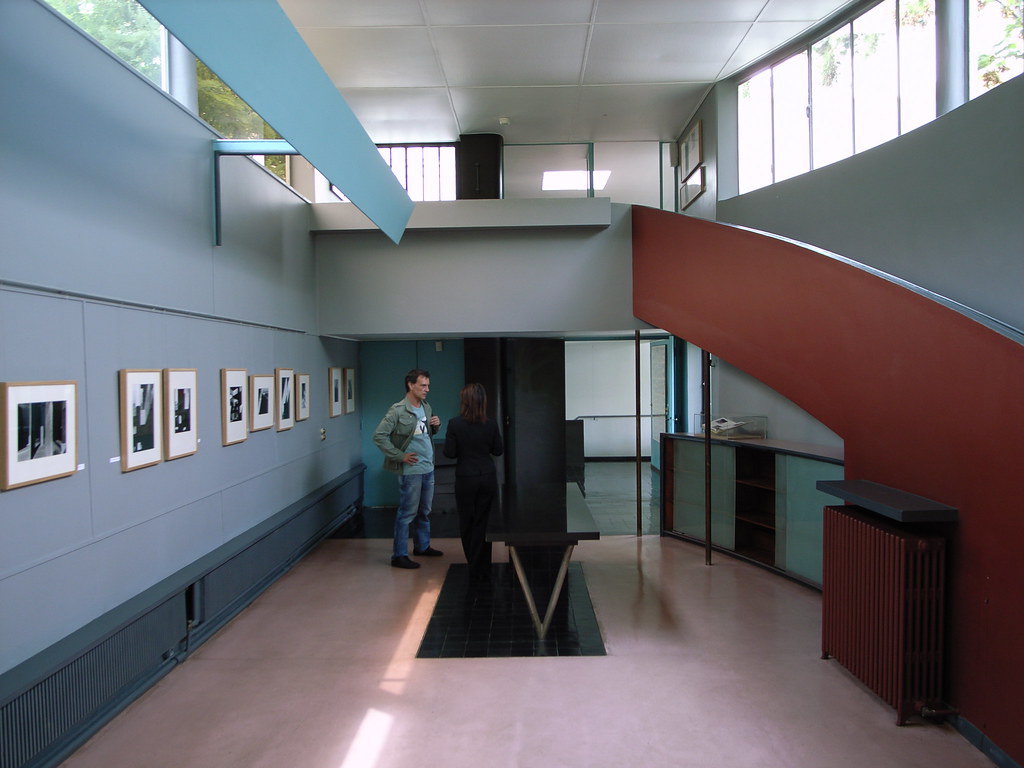
The exhibition headlined “Le Corbusier. The Secret Laboratory: between art and architecture” opened at the Pushkin Museum of Fine Arts in Moscow to run through November 18th.
By Tatiana Zavyalova, This is the first time that Le Corbusier`s legacy is so widely represented in Russia. The collection features over 400 pieces created by outstanding French architect of the 20th century: paintings, drawings, wooden sculptures and tapestries, tables, armchairs, photographs and architectural models. This all helps to have a deeper insight into the life of Corbusier as a pioneer of modernism. The architect’s legacy includes buildings in twelve countries, including Russia. In Moscow he designed the Tsentrosoyuz Building on Myasnitskaya Street which currently is the home to the Russian State Committee for Statistics. Constructed in 1933, the building still looks impressive. Le Corbusier was very interested in working in the Soviet Union, he was inspired by the Soviet ideology of a new world order. Encouraged by the success of his first project in Moscow, Le Corbusier expected his project of the Palace of the Soviets to be implemented, too. But the jury was not impressed with the interior designs which they found ‘too liberal’. Professor at Sorbonne in Paris and at the New York Institute of Fine Arts, Jean-Louis Cohen: “Le Corbusier invented the so-called architectural promenade,a kind of a pathway which allowed people walk freely inside the building.” In the 1930s Le Corbusier suggested a new look on the Moscow urban policy but his ideas were not accepted. Today when the Russian capital is expanding the ideas again sound up-to-date. The deputy director of the Moscow Pushkin Museum of Fine Arts, Andrei Tolstoy: “In the 1930s the central Moscow looked differently. Now we can hardly breathe due to the jam packed traffic even in broad streets. Then practically all streets in Moscow were much narrower. Le Corbusier predicted the city expansion and offered his solution.” It took two years to prepare the exhibition at the Pushkin Museum. The company’s unchallenged director Irina Antonova insisted that the collection transported from France comprised as many pieces as possible, including Le Corbusier`s collection of sea shells. The Barcelona School of Architecture made over 10 architectural models byLe Corbusier especially for the exhibition in Moscow. By the way, the Tsentrosoyuz Building in Moscow designed by Le Corbusier is open to everyone willing to have a stroll inside this modernist building. Soon, a memorial dedicated to the great constructivist architect is going to be unveiled outside the Tsentrosoyuz. Source: Voice of Russia, Image: flickr.com
Immortalised in Bronze: A statue depicting Zinedine Zidane's headbutt on Italy's Marco Materazzi in the 2006 World Cup final has been unveiled outside the Pompidou museum in Paris
Zinedine Zidane's infamous World Cup final headbutt on Marco Materazzi has been immortalised by a five-metre high bronze statue in the heart of Paris. The shocking incident, in the 110th minute of the 2006 World Cup final with Italy, ended the legendary Frenchman's international career and the red mist moment Moment of impact: The statue, by Algerian artist Adel Abdessemed, captured the red mist moment from the 2006 World Cup final between Italy and France in Berlin
has been captured byAlgerian-born artist Adel Abdessemed. The statue has been unveiled outside the famous Pompidou art museum and shows the grimace on the Italian defender's face as Zidane plants his shaven head into his chest. Zidane had been planning to step down from the national team after the tournament but he bowed out early - and literally - after Materazzi allegedly made a derogatory remark about his sister. It meant Zidane, one of the most gifted midfielders of his generation who shone for Juventus and Real Madrid and helped France to World Cup glory in 1998, missed the penalty shoot-out in
which Italy won. This is the end: The incident marked the conclusion of Zidane's illustrious international career.Source: Travelfwd+, open images in new tab or window to find its source of sharing
New groove: Guitarist Gilad Hekselman will be the main attraction at the Tokyo Jazz Festival's "Taste of Israel" program at the Cotton Club.
By JAMES CATCHPOLE: Jazz fans in Tokyo are already a lucky bunch, but when the Tokyo Jazz Festival (TJF) announced Ornette Coleman as this year's headliner it became clear — we're downright spoiled. "We've been trying to get him to come play the festival for years," says Atsuko Yashima, TJF's executive producer. "At his age (82), coming all the way to Tokyo for a gig is not easy. We're thrilled we could feature him." Coleman will headline the festival's "Jazz Roots" program at Tokyo International Forum Hall A on Sept. 8. He'll join an already impressive bill that night, but stands out as a major coup for the festival's 11th edition. The Texas-born musician is now known as a visionary and innovator, but was originally accused of being a phony. His style of soloing, which lacks a harmonic background, can sound shrill to many who are new to his music. This has made him one of the most controversial figures on the jazz scene over the last 50 years, with critics and peers leveling charges that he couldn't really play his instrument. Even trumpeting giant Roy Eldridge was quoted as saying, "I've listened to him high and cold sober. I've even played with him. I think he's jiving, baby." As time passed, though, Coleman's technique and complex musical theory of harmolodics came to be regarded as genius rather than lunacy. His tone on the alto saxophone is a primal, blues-soaked wail that has become a part of the legacy of 20th-century jazz. Even on his most dissonant recordings, the artist's complete mastery of melody and deep feel for the blues comes through (the latter a product of his R&B background in Texas). With more than 50 years of live performances behind him, Coleman's shows are usually unpredictable. It's common for him to pull out songs from early in his career from albums such as "The Shape of Jazz to Come" (1959) and "Change of the Century" (1960). His gig at Orchard Hall in Tokyo in 2006 is still reminisced over by local jazz aficionados, and recent reviews of shows in London have been ecstatic, with British newspaper The Guardian calling his gig a "thrilling journey." Coleman will play with his double-bass quartet alongside his son, drummer Denardo Coleman, and since this may be his last time in Japan, it could be the can't-miss jazz gig of the year. The "Jazz Roots" program has the most enticing lineup for hard-core fans. Opening the Coleman-topped bill will be pianist Makoto Ozone, whose Jazz Journey show is set to feature noted musicians Ellis Marsalis, Christian McBride and Jeff "Tain" Watts. Ozone has been playing with the talented rhythm section of McBride and Watts for years now, and his Tokyo Jazz Festival appearance will give him the opportunity to share the stage with Marsalis, the patriarch of one of America's most notable music families. Ozone, McBride and Watts are set to extend their festival performance into a short Japan tour as a trio as well, hitting venues in Nagoya, Osaka and Iwate Jazz in the prefectural capital of Morioka, so it looks like jazz fans in Tokyo won't be hogging all the fun. With last year's so-called world acts proving to be a popular addition to the side stages, this year five countries are being profiled in addition to the bigger American acts at the main hall of the International Forum. The Cotton Club and the plaza outside the main venue will feature artists from The Netherlands, France, Norway, Australia and Israel. Guitarist Gilad Hekselman is Israeli, but relocated to New York in 2004. Hekselman should put on a particularly interesting show as he has been getting some very good press from his gigs in New York, which boasts the most competitive jazz scene in the world. Hekselman will be joined by frequent collaborator American Mark Turner on saxophone for this, his fourth visit to Japan. "I'm always happy to come back," Hekselman tells The Japan Times. "I love the audiences, the culture, the people and, of course, the food! For me as an artist, it means a lot to feel that our music touches people and that it's appreciated." This kind of international pairing is becoming more commonplace in jazz as musicians link up via the Internet, relocate and collaborate together. Some critics have voiced concern about a kind of blandness that could come from this leveling off of global scene, which they worry would reduce it to ethnically accented background music streamed in the hip cafes of New York or London. However, such globalized shows at the festival have previously only succeeded in reaffirming jazz's legacy as an open-minded music genre, and it's encouraging to see festival planners continue down this road. Something that has been happening at jazz festivals worldwide that has come under more criticism, however, has been the addition of bigger-name acts to lineups in an effort to draw in more punters. Die-hard fans (and some musicians) have been adamant in their opposition to this trend and want to keep jazz front and center, but financial realities look likely to make the "big-name draw" a continuing part of the show. Tokyo Jazz Festival does a fairly good job when it comes to picking more well-known artists. This year's "The Songs" program features gospel group Take 6, soul giant Ben E. King and songwriting master Burt Bacharach. The lineup likely targets an older music fan, although younger customers may be familiar with King's hit "Stand By Me." His set will also feature Yoichi Murata's big band, which should be interesting. King is of course best known for his soul music with The Drifters, but he has been performing with jazz bands for more than a decade now. Finally, "The Groove" program on Sept. 9 will likely appeal more to younger audiences, with the American-Israeli Balkan Beat Box joining local favorites Soil & Pimp Sessions for a set. U.S. horn gods Tower of Power follow; they play annually in Tokyo and it's always one of the hottest nights of the year. Funk-rock pioneers Rufus will close out the program with the Tower of Power horn section, and Tokyo artist Shikao Suga is scheduled to join in. That might not make up for former Rufus member Chaka Khan not being there, but the set should still be great. Finally, the main hall events conclude with the Sunday night "Put Our Hearts Together" program. Don't be put off by the smooth-jazz sounding title. The name comes from a project carried out by jazz pianist Bob James in the aftermath of the Great East Japan Earthquake. Grammy Award-winning bassist and vocalist Esperanza Spalding will take the stage first, followed by Japanese fusioner Casiopea3rd. The Bob James Quintet will close out the night and the set will feature plenty of special guests. One of the more notable names on the roster is Japanese pop star Seiko Matsuda. How she fits in with James and his group is a bit of a mystery at the moment, but as a pop draw she should be a surefire success. The Tokyo Jazz Festival takes place Sep 7-9 at Tokyo International Forum Hall A, Tokyo International Forum Plaza and the Cotton Club in Chiyoda-ku, Tokyo (starting times and ticket prices vary). For more information, call (03) 5777-8600 or visit www.tokyo-jazz.com. Source: The Japan Times Online
A museum devoted to the 200th anniversary of the War of 1812 opens today in Moscow.
Uniforms and weapons of Russia and France, rare maps and documents, decorative arts and objects of military life will allow visitors to experience the atmosphere of the war of 1812. One of the features of the new museum is a multimedia information system, which includes interactive battlefields, and animated maps of major military campaigns. Source: Voice of Russia
If you were a wealthy land owner in Britain in the Eighteenth Century (rather as it is now—anywhere), you wanted the people around you to know just how rich and prosperous you were. Your house, your carriage, your horses, your clothes, your jewels—these were all status symbols. But, the real indicator of wealth was your ability to decorate your house. The more you could spend on your interiors, the better you looked. And, the real icing on the decorating cake was the paintings you displayed in your home. Portraits—sure, they were great. But, the best thing of all was to commission a painting of your family in your home. And, even better—a mural, right there on the wall, forever. Of course, even mural painting was subject to levels or pretension. If you could get a foreign painter—you were the top dog! Painters from France, Italy and the Netherlands were brought into the stately homes of England to adorn the walls with scenes from mythology, allegorical motifs, fantastic designs and bucolic views—most of which would incorporate the visages of the homeowner and his family. Here we see one such mural which was carefully removed from its original location. Thankfully, the murals were painted on canvas which had been applied to the walls, conveniently allowing them to be removed two centuries later. This is one of a series of 16 panels which were commissioned by Charles Calvert, 5th Baron Baltimore, in 1742 to decorate the “Scaramouche Parlour” in his house, Belvedere, in Kent. Each of the panels depicted scenes from the Italian Commedia dell'Arte and showcase the knock-about comedy’s most famous characters: Capitano, Arlecchino, Pulcinella (who, as we know, inspired the English Punch), Pedrolino (later Pierrot) and Colombine. The mural group is the work of Andien de Clermont (active 1716-1783), a French artist who arrived in Britain in 1716. Clermont was, certainly, the most avant-garde and highly-inventive decorative artist working in Britain during the Rococo period. This mural sets the scene for the antics of Pulcinella and his friends. An unnamed young man is depicted playing the violin. He stands in profile in the foreground of a landscape with a grand building showing in the background. To his right are two dancing figures. The whole is en-framed by foliage border. Source: Stalking the Belle Époque
In this world couples want to have more and more romantic trips with their buddies but sometime they get confused to choose the best romantic destination. So here we have brought some of world’s best romantic destinations for the romantic couples. Schönbrunn Palace, Vienna , Austria it comes on the top among the topper list of romantic destinations. It is best for lovers and this palace has inspired poets, writers and painters. It has 1,441-room imperial building and grounds that drag back to the 16th century. Paris, France this is the most romantic location for love birds it is known as Luxembourg Gardens. It has a quality to push the humans near it. Agra, India, it is a monument in white marble and it is popularly known as a place for romantic couple because it was made in the memory of a beautiful queen. It is beautifully designed and a lot of tourists and people from overseas visit here and enjoy. Alhambra, Granada, Spain, this place was constructed in 14th century by a Muslim dynasty. It was rediscovered in 19th century now it is restored. London, Great Britain, looks great when you go up and say your partner that 3 magic words, amazing experience. It has ignited a lot of couple’s romance. San Francisco, California San Francisco what we should say about it is dearth of heart stopping place. Here anyone can take a beautiful experience its best part is the art museum. Vancouver, British Columbia, Canada it is salubrious for everyone as it’s water waves are charming when anyone goes at Vancouver, definitely ignites the romance. Verona, Italy it is a place where many of love stories converted into a heavenly life. It is best for smitten lovers and it attracts the many of couples form whole world. Bourbon Street, New Orleans, USA it is a historical street and full of dynamism. It has complete store of strip bars, restaurants as well as gay nightclubs. Australia – The Whitsundays, it is a group of island in Australia. It is a largest Whitsundays island and a haunt for honeymooners. Source: Medley News , Image: flickr.com,


 Le Grand Pique Nique, credit – Ubi Bene, released by Paris.fr




 DO economies have to grow? Or, to put the point another way, what do they have to grow for? As rich countries suffer their worst failure of economic growth since the Second World War, those questions have resurfaced with a new urgency. The sense that our prevailing economic model is bankrupt, allied to fears that the world is heading for catastrophic climate change, has stoked demands for a radical rethink of the guiding principles of modern capitalist democracies. Answering that call, an assortment of pundits have been issuing challenges to political and economic orthodoxy, offering alternative visions of what a good society would look like. At the user-friendly end of the field, Zac Goldsmith, an environmental adviser to the British Conservative party, has taken an amiable stroll round the issues in The Constant Economy. At the more rigorous end, a commission convened by France’s former president Nicolas Sarkozy and led by the Nobel prize-winning economist Joseph Stiglitz has examined the limitations of standard gross domestic product data as a lodestone for policy. Between those extremes lies Tim Jackson’s Prosperity Without Growth: Economics for a Finite Planet, a challenge to mainstream economic thinking that is both accessible and robustly argued. Jackson, a professor of sustainable development at the UK’s Surrey university, has thought hard about the subject. His prose is lucid and lively, and many of his policy prescriptions are sensible. Jackson is a member of the British government’s Sustainable Development Commission (SDC), and the book draws on a report for that commission published earlier in the year. (Full disclosure: I also served on the SDC until 2004.) For a work by a government adviser, based on an officially supported research project, his stance is also refreshingly radical. Yet for all these strengths, his argument is flawed. Jackson’s starting point is that, as he puts it, "a return to business as usual is not an option." If economic growth carries on as it has done since the industrial revolution, he writes, "by the end of the century our children and grandchildren will face a hostile climate, depleted resources, the destruction of habitats, the decimation of species, food scarcities, mass migrations and, almost inevitably, war." In his strongest chapter, he takes on what he calls "the myth of decoupling": the idea that the link between economic growth and environmental damage can be broken. Typically, the environmental impact of an economy, relative to its income, falls as it gets richer. But while that "relative decoupling" is well-established, "absolute decoupling" — a decline in greenhouse gas emissions, for example — has been elusive. Jackson’s conclusion is that if economic growth cannot be separated from environmental damage, then — in rich countries at least — it is growth that will have to be abandoned. Instead, he argues, societies can attain a truer prosperity that "consists in our ability to participate in the life of society, in our sense of shared meaning and purpose and in our capacity to dream." Lives of frugality and simplicity, with stronger communities and healthier relationships, will make us more genuinely prosperous than our present obsession with "material pleasures", he argues. This is, in many ways, a beguiling vision, particularly at a time when the pursuit of prosperity in the material sense has proved so harrowing. The problem comes with reality. Jackson’s policy prescriptions — including greater financial prudence and tighter regulation of TV advertising — are all sound, to varying degrees. Yet they take only the smallest of steps towards the post-growth society that he suggests we need. His only idea that could put the brake on growth would be cutting working hours. Here he takes the economist’s famous "lump of labour" fallacy — the idea that there is only a fixed amount of work to do that has to be shared round — and suggests it should be a goal of policy. Yet in anything other than a perfect utopia, the idea that there is no more work that needs doing is ludicrous. There are other problems, too. Jackson has no answer for the question of how a post-growth economy would handle technological innovation, or a refutation of Benjamin Friedman’s argument, in his excellent The Moral Consequences of Economic Growth, that rising standards of material prosperity foster opportunity, tolerance, fairness and democracy. A society that has given up on growth seems unlikely to be the open, friendly community of Jackson’s imagining. His pessimism about decoupling is probably also overdone. There is plenty of analysis, from Lord Stern’s report on the economics of climate change, to show how carbon dioxide emissions can be cut to keep global warming within reasonable limits while the world economy continues to grow. While the goal may be achievable, reaching it will require an enormous effort. By daring to challenge one of the fundamental precepts of orthodox policy-making, Jackson performs a valuable service in reminding us of that. His questions are worth asking, even if his answers are wrong. TITLE: Prosperity Without Growth: Economics for a Finite Planer. Author: Tim Jackson, Publisher: Earthscan, © The Financial Times Limited.