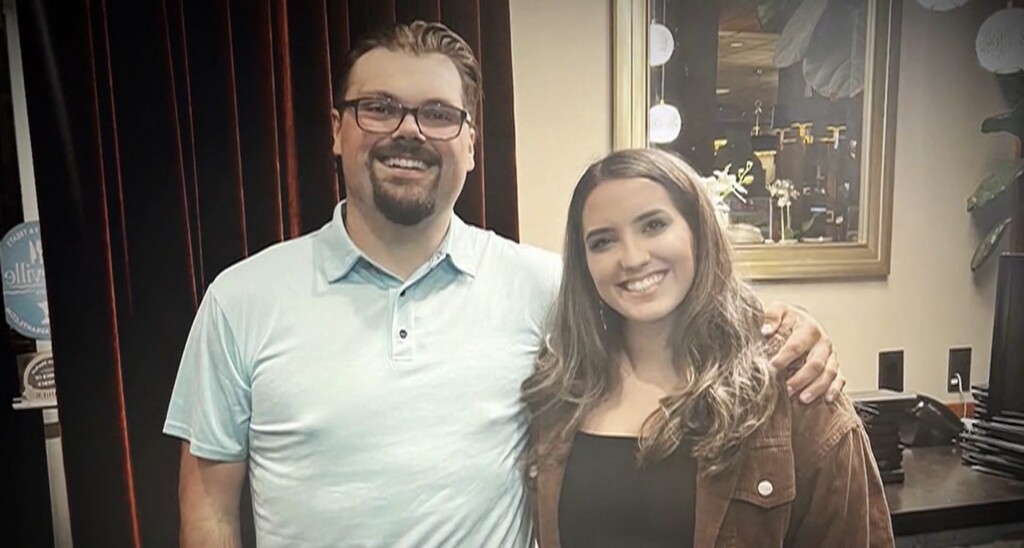
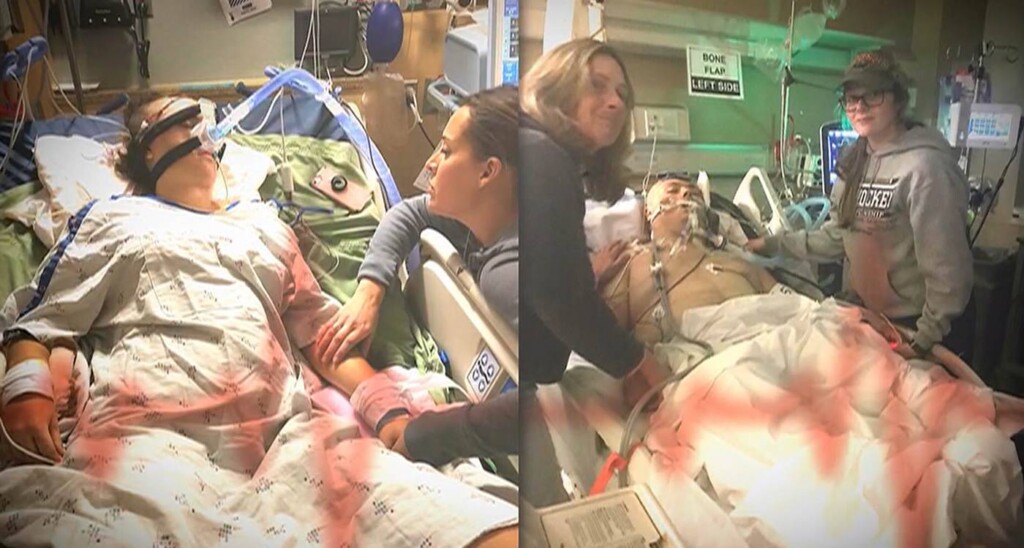
Zach Zarembinski and Isabelle Richards – credit, family photo
credit – family photo
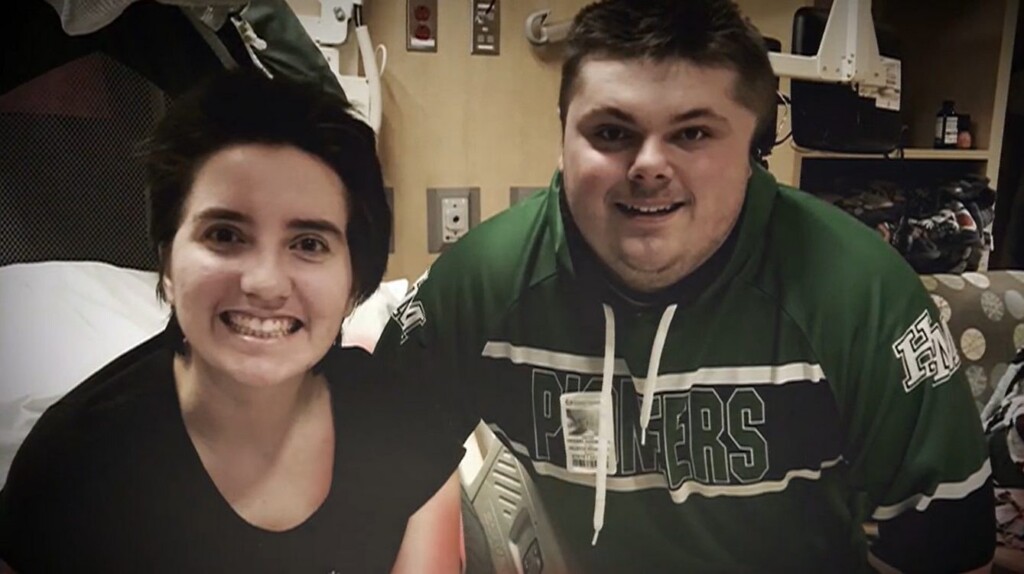
Zach and Isabelle after they’d both woken up – credit family photo
Zach Zarembinski and Isabelle Richards – credit, family photo
credit – family photo
Zach and Isabelle after they’d both woken up – credit family photo
Thousands of couples will celebrate a day of romance this week, while many single people will hope for their own one. But what makes a relationship last? And what makes one couple crumble while another becomes stronger?
There are some psychological theories that can explain romance and relationships. Theories of love and romance are often misinterpreted as cold or callous. But knowing the physics behind rollercoasters does not reduce their thrill and excitement. In the same way, the thrills, spills and romance of relationships exist far beyond the theories.
The formation of a relationship is arguably the one of the most special moments. Life seems a little brighter, a little happier, and a lot more beautiful.
Sadly, for most, this only usually lasts for a matter of rose-tinted weeks, until the honeymoon period wears off and reality seeps back in. The halo is removed, and the effect is diminished. It is at this stage that arguments usually begin, which, while not inherently unhealthy, can become so if they go unresolved.
Some do find the resolution; others find their constitution – to continue. For those that do continue, the question psychologists often face is: why maintain an unhealthy relationship? It is to this question that psychological theories can shed some light.
A man sits at a casino table, having lost a small fortune over a large amount of time. He mutters to himself: “my luck will change soon”. A woman sets out to go to work and sees it’s raining. Her car won’t start, and her umbrella is broken. Forlornly, she whispers: “surely, no more bad luck can happen”.
In both cases, this is the gambler’s fallacy at work – the belief that runs of bad luck cannot last. This same effect can be used to explain why someone in a relationship continues to hope the relationship improves despite long periods of dysfunctional interaction.
In nature, previous events seldom predict the future. In human nature, our past strongly predicts our future.
Even when confronted with overwhelming evidence to the contrary, you still believe what you want, and this belief is an impenetrable fortress. An overarching explanation for why people will not quit at relationships is our own ego. Implicitly, when we make most choices, we believe we are correct.
To justify our choice, we then seek information to support it – sometimes dismissing or denying evidence to the contrary. Religion’s representation of miracles is an example of this.
Irrespective of the myriad examples that falsify a claim, the one example that supports it is heralded and exaggerated. The scales should be weighed and judged equally.
After some time, the relationship may have effectively broken down. Friends, family and the voice in your head are calling for a break-up. But some people still will not end their relationship.
Why? Notable, Noble-prize winning economists developed the theory of “loss aversion” to explain people’s behaviour in winning and losing situations. On the one hand, having a dysfunctional relationship is a harmful, hurtful experience. However, usually by this stage, a person’s self-concept is so merged with their partner that being single seems worse still.
Studies have shown that our self-esteem can become dependent on a partner, and so losing a loved one really is like losing a part of you.
But tearing a band-aid off quickly hurts less in the long-run.
The psychology of romance can go a long way to explaining why some people maintain commitment to a relationship that seems to have broken down. Ultimately, few relationships are all smooth sailing, and no success achieved ever came easily. The journey is long, and at times a struggle.
However, always be willing to openly ask yourself: what would I advise a friend in my position to do? Some psychological theories can help us understand why some people stick with rough relationships and try to ride out the storm. Even the best explanations and theories, however, cannot explain what it is to see colours or enjoy rollercoasters.
Given the unpredictable, irrational nature of humans, maybe all you need is love.![]()
David Keatley, Lecturer in Psychology, Curtin University
This article is republished from The Conversation under a Creative Commons license. Read the original article.
Romance scams – where scammers create fake identities and use dating or friendship to get your trust and money – cost Australians A$201 million last year.
But the emotional impact of romance scams can often feel worse than losing money. Those who have been scammed may experience shame and embarrassment and have difficulty accepting the relationship wasn’t real.
People who have acquired a brain injury, for example after a stroke or car accident, may be more vulnerable to these scams. My research with colleagues shows they are often less aware of scams and find it harder to recognise red flags.
But our project has found there are benefits when people with brain injuries who have been scammed share their experiences. It can create awareness, reduce stigma and help prevent future scams.
Anyone can be scammed. But some groups are more at risk, including people with a disability such as an acquired brain injury.
We surveyed 101 clinicians in Australia and New Zealand who work with people who have acquired brain injuries. More than half (53%) had a client who had been affected by a cyberscam. The most common type was a romance scam.
Romance scams involve a scammer (or sometimes multiple people) luring someone into a fake relationship in order to exploit them, often to get money. Scammers may use online dating platforms to connect, or social media, gaming and even online shopping sites.
Romance scammers build trust and strong emotions using techniques such as love bombing (early and frequent declarations of affection), grooming and manipulation over an extended period of time. They share common interests and even similar types of trauma to make people trust them. As a romance scam survivor with an acquired brain injury explained:
My way of thinking was sort of skewed because all I seen was love, the money, all the things I wanted, so I didn’t worry about all the other little stuff.
The identity of the scammer usually appears very attractive and trustworthy but is often fake, stolen from a real person or AI-generated. They present lots of evidence and exciting details about their everyday life to appear real and keep people hooked into the relationship.
Scammers use pre-written scripts with compelling narratives describing significant financial success, being a widower or orphan, or working overseas to attract people. Flirty language and flattery makes people want to keep communicating with the scammer. They might tell you they think you have a beautiful smile and their dog or cat would love you.
Scammers will invest weeks and months to build up a connection, then scammers present exciting “opportunities”. These may include investments and requests to cover international flights for a first meet-up. Or paying for medical bills for a sick relative. As a scam survivor with an acquired brain injury explained:
She was really jumping into a kind of quite intimate relationship with me, even though we haven’t met yet, but she’s promising we will one day. All I need to do is send money.
One in 45 Australians lives with a brain injury acquired during an event such as car accident or stroke. This can damage a specific part of the brain, widespread brain cells (neurons), or both.
The impact of a brain injury varies but can affect cognition, emotions, behaviour and neurological functioning. As a result, people can experience changes in their ability to care for themselves, work, socialise and make complex decisions.
Cognitive difficulties – such as memory problems and reduced information processing – can make it harder to learn, notice and respond to scam red flags in real time. People may struggle to comprehend new or complex information, have reduced judgement and be more impulsive.
Like other vulnerable Australians, people with brain injury may also be bored, lonely and require care. This may mean the scammers’ constant online availability, messaging, attention, praise and acceptance of the person regardless of their disability is even more attractive.
People with acquired brain injuries may also struggle to move from knowing or intending to do something, to actually enacting that behaviour. This is called the frontal lobe paradox. As one of our interviewees explained:
I make some big realisations and then I forget about it, like … ‘don’t do that again’. And then I go and do it again.
When the scam is uncovered, family, friends and frontline services such as police and banks may respond with blame, judgement and ridicule. This contributes to further distress:
They just say how stupid I was for being conned.
Scams are likely under-reported to authorities such as Scamwatch as a result of shame and a lack of awareness about scams.
Family and clinicians of people with brain injury may cut or reduce their access to money or the internet, which adds to the scam’s financial and emotional impacts.
As one clinician explained:
The depression […] didn’t come from being scammed. It came from quite the opposite, almost like he […] feels like it’s his right to have access and leave himself open to those things.
Our research team has developed a suite of tailored resources called CyberAbility, which were co-designed with people who have brain injuries and experience of being scammed. We call them “Scambassadors”.
The Scambassadors alleviate some of the stigma and shame associated with being scammed, through conducting community education sessions, speaking with media, and co-facilitating therapy groups. They also spread awareness to other people with brain injuries about what to look out for – but the advice is helpful for everyone.
You can look out for signs someone in your life is being scammed. This could include a new unmet lover, major unexpected purchases or loans, or an increase in secrecy about online activities.
Approach difficult conversations about possible scams with curiosity, care and patience. Share your own experiences of being scammed or ripped off to normalise this and reduce judgement.
Whoever is scammed, the real fault lies with the criminals who commit this fraud. But regularly discussing scams can help reduce stigma and protect our community.![]()
Kate Gould, Senior Research Fellow and Clinical Neuropsychologist, Monash University
This article is republished from The Conversation under a Creative Commons license. Read the original article.
“I’ve actually never had a girlfriend,” 32-year-old Bachelor Wesley Senna Cortes told contestant Brea Marshall in the second episode of the most recent season of The Bachelors Australia.
Obviously, I grew up with Christian values and trying to do the right thing and not be another reason for girls not to trust men […] I never saw myself as being a one-night-stand guy and, matter of fact, I’ve actually never had sex.
These twin disclosures – of Cortes’ lack of relationships and sexual experience – have formed the foundation of his narrative as one of the three leads in this season of Australia’s longest-running reality romance format.
He is an unusual figure not just in comparison to his fellow leads, Ben Waddell and Luke Bateman, but in reality television more broadly, where adult male virgins – particularly adult male virgins cast as romantic leads – are not commonly seen.
This is not to say Cortes is a unicorn. There have been other male virgins on Australian reality romance shows and in The Bachelor franchise.
In 2019, then 29-year-old Matthew Bennett was one of the grooms on the sixth season of Married At First Sight. He disclosed to his TV wife, Lauren Huntriss, he was still a virgin, and later lost his virginity to her on their honeymoon.
The poster for the 23rd season of The Bachelor US (also 2019) closely mirrored that of the 2005 film The 40-Year-Old Virgin, and included the tagline, “What does he have to lose?”
Later, in his pointedly titled book The First Time: Finding Myself and Looking for Love on Reality TV, star Colton Underwood disclosed he lost his virginity, like Bennett, under the auspices of the show, sleeping with his eventual partner, Cassie Randolph.
It seems unlikely Cortes’ narrative in The Bachelors Australia will follow the same path.
For one, unlike Married at First Sight and the US iteration of The Bachelor, the Australian Bachelor franchise does not include sex as a narrative milestone (in the US, this is referred to as the “fantasy suite”). Secondly, he appears to embody “virgin” as an identity in a different way.
Broadly speaking, sociological literature on virginity has identified two key virgin identity types: adamant virgins and potential non-virgins.
Adamant virgins have made an active decision not to have sex (often until marriage). Potential non-virgins, by contrast, have not made this decision, but have not found themselves in an appropriate situation.
Virgins in the first category often make their choice for religious or moral reasons. Those in the second category are often waiting for the right partner.
While their narratives of virginity are not as clear-cut as these two tidy identity categories, arguably both Bennett and Underwood were potential non-virgins.
“It was never a conscious choice to still be a virgin at 29,” Bennett said in his Married at First Sight audition tape.
It was just an unfortunate side effect of walling myself off from any sort of vulnerability, being social and dating.
Underwood, unlike Bennett, is openly Christian, and this was often assumed to be the reason for his maintained virginity. However, he offered a different one after breaking up with Randolph and coming out as gay in 2021:
I could never give anybody a good answer of why I was a virgin. The truth is I was a virgin Bachelor because I was gay, and I didn’t know how to handle it.
Cortes, however, seems to occupy the first category. He is a devout Christian and these religious convictions seem to have underpinned an active choice.
This makes him an adamant virgin – something of a problem for many of the women paired with him on the show.
Sociologist Laura Carpenter outlines three key ways in which people tend to think about virginity loss: as a gift (something to be valued), as a stigma (something to be disposed of as soon as possible), and as part of a process (a rite of passage in a broader process of sexual maturation).
Many more men than women, she notes, tend to view their virginity in terms of stigma – as something “abnormal and in need of explanation”. This, paired with a widespread toxic assumption that virginity loss can make a boy a man, means male virginity in particular can be pathologised.
Unlike Underwood’s season of The Bachelor US, The Bachelors Australia has not sought to fetishise nor especially belabour Cortes’ virgin identity (unlike the way it approached the narrative of polyamorous contestant Jessica Navin in the previous season). Instead, his lack of relationship and sexual experience has been treated as a problem of compatibility with many of the female contestants.
Both Marshall, to whom he initially disclosed his virginity, and fellow contestant Jade Wilden have asked Cortes how comfortable he would be sexually progressing with a partner.
“I was nervous […] that he might progress too quickly, and […] now I’m nervous he won’t progress at all,” Marshall said. Wilden appeared to share that fear, especially when Cortes stated he would not want to move in with a partner before marriage.
If we think of virginity loss as a step in a process, this compatibility concern arises from a worry from these potential partners that they and Cortes might be at very different – possibly irreconcilable – steps in that process.
In the season premiere, the show teased the strong possibility one of the three Bachelors might end the show heartbroken. It will be interesting to see, given these narratives of potential mismatch developing around Cortes, whether that man will be him. ![]()
Jodi McAlister, Senior Lecturer in Writing, Literature and Culture, Deakin University
This article is republished from The Conversation under a Creative Commons license. Read the original article.

Gery Karantzas, Associate professor in Social Psychology / Relationship Science, Deakin University This article is republished from The Conversation under a Creative Commons license. Read the original article.

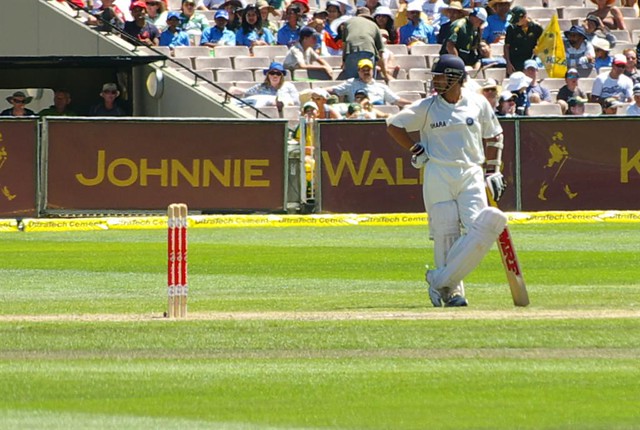
Sachin Tendulkar has had several partnerships cricket through his 24-year career . That he loves the most in his life, however , the “partnership” with his wife. Emotional Anjali Tendulkar thanked for keeping by throughtout her career ended at Wankhede with his 200th test on Saturday. ” The best thing that happened to me in 1990 when I met my wife Anjali . They were the most wonderful years ,” he said .